Summer 2026 Release: From System of Record to System of Work
June 30, 2026Inriver's Summer 2026 release introduces enhanced MCP extensibility, AI-assisted content enrichment, content lifecycle management, and new print and digital publishing automation.
Product information management has always required accuracy. What’s changed is the standard for what “accurate” means. As agentic commerce and AI-powered search change the way customers find and evaluate products, the information provided by brands and manufacturers doesn’t just need to be correct – it needs to be structured, enriched, governed, and ready for activation wherever buying decisions are made. A PIM that stores clean data but leaves teams to manually coordinate the work of improving and activating it is no longer enough.
Inriver’s Summer 2026 release directly responds to this need – deepening AI ecosystem connectivity with an enhanced MCP server, embedding a natural-language AI-assistant into enrichment workflows, coordinating content operations for greater governance and efficiency, and automating product content activation across print and digital channels.
The capabilities in this release reflect a deliberate shift in what the PIM does: moving from a system of record toward a system of work — one that doesn’t just hold product data but actively guides teams through operations at scale.
Here’s what’s new and what it means for your business.
Deepening AI Ecosystem Connectivity with an Enhanced MCP Server
Inriver’s Model Context Protocol (MCP) Server was first introduced in September 2025 as a standardized way for AI tools, assistants, and agents to securely access and query governed product information directly from the PIM. Since launch, customers and partners have been pushing the boundaries of what’s possible.
The Inriver MCP Server has evolved into a rapid development foundation. Using the Inriver MCP Code Writer alongside Inriver REST APIs, your teams and technology partners can now build custom applications, workflow extensions, and administrative tools on top of Inriver — without complex custom coding, and without waiting for core product enhancements. These purpose-built applications can be deployed directly into the Inriver platform, where they remain maintainable through configuration-driven design and resilient as your business needs evolve.
The practical implications are significant. Previously, a unique business requirement, such as custom taxonomy behavior, a specialist data transformation, or a tailored administrative experience, might have required a formal development project or a product enhancement request. These can now be addressed with reusable, configurable applications built on standard web technologies and Inriver APIs.
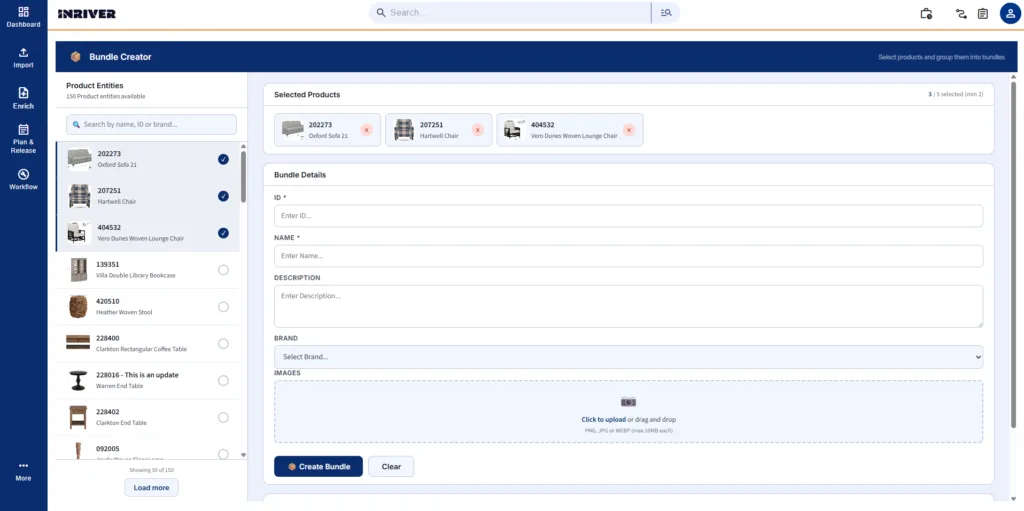
For technology partners and system integrators, this represents a faster path from customer requirement to deployed solution. For enterprise teams with specialist needs that fall outside standard platform configuration, it means greater agility without greater technical debt.
As agentic commerce builds momentum, the Inriver MCP Server provides the foundational layer that connects governed product data to the AI ecosystem — ensuring that accurate and trusted product information is available wherever AI-driven decisions are made.
AI-Assisted Enrichment, Inside the Governed PIM
Inriver Inspire AI already gives product teams the ability to use LLMs to enrich product content directly inside the PIM. The Enrich Assistant extends this with the kind of natural language interaction that anyone using ChatGPT or Claude in their daily work will immediately recognize — conversational, iterative, and responsive to plain language instructions.
Instead of selecting from configured prompts, you can now tell Inspire exactly what you need: “make this more concise,” “adapt this for the German market,” or “this description feels too technical.” The result eliminates the temptation to take enrichment outside the PIM into external AI tools — where security, governance, and audit trails break down. You can also work in bulk, instructing the Assistant to enrich multiple fields in a single interaction.
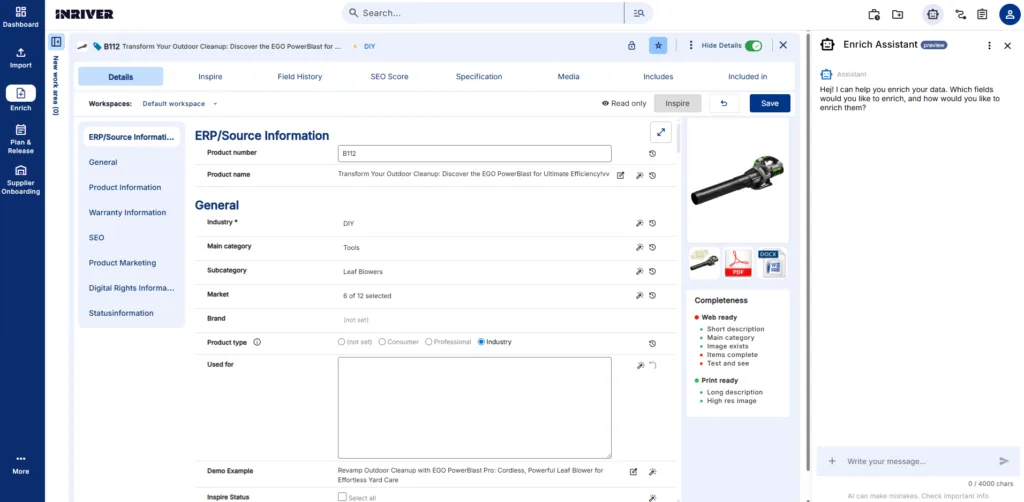
You review what the Enrich Assistant suggests, select what to keep, and apply it in one click. Or continue the conversation to refine further. Either way, enrichment stays governed, traceable, and entirely within the platform.
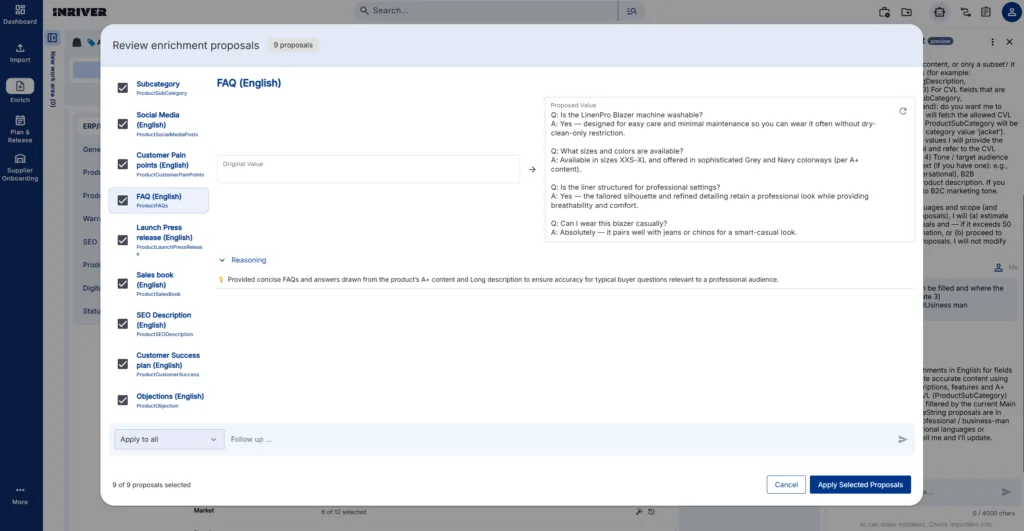
For product managers handling large catalog updates, this removes the manual effort of working field by field across hundreds or thousands of SKUs. For marketing and e-commerce teams responsible for channel-specific content, it means faster adaptation without copy-paste workflows or external tool dependencies. For compliance and governance leads, it means AI-assisted content generation that stays inside the platform’s audit trail rather than circumventing it.
The Enrich Assistant is the latest in Inriver’s growing family of AI assistants, complementing the Expression Assistant introduced in the Spring 2026 release to help you create and validate complex formulas for product data transformations.
Turning Content Intelligence into Coordinated Work
For enterprise product teams, identifying content gaps is rarely the hard part. The greater challenge is coordinating the work to close those gaps, without relying on external tools such as spreadsheets, email threads, and status meetings that are disconnected from the underlying data.
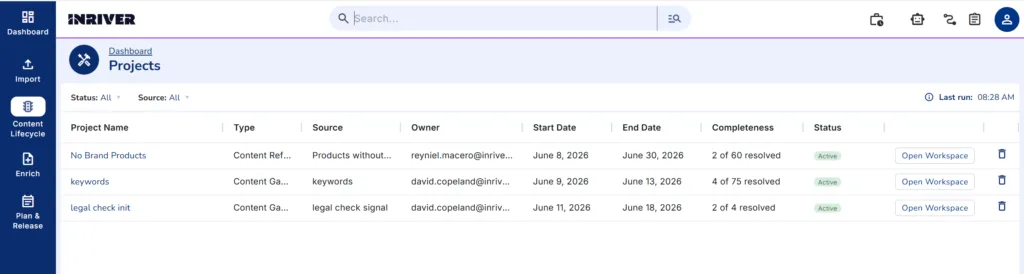
The new Signals and Projects functionality brings that coordination inside Inriver, and in doing so, marks a meaningful shift in what the PIM does. Rather than surfacing what needs attention and leaving teams to manage the response elsewhere, Inriver now orchestrates the work of improving product data from identification through to resolution.
Here’s how it works: First, you configure Health Checks, which continuously monitor your catalog against conditions you define — missing descriptions, incomplete retailer attributes, localization gaps, or low enrichment quality scores. When a condition is me, it generates a Signal: a prioritized, actionable opportunity that tells your team what needs attention and why. Signals can then be converted into Projects, with ownership assigned, deadlines set, and progress tracked. It’s all connected to the live product data in the PIM, so when a catalog gap is resolved by your team, the product passes the Health Check, your project dashboard updates, and the coordination loop is closed.
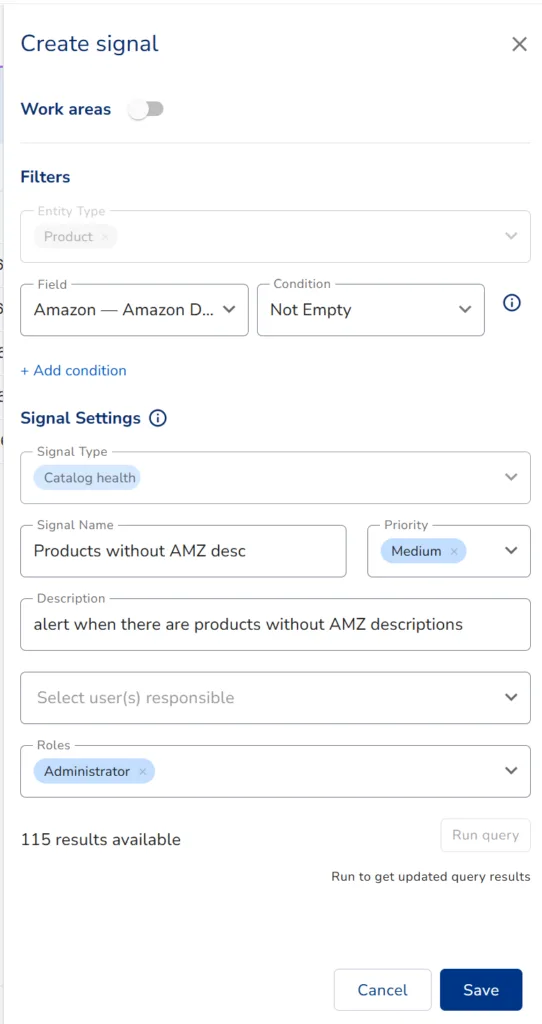
For product operations teams managing large catalogs across multiple markets, this replaces the informal, disconnected coordination that currently happens outside the PIM with a structured, governed process that happens inside it. For commercial and e-commerce teams, it means content gaps that carry revenue risk get surfaced, prioritized, and resolved faster. For operations and compliance leads, it means full visibility into what’s being worked on, who owns it, and whether it’s done.
This is where the PIM becomes a system of work. Instead of simply surfacing what needs doing, it now orchestrates the action.
Automating Product Content Activation for Print and Digital
Product catalogs, data sheets, and brochures still play a vital role in enabling confident buying decisions, whether distributed digitally or in print. For manufacturers and brands managing large product portfolios across multiple markets, keeping this content accurate, on-brand, and current is a significant operational burden. One that grows with every new product, market, and language added to the mix.
Inriver Print & Publish connects the PIM directly to Adobe InDesign, ensuring that publications for both print and digital channels always reflect your governed product data. The connection eliminates the manual data handling and repetitive rework that typically accompanies catalog and collateral production. When data changes in the PIM, publications can reflect that change automatically.
he Summer 2026 release introduces three new automation capabilities that go further:
Self-Service Publishing gives business users such as product managers, marketing teams, and regional content teams the ability to generate finished, on-brand documents from PIM data using designer-built templates, without requiring InDesign skills. Outputs can be exported imediately as PDFs, .idml or .indd – or passed to a designer for final review before distribution. For organizations where catalog and collateral production are currently constrained by design resource bottlenecks, this opens a faster path to market.
AutoPublisher takes publishing entirely out of human hands for high-volume, frequently updated materials. Define a template and a set of conditions — for example, specific fields changing in the PIM — and AutoPublisher generates updated PDFs, HTML, or PNG files automatically, typically scheduled overnight, and only for products where data has actually changed. For manufacturers managing large data sheet libraries, this means documentation that stays current without manual intervention.
Advanced Data Handling supports organizations with complex, multi-market requirements. The Organizer filters a master data source into targeted regional or special editions. Advanced data transformations support custom calculations at the point of publication. Combined data sets allow designers to work across multiple data sources within a single InDesign panel — eliminating the manual reconciliation that multi-market publishing typically requires.
Taken together, the capabilities in the Summer 2026 release reflect Inriver’s ongoing commitment to making the PIM an active engine of product operations — not just a place where data lives, but a platform that connects your data to AI ecosystems, guides your teams through the work of improving it, and activates it automatically wherever buying decisions are made. The shift from system of record to system of work is not a single release. It’s a direction — and this is the next step.
Want to learn more about these great new upgrades?
Inriver customers who are ready to explore these new capabilities can contact their Inriver CSM to learn more. Are you new to PIM or Inriver and want to discover what all this could mean for your business?
See these new innovations in action
Inriver offers the most comprehensive PIM solution on the market, built for speed, scale, and complexity.
Let an Inriver expert explain how the Inriver PIM can turn your product data flows into a sustainable revenue stream.
- Get a personalized, guided demo of the Inriver platform
- Have all your PIM questions answered
- Free consultation, zero commitment
Thanks for reaching out!
We’ll be in touch soon.
Please try again in a moment.