Shopping has a new customer: AI
Your next customer may be a machine
AI agents increasingly decide which products reach human buyers. See how product teams are adapting their data and PIM operations for AI-driven commerce.
Skip to:
- How has AI changed the way consumers shop?
- What do AI shopping agents look for when they recommend products?
- Can AI agents trust your brand? Why trust is becoming machine-readable
- Why is product data speed the new competitive advantage?
- Is AI completely replacing traditional retail and marketing?
- What challenges should retailers and brands prepare for?
- What will shopping look like in the next five years?
- How do you make your product data AI-ready without a massive data project?
- FAQs
Agentic commerce is AI systems that search, compare, recommend, and increasingly complete purchases on a consumer’s behalf. According to McKinsey’s “Shopping in the age of AI” research with ICSC, the US B2C retail market alone could see up to $1 trillion in revenue from it by 2030, with global projections as high as $3 trillion to $5 trillion.
AI evaluates your products on different criteria than the human shoppers you built your brand for. Drawing on McKinsey’s research and KPMG’s report “AI in Retail: Global Lessons from Strategy to Storefront,” this article breaks down what’s changed and what to do about it.
How has AI changed the way consumers shop?
Consumers have handed the early stages of shopping to AI, shifting the store visit from the beginning of the journey to the end. Adoption is likely even higher than surveys capture, since many people use AI-powered search and in-app features without realizing it.
McKinsey describes what comes next as delegation. Recommendations progress to basket building, automated replenishment, and post-purchase support, starting with household staples.
How consumers are already shopping with AI
The journey is collapsing at the transaction end too, where a product question can move straight to instant checkout within ChatGPT. The same pattern is transforming trends in B2B e-commerce, where professional buyers expect agent assistance for repeat orders.
The new trip calculus
Shoppers today evaluate their trips using what McKinsey calls a “new trip calculus” before deciding to head out. They consider whether the trip will be quick, if the item they want is in stock, and whether the in-store experience offers anything that an AI agent cannot replicate. By the time they arrive at the store, they have usually already decided.
This represents the new standard that is being set. According to the ICSC survey, Gen Z and millennial respondents are significantly more likely than older generations to combine shopping channels, automate routine purchases, and prioritize seamless payment methods. Furthermore, McKinsey notes that baby boomers could transfer over $100 trillion in assets to these younger generations by 2050. As a result, the preferences of AI-savvy shoppers are likely to become the new market norms.
What do AI shopping agents look for when they recommend products?
AI agents assess product data quality. If your product information is incomplete, inconsistent, or unreadable to machines, your products will be overlooked before a human ever sees them. KPMG explains this as competing for both the agent’s algorithmic preference and the human’s emotional loyalty. According to the report, an AI agent prioritizes:
- Data quality over brand story. Complete, accurate, structured product information outweighs the narrative and imagery that persuade human shoppers.
- API speed over aesthetic design. How fast and reliably your systems answer an agent’s query matters more than how your storefront looks.
- Transactional efficiency over immersive experience. Frictionless, machine-completable purchasing beats the experiential elements built for people.
McKinsey’s research identifies similar requirements from the retail side. As agents gather baskets and compare options upstream, stores must make several aspects machine-readable and accessible through APIs:
- Product catalogs
- Pricing
- Fulfillment options and reliable fulfillment windows
- Return policies
The report makes the consequence clear: a store that cannot offer reliable fulfillment windows or structured product data will be overlooked in agent-mediated journeys.
Two customers, opposite value systems
In the AI era, retailers and manufacturers now cater to two customers with opposing priorities, and most product content pipelines were designed for only one.
KPMG has quantified the leadership gap, revealing that 52% of retail CEOs consider agentic AI transformative, yet most still see it primarily as a tool for assistance. The report suggests that the gap between recognizing this revolution and preparing for it is where market leaders will either emerge or falter.
Understanding how AI recommendations determine which products are discovered and selected is becoming essential. This shift is similar to the challenges brands encountered a decade ago when search rankings began to influence product visibility.
What’s particularly concerning is that most brands aren’t starting from scratch; they are dealing with information that is often difficult to interpret. For most brands, the product data already exists, but AI struggles to read it. Specifications are stored in engineering systems, operational details in the ERP, and customer-facing content across dozens of channels. None of it is structured in a way an agent can easily consume it.
Although operating two content systems isn’t necessary to reach both audiences, you need a reliable product data foundation that delivers information to each audience in their preferred format, sourced from the same place.
Human shoppers can forgive an imperfect attribute if the brand earns their attention. AI agents cannot. They evaluate the product information available to them and filter accordingly. See what businesses are learning about preparing product data for AI.
Can AI agents trust your brand? Why trust is becoming machine-readable
An AI agent assesses your brand by evaluating the accuracy, consistency, and verifiability of your product data. This evaluation is crucial in determining whether your products will be displayed. According to KPMG, the future will see a competition between AIs: your pricing and recommendation systems will negotiate directly with a customer’s personal shopping AI.
This raises an important question: Which brand’s AI will the consumer’s agent trust? McKinsey reaches a similar conclusion and emphasizes a key strategy: program your systems to be fair and transparent negotiators, and invest in explainable AI. This approach will enhance the effectiveness of your pricing and recommendations in machine-to-machine interactions.
Furthermore, trust is measured beyond your organization. KPMG’s recommended scorecard for this new “agentic” era includes key performance indicators (KPIs) that most retailers currently do not track:
- Agent conversion rate, or how often AI agents that evaluate you actually transact
- API uptime, because an agent that can’t reach your systems moves on
- Your brand’s trust rating within third-party agent platforms
Consider the implications of this situation. Trust used to be built over many years based on reputation and customer experience. However, in agent-mediated commerce, trust is now assessed in real time based on your data. A single incorrect product specification no longer just costs you one sale; it can affect your overall standing with a system that handles thousands of transactions.
This exchange occurs through the protocols that govern AI shopping agents, which dictate how your catalog, pricing, and policies are interpreted and verified. The commercial implications are significant: the choice between MCP (Model Context Protocol) and UCP (Universal Commerce Protocol) determines which agent ecosystems can interact with your business.
It’s crucial to take this seriously. KPMG’s research, in collaboration with the University of Melbourne, found that 46% of consumers remain hesitant to trust AI, yet still rely on it to make decisions. This situation shifts the burden of trust to those who provide the data that these systems rely on. If an AI agent’s recommendation proves to be incorrect, the consumer is likely to blame the brand behind the data.
Why is product data speed the new competitive advantage?
Demand now shifts more quickly than most product data operations can keep up with, and the gap between the two is where revenue is lost. The two studies identify three key reasons.
1. Demand signals now shift within weeks.
McKinsey clearly states that planning product assortments just once or twice a year is no longer enough. With search trends, social signals, and AI-assisted discovery influencing demand in just a matter of weeks, retailers must find faster ways to adjust featured products, allocate local inventory, and prioritize promotions.
2. Stale data breaks the store visit itself.
According to the ICSC consumer survey, in-stock reliability is the most important factor for shoppers when deciding where to shop, with 37% of respondents ranking it among their top three priorities. McKinsey warns that if a convenience-driven shopping trip is unsuccessful due to stock-outs, long wait times, or unclear pricing, customers are likely to consider online alternatives and may not return to the store.
3. Speed advantages compound at the top.
McKinsey’s analysis indicates that the top 10% of retailers are expected to capture over 85% of the sector’s economic profit, an increase from 73% a decade ago. Small adjustments to undifferentiated formats are unlikely to bridge this gap. Every week that your product data operations fall behind, industry leaders move further ahead.
So, what does it mean to operate at demand speed in practice? It involves running enrichment, translation, validation, and channel updates in a continuous flow. AI-powered product data enrichment makes this flow sustainable, while AI-driven product content creation within governed workflows allows you to update listings at the pace of actual demand, without compromising accuracy for both agents and shoppers. Furthermore, distribution is no longer the final goal; product content requires a feedback loop from every channel it reaches.
Is AI completely replacing traditional retail and marketing?
No. Both studies indicate that as AI takes over routine purchasing tasks, the human aspect of retail becomes increasingly valuable, raising expectations in that area.
The ICSC survey reveals that online shopping is the most common method across all generations and product categories. However, physical stores remain destinations for exploration and connection, particularly for younger shoppers who prefer curated environments, pop-up shops, and showroom-style formats.
Consumers from various age groups are also looking for “third places” where they can meet and relax, with nearly half of those surveyed identifying dining as the most sought-after activity near retail locations.
A division of labor is starting to emerge:
- Agents take the routine. Repeat purchases, replenishment, transactional questions. AI chatbots in e-commerce already absorb order status and returns queries.
- Humans keep the meaningful. Discovery, validation, connection. McKinsey found 78% of shoppers prefer assistance only when they seek it out, yet they rate the quality of that interaction as highly important when it happens.
- Marketing funds both. KPMG describes the new competition as a contest for two loyalties at once: the human’s emotional loyalty and the agent’s algorithmic preference. Brand storytelling wins the first, while structured data wins the second.
Store visits are becoming less frequent, which makes each visit more significant. An enhanced human experience relies heavily on accurate product information.
According to McKinsey, clienteling tools provide associates with real-time visibility into inventory and customer context. These tools utilize the same retail digital catalog that supports your sales channels. If your catalog contains errors, everything built on it, including the recommendations from your best associates, will also fail.

What challenges should retailers and brands prepare for?
Most obstacles identified in both studies often originate within the organization and are encountered immediately.
1. The capital squeeze
McKinsey highlights that retailers have limited capital budgets, with an increasing portion allocated to AI, data, and digital infrastructure. This allocation reduces funding for store reinvention at a time when significant changes are necessary.
2. Internal resistance
McKinsey observes that merchandising teams might resist fewer assortments, store leaders are often evaluated based on uniform productivity metrics, and capital is frequently distributed evenly across the fleet. These practices reinforce a one-size-fits-all strategy even as customer needs become increasingly diverse.
3. The bias trap
In KPMG’s case study on Lidl and Kaufland in Asia, the CFO warns that historical purchasing and supplier data often contain systemic biases that AI can learn and amplify, unfairly excluding emerging suppliers by assigning them higher risk scores.
4. Shadow AI
KPMG reports that many employees use free public AI tools instead of those provided by their employers, increasing the risk of data leakage, errors, and reputational damage while governance fails to keep pace with adoption.
5. The talent pipeline paradox
DFI Retail Group’s Head of Business Transformation poses an essential question: if AI takes over the tasks traditionally performed by entry-level employees, how can we establish a healthy career path for individuals to develop industry expertise?
6. Nobody owns the machine customer
In a McKinsey survey of retail executives, 45 out of 50 indicated that they have considered implementing an agentic commerce tool; however, fewer than five reported having a board-aligned agentic commerce strategy. Agentic commerce spans e-commerce, IT, and marketing, so each department may assume the others are handling it.
KPMG proposes a solution in the form of a new role: the machine-customer strategist. This leader is dedicated to the machine-customer channel and is responsible for developing the roadmap for how the brand presents itself, competes, and succeeds within agent-powered ecosystems.
If you take on this role or hire someone for it, you will be responsible for the entire stack, from trust ratings to the payment protocols behind AI agent commerce. Begin with a thorough audit of your infrastructure. Clear indicators suggest a traditional SaaS platform may not suit AI agents, and discovering these issues late can be costly.
What will shopping look like in the next five years?
KPMG and McKinsey describe a similar trajectory: as delegation deepens, agents begin negotiating with one another, and stores shift to tasks machines cannot perform.
McKinsey outlines this progression. Currently, AI use is mainly focused on research and comparison. However, as consumers gain more trust in these agentic tools, recommendations will evolve into basket building, automated replenishment, and post-purchase support, starting with routine categories.
As more repeat purchases become automated, the necessity for trips to the store will decrease. Consequently, stores will increasingly serve as locations for order fulfillment, convenient returns, product validation, immediate access, and differentiated experiences.
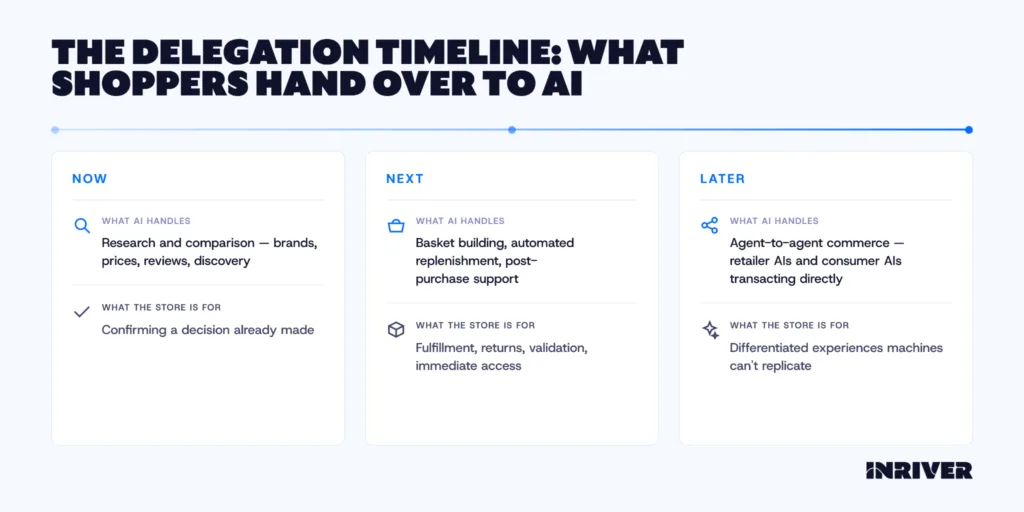
KPMG forecasts that the future will see retailer AIs and consumer AIs interacting directly, with success defined by which machine makes the best decision. The report outlines key imperatives for this new landscape, including prioritizing bot system design, treating enterprise data as a product for external agents, and redefining value for both humans and their digital counterparts.
In terms of timing, industry practitioners offer a more definitive outlook than the projections suggest. DFI Retail Group’s data and AI director anticipates that retail will experience significant AI impact within the next 18 months.
However, opinions on the pace of this change vary. Some leaders from KPMG’s case studies question whether AI agents will ever completely replace human shopping. AS Watson’s Group CEO acknowledges that direct purchasing through AI platforms could expand rapidly, but this growth will depend on how ecosystems evolve.
Meanwhile, AS Watson is proactively adapting its digital content to improve visibility on AI platforms, ensuring that its products appear in AI-driven recommendations as the discussion continues.
Shopping today vs. shopping in 2030
| Today | By 2030 | |
|---|---|---|
| Where discovery starts | Search engines and retailer websites | A question posed to an AI |
| Who completes routine purchases | The shopper | AI agents, through automated replenishment |
| What the store visit is for | Fulfilling a decision made online | Validation, immediate access, and experience |
| Who evaluates your brand first | A human comparing options | An agent scoring your data quality and API reliability |
| How trust is built | Reputation and marketing over years | Computed from data accuracy in real time |
| What success is measured by | Traffic, conversion, basket size | Agent conversion rate, API uptime, trust rating |
How do you make your product data AI-ready without a massive data project?
Start with the data you already have and change how it gets ingested, instead of cleaning everything first. In practice, that means three things:
- Ingest as-is. A flexible data model, like Inriver’s, takes product data from any source in its current state, with no upfront cleaning, restructuring, or ETL project. The platform applies the structure, so value starts in weeks.
- Enrich and validate in the flow. Run enrichment, translation, and readiness checks as continuous workflows, so data stays current instead of aging between cleanup cycles.
- Verify what agents do with it. Every AI workflow acting on your product data needs a verification and validation layer, so output is checked against trusted data before it reaches a channel.
See what AI-ready product data looks like in practice; schedule a personalized demo with an Inriver expert today.
See the Inriver PIM in action
Inriver transforms the way your business thinks about product data. Let an Inriver expert explain the many benefits of the enterprise-ready, fully adaptable Inriver platform.
- Get a personalized, guided demo of the Inriver platform
- Have all your PIM questions answered
- Free consultation, zero commitment
Thanks for choosing Inriver! We’ll be in touch soon.
Please try again in a moment.