What is product information orchestration? (And why PIM alone isn’t enough anymore)
Bring control to AI-driven product operations
Give your team and AI agents clear rules for enriching, validating, approving, and activating product information.
Skip to:
- What is product information orchestration?
- Product information orchestration vs. PIM: what’s the difference?
- Why traditional PIM is no longer enough
- What does product information require?
- How does orchestrated product data flow work? A step-by-step example
- Where do you start with product information orchestration?
- Decide who can change your product data before AI decides for you
- FAQs
AI agents already enrich, translate, and validate product data inside live commerce operations, and they act on that data whether or not your team has defined rules for the work.
Product information orchestration is the discipline that coordinates every process that creates, validates, and delivers product data, covering the tasks your people perform and the tasks agents now perform alongside them. It governs which systems, people, and agents can act on which data, and it verifies output before anything reaches a channel.
Your PIM centralizes and distributes product data, yet it was designed for human teams alone, which is why orchestration has become a separate conversation.
What is product information orchestration?
Product information orchestration is the practice of coordinating those workflows under one set of rules. In practical terms, it covers three things.
First, it coordinates work across the systems where product data lives, from ERP and PLM through to every downstream channel. Second, it coordinates the actors doing the work, meaning your teams and the AI agents operating alongside them, with defined permissions for each. Third, it verifies output, so enriched, translated, or agent-generated content gets checked against trusted data before activation.
Analysts have started tracking this territory as its own discipline. Gartner’s 2026 Hype Cycle for Agentic AI profiles orchestration technologies and agent management platforms separately, noting that agentic systems require operational and governance models beyond those used for traditional automation. Product information orchestration applies that same discipline to the data your buyers, channels, and AI assistants read every day.
Why does product information orchestration matter now?
- Gartner predicts 40% of enterprise applications will embed task-specific AI agents by the end of 2026, up from under 5% in 2025
- Through 2026, organizations will abandon 60% of AI projects unsupported by AI-ready data, according to Gartner
- Gartner expects 40% of enterprises to demote or decommission autonomous AI agents by 2027 due to governance gaps found after production incidents
- Product data feeds the AI systems that now decide which products buyers see
Product information orchestration vs. PIM: what’s the difference?
Your PIM already performs a version of coordination. It collects product data from source systems, holds it in a central catalog, runs enrichment and approval workflows, and pushes finished content to channels. The comparison with orchestration therefore comes down to scope rather than replacement, because orchestration extends what a PIM coordinates rather than replacing it.
| PIM as most teams run it | Product information orchestration | |
|---|---|---|
| Primary job | Centralize, enrich, and distribute product data | Coordinate all work performed on product data, by people and by AI |
| Who acts on the data | Your teams, through manual workflows | Your teams plus AI agents, each with defined permissions |
| Quality control | Manual checks and approval gates | Validation and verification built into every workflow, including agent output |
| Definition of done | Content published to channels | Content verified, activated per channel, and monitored after publication |
| Relationship to AI | AI added as separate features | AI work governed inside the same flow as human work |
You still need a PIM under an orchestration model, since something has to remain the system of record for product data. What changes is the operating discipline around it.
A PIM answers where product data lives and how it gets to channels, whereas orchestration answers who and what may change it, under which rules, and with what verification before the change ships. Teams that treat these as the same question tend to discover the difference the first time an AI-generated description reaches a retailer unreviewed.

Why traditional PIM is no longer enough
Product data teams spent the last decade solving centralization, and most succeeded. Now pressure comes from three directions at once, and none of them existed when you implemented your PIM.
1. AI agents are entering product operations faster than teams can define rules for them
Gartner predicts that 40% of enterprise applications will integrate task-specific AI agents by the end of 2026, up from under 5% in 2025. Product operations sit squarely in that expansion, since enrichment, translation, and attribute validation rank among the most automatable commerce tasks. Your product data will be worked on by agents whether you plan for it or not, and a repository built for human workflows has no native way to assign those agents permissions or check their output.
2. AI projects fail on data readiness, and product data is a hard case
Gartner predicts that organizations will abandon 60% of AI projects unsupported by AI-ready data through 2026. In the same research, 63% of organizations either lack the right data management practices for AI or remain unsure whether they have them. Product information carries the exact traits that make readiness difficult, because it arrives from many sources, changes constantly, and varies in structure across categories and markets. Holding that data in one place does not make it AI-ready, and readiness is where the projects die.
3. Bolt-on AI features stall without an operating model around them
MIT’s GenAI Divide report found that about 5% of enterprise AI pilots achieve rapid revenue acceleration, and its authors attribute the gap to flawed workflow integration rather than model quality. A translate button inside your PIM is a feature. An operating model defines when translation runs, what validates the output, and who approves it before release, which is a different level of maturity.
The consequence of skipping that maturity step is already measurable. Gartner expects 40% of enterprises to demote or decommission autonomous AI agents by 2027 after governance gaps surface in production, and its analysts identify the root cause as governance treated as binary, with agents either locked down or fully trusted. Orchestration exists to occupy the ground between those two failure modes, raising practical questions about who should control what agents can do and how much autonomy to grant them.
Decide how AI works on your product data
AI agents are entering enrichment, translation, and validation workflows. See how Inriver gives you control over what agents can change, what requires approval, and what gets verified before publication.
What does product information require?
Orchestration is an operating discipline before it is a software purchase, and the capabilities below describe what the discipline demands regardless of which platform provides them. Most teams already have partial versions of two or three, and the gaps usually sit in the last two.
1. A data foundation that accepts product data as it arrives
Your product data originates in ERP, PLM, supplier feeds, and spreadsheets, each with its own structure. Orchestration needs a foundation that ingests those sources without a long restructuring project first, because Gartner’s data-readiness research shows preparation work is where AI initiatives stall before delivering value.
2. Workflow coordination across teams and systems
Enrichment, translation, approval, and channel activation involve different owners in most organizations. Orchestration requires those steps to run as one coordinated flow with visible handoffs, so a change entering the flow midstream moves through every dependent step instead of stalling in a queue nobody monitors.
3. Defined permissions and graduated autonomy for AI agents
Every agent working on your product data needs an explicit scope covering which attributes it can touch, which actions it can take, and which decisions stay with people. Gartner’s agent-governance research warns against uniform governance across agents with different autonomy levels and scopes, which means permissions need to be set per agent and per task rather than as one policy for all AI. Deciding where people stay in the loop is a leadership question before a technical one.
4. Validation and verification checkpoints
Agent output needs checking against trusted product data before it reaches a channel, the same way human work passes through approval. Verification at this layer is what separates governed automation from publishing whatever the model produced.
5. Audit trails and traceability
You need a record of which actor changed which data, when, and under whose approval. Regulation is turning this from good practice into an obligation, since the EU AI Act phases in documentation and human-oversight requirements for AI systems used in commercial operations.
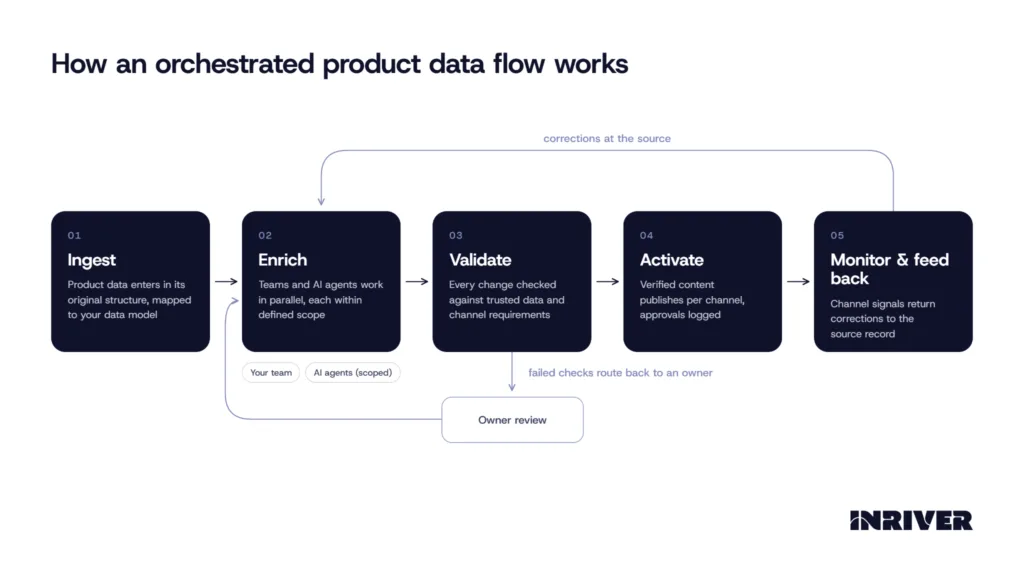
How does orchestrated product data flow work? A step-by-step example
Consider a product update that arrives from a supplier feed, a scenario your team likely handles weekly. Under an orchestrated model, the update moves through five coordinated stages instead of a chain of manual handoffs.
1. Ingest. The update enters the flow in its original structure, and the foundation maps it to your data model without a separate cleanup project.
2. Enrich. Your team and your AI agents work on the record in parallel, with agents handling tasks inside their defined scope, such as drafting translations or filling attribute gaps, while people handle judgment calls like positioning copy.
3. Validate. Every change, human- or agent-made, gets checked against trusted product data and channel requirements before anything advances, and failed checks route back to an owner instead of passing through silently.
4. Activate. Verified content publishes to each channel in the format that channel requires, with approvals logged against the actors who made each change.
5. Monitor and feed back. Performance and error signals from channels return to the flow, so corrections happen at the source record rather than channel by channel.
Remove the orchestration layer, and the same update crosses several inboxes, two or three tools, and at least one unverified AI output before it ships.
Where do you start with product information orchestration?
Orchestration fails as a big-bang initiative for the same reasons most AI projects fail, so the practical path runs through three narrow decisions rather than a platform overhaul.
1. Start with a data readiness assessment, not a tool evaluation.
Gartner’s research found 63% of organizations either lack the right data management practices for AI or remain unsure whether they have them, and you cannot orchestrate work on data you cannot trust. Map where your product data originates, which sources conflict, and which attributes AI would act on first. The answer tells you whether your gap is foundation or coordination.
2. Assign ownership of agent behavior before any agent runs.
Someone in your organization needs to own what agents may do, approve their scope, and answer for their output, and that accountability has to exist before deployment rather than after the first incident. Gartner’s finding that governance gaps surface in production describes organizations that discovered ownership questions too late.
3. Grant autonomy gradually, starting where mistakes are cheap.
Begin with agents suggesting changes for human approval on low-risk work such as internal attribute completion, then extend scope as verification proves reliable. Autonomy earned through verified output beats autonomy granted by default, and it gives your team evidence for every expansion decision.
Decide who can change your product data before AI decides for you
Product information orchestration coordinates the work your teams and AI agents perform on product data, under defined permissions, with verification before anything reaches a channel. Your PIM remains the system of record, and nothing in this shift argues against it. The evidence argues against treating a repository as an operating model, because agents are arriving in enterprise applications at speed, data readiness determines which AI projects survive, and ungoverned agents get pulled after production incidents rather than before them.
The teams that adapt earliest will not be the ones that bought the most AI. They will be the ones that answered, in advance, who and what may change their product data, under which rules, and with what check before it ships, and orchestration is the name for having that answer.
See the Inriver PIM in action
Inriver transforms the way your business thinks about product data. Let an Inriver expert explain the many benefits of the enterprise-ready, fully adaptable Inriver platform.
- Get a personalized, guided demo of the Inriver platform
- Have all your PIM questions answered
- Free consultation, zero commitment
Thanks for choosing Inriver! We’ll be in touch soon.
Please try again in a moment.