Product data maturity by geo
From the Inriver Product Data Paradox report series
The US, Nordics, and Europe each leads on a different front of product data maturity. Three lessons from the 2026 PDMI benchmark.
Read the full Product Data Paradox reportThree markets, three lessons in product data maturity
When we published The Product Data Paradox, one number defined the field: of 405 industrial manufacturing and distribution organizations benchmarked, three reached Tier 4 of the Product Data Maturity Index. None reached Tier 5.
But when we cut the 405 organizations in the 2026 benchmark by geography, the natural expectation was a leaderboard — one region out in front, the others following. The data tells a more interesting story.
The United States (204 respondents), the Nordics (85), and the rest of Europe (116) have each advanced furthest along a different dimension of product data maturity: strategic clarity, operational automation, and structural standardization. Because each market is furthest along a different path, each has seen things the others haven’t — yet.
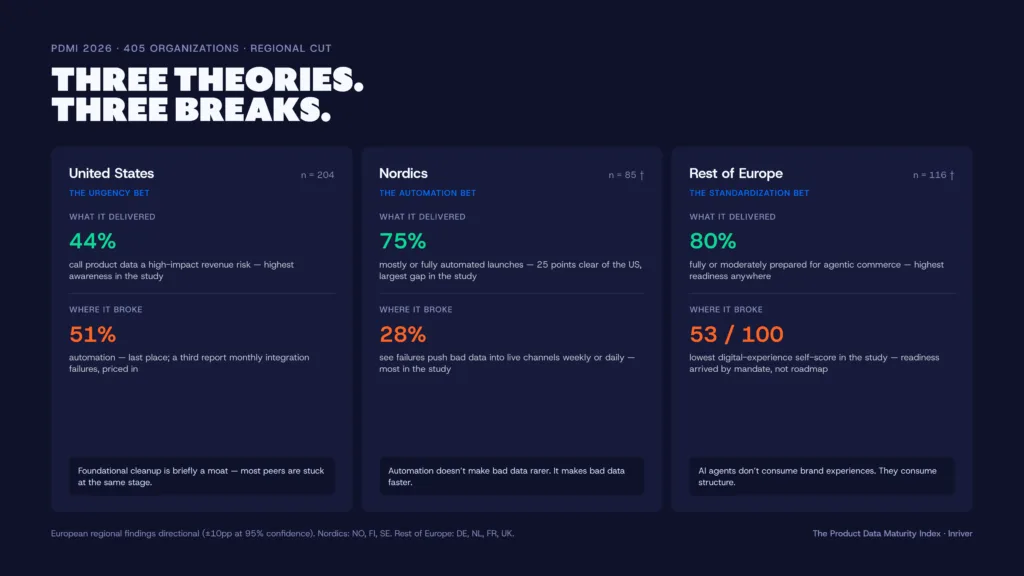
How each market is performing in product data readiness
01. The Nordic experience: automation moves the frontier to governance
The Nordics are the study’s most operationally advanced market: 76% run mostly or fully automated product launches, 25 points ahead of the US, on the field’s deepest system stacks. Being furthest along, they’re also first to encounter what comes after automation — 28% see integration issues move imperfect data into live channels weekly or daily, versus 17% in the less-automated US. In an automated environment, data travels at machine speed in both directions. Nordic priorities have already responded, rotating from data accuracy toward governance (69%, their #1), findability, and speed of change — a preview of the post-automation roadmap.
The lesson for everyone else: plan governance and validation to scale alongside automation, not after it. The Nordic experience suggests the two are a single investment, not a sequence — and their current priority list is a useful template for what comes next on yours.
“Automation doesn’t end the data quality challenge — it changes what the challenge is.”
02. The US experience: strategic clarity arrives before infrastructure
The US brings something neither European cohort matches: conviction. 44% of US respondents rate product data as a high revenue-impact factor — the strongest strategic attribution in the study. The operational picture is still catching up: 51% run automated launches, a third have reached advanced measurement, and 36% are still evaluating infrastructure gaps before starting agentic-commerce work — twice the European share. With the market’s highest urgency, largest revenue bases, and concentrated budgets, that gap is more likely to close quickly than persist — and foundational work still differentiates while most of the market sits at the same stage.
The lesson for everyone else: in the US, the foundational agenda isn’t behind the curve — it is the curve, and early movers gain ground while it lasts. In Europe, it’s a reason to keep extending your operational lead.
“The US market has already made the strategic case for product data. The coming cycle is about converting that conviction into infrastructure.”
03. The continental experience: structure turns out to be an AI strategy
The most instructive result comes from Germany, the Netherlands, France, and the UK. This cohort reports the study’s most modest digital-experience self-assessment (53/100) — yet the highest readiness for agentic commerce anywhere in the benchmark, at 80%. The reason: taxonomy and standardization is the continental #1 priority at 72%, reflecting ETIM and eCl@ss requirements moving through industrial supply chains. Firms that structured their product data because customers required it now hold an unplanned dividend — AI agents consume structured data, and the region that standardized earliest finds itself closest to ready.
The lesson for everyone else: standards-aligned structure is one of the most cost-effective routes to agentic readiness in this data. There’s no need to wait for a customer mandate to adopt the discipline one would impose.
“Some of the strongest AI readiness in this study didn’t come from an AI initiative. It came from years of standards discipline — structure, it turns out, is a strategy.”
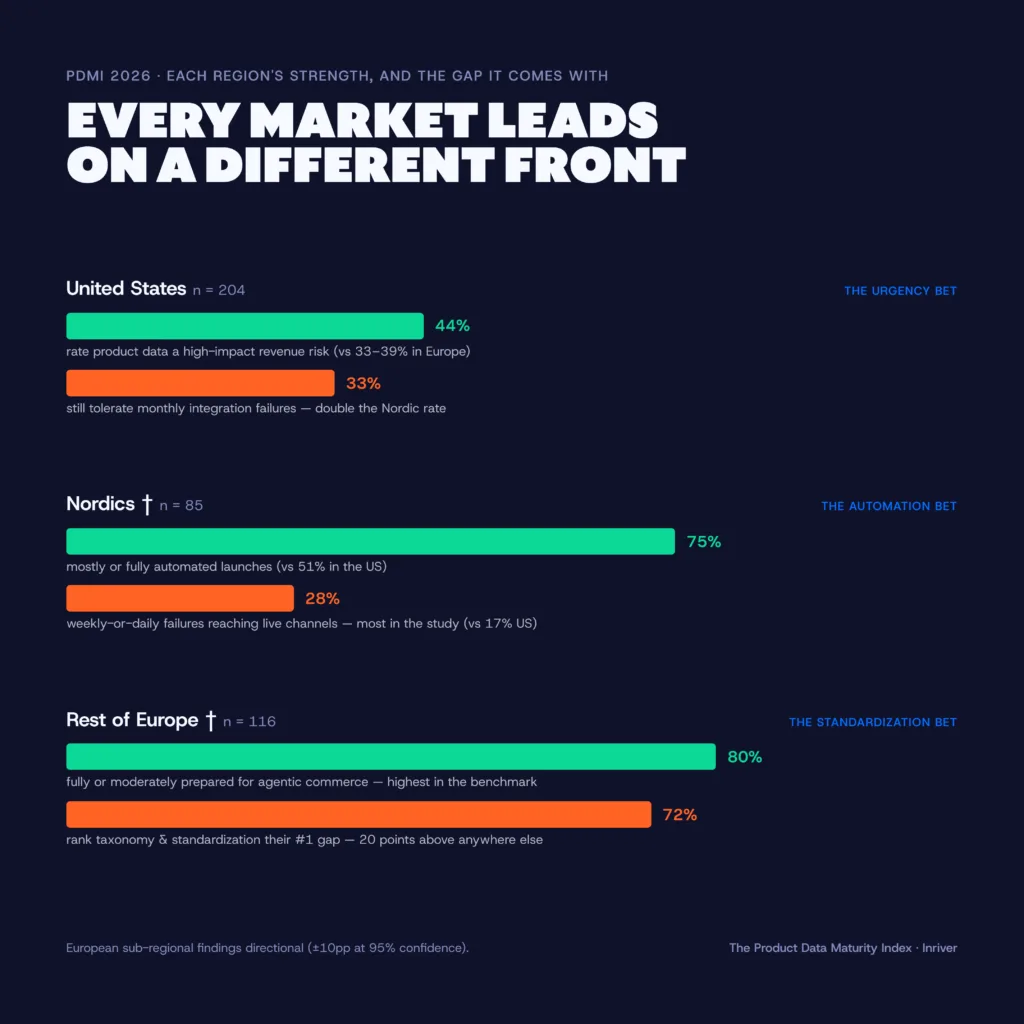
Where the three markets converge
After three distinct stories, the data converges. AI infusion into product-data workflows sits at 51–53 out of 100 in every region today — and every region expects 66–67 within twelve months. The same step, on the same clock, in Boston, Stockholm, and Munich. The gaps converge too: digital findability ranks at or near the bottom everywhere, and only ~2% of firms in any region say nearly all their SKUs are publish-ready. Your market tells you which gap to close first. It doesn’t change the timeline.
What the data supports, wherever you operate
The regional patterns differ, but the lessons they produce apply to any product data operation.
Automate and govern in the same breath.
The data is consistent: every gain in pipeline speed raises the cost of an unchecked error, because data now travels at machine speed in both directions. Treat governance and validation as part of the automation budget, not a phase-two project — the most automated organizations in this study are the ones now prioritizing it most urgently.
Activate your beliefs about product data
Believing product data drives revenue is the most common starting point in this benchmark — and the least predictive of operational maturity. The gap between “we know this matters” and “we’ve built for it” is where most organizations sit today, which means the assessment phase is exactly where the ground can be gained. Set a date to stop evaluating and start activating.
Structure your data like it’s already required.
The single strongest predictor of AI-agent readiness in this study wasn’t budget or transformation ambition — it was standards-aligned, well-classified product data. AI agents consume structure. Adopting taxonomy discipline before a customer or channel mandates it is the cheapest AI-readiness investment on the board.
Which geo profile looks like your organization?
The three patterns in this data are regional, but there’s plenty to be learned from any geo. Here are three questions to ask about your organization’s product data readiness.
- How long has “data accuracy and completeness” been your #1 roadmap item? If the answer is measured in years, you’re running the conviction profile: the business case is made, the infrastructure isn’t. The gap between those two is where the next budget cycle gets decided.
- When your product data is wrong, how many channels does it reach before a human notices? If that number has grown with your automation, you’ve entered the velocity profile: accuracy is no longer the constraint — blast radius is. Governance that scaled with your pipelines is the tell that you’ve handled it; governance that didn’t is the roadmap.
- If an AI agent queried your catalog today, would it find structured attributes or formatted marketing copy? Structure is the readiness profile — and in this data, it mattered more than transformation budget. If a customer mandate is the only thing that would make you classify your data properly, the agents arriving over the next twelve months are that mandate.
Methodology: Based on the 2026 Product Data Maturity Index survey of 405 senior technology, data, and marketing executives at industrial manufacturing and wholesale distribution organizations ($100M+ revenue) in the US and Europe. European regional findings are directional (Nordics n=85, ±10.5pp). Research by Silicon Valley Research Group. Published by Inriver.
Want to share this guide?
Download this guide as a PDF. Or download the full Product Data Paradox report to find out even more
Get the full Product Data Paradox report
AI commerce is here. Research shows, the more confident you are that you’re ready, the less likely it is that you are. Read the report to learn the 5 biggest AI commerce blindspots that organizations face and how you can close the gaps.







“Best-in-class SaaS solution for PIM.”
Verified G2 review by cosmetics brand
“The most flexible data modeling platform.”
Verified G2 review by medical manufacturer
“There are no limits to what [Inriver] can do.”
Verified G2 review by medical manufacturer
See the Inriver PIM in action
Inriver transforms the way your business thinks about product data. Let an Inriver expert explain the many benefits of the enterprise-ready, fully adaptable Inriver platform.
- Get a personalized, guided demo of the Inriver platform
- Have all your PIM questions answered
- Free consultation, zero commitment
Thanks for choosing Inriver! We’ll be in touch soon.
Please try again in a moment.