Product data is never done: 5 Steps for AI visibility
October 5, 2026Product data AI visibility requires continuous maintenance. Follow five steps to resolve conflicts, structure approved information, govern new content, and measure AI results.
AI assistants now answer 30 to 50% of product queries without sending a single click to a website, according to Inriver’s AEO masterclass. When the answer is the destination, the product data behind it determines whether your product appears, and that data is never finished.
You keep product data ready for AI with a continuous, governed loop, not a one-time cleanup. Every change to a product record can open a gap between what your team knows and what AI engines can use.
AI engines read structured attributes, schema markup, and consistent specifications more readily than marketing language. Most of the details they need already sit in your ERP, PLM, PIM, product documentation, and existing descriptions, just not in a form machines can use. The loop surfaces that approved information and keeps it consistent as your catalog grows.
This article shows how to maintain your product record over time, structure the information your team already has, and handle new content that needs its own scope, approval, and mandatory human sign-off before publication.
How often does AI-indexed content need updating?
Every time an approved product record changes. Steve Vink, Business Solutions Architect at Inriver, explains in the AEO masterclass that teams should treat structured data as an ongoing asset, because each approved change can alter the information an AI engine uses to answer a buyer’s question.
Your team needs an ongoing process to check where each type of change goes next.
| Change | What your team needs to check |
|---|---|
| Product update | Whether the approved attribute and schema output reflect the new specification, claim, or certification |
| Market change | Whether localized product content and schema match the language and requirements of the market |
| New SKU | Whether the product inherits the approved data model, mapping, and review process |
A product content feedback loop gives your team a disciplined way to respond to those changes without losing track of approved information.
5 Steps to build a product data loop for AI visibility
Product records, technical documentation, and existing copy often contain the details AI agents need, even though the same product content needs to serve humans and machines.
The first three steps surface and structure approved information that already exists across those sources. Enrichment and generation begin only after your team defines what new content is needed, which source material supports it, and who approves it.
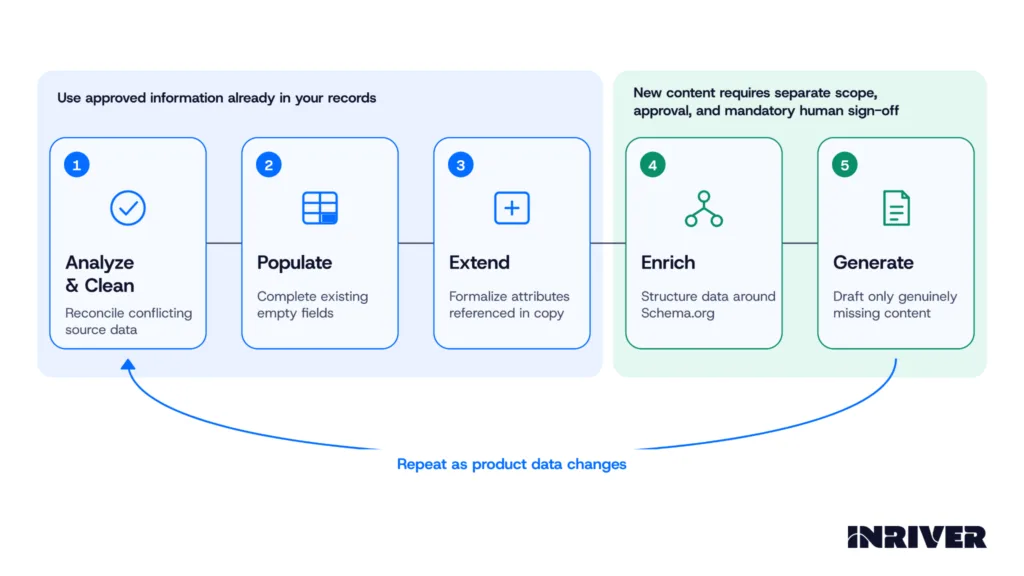
1. Analyze and clean: Start with conflicts hiding between systems
The same product can carry different dimensions, classifications, materials, or claims across your ERP, PLM, PIM, supplier sources, product pages, retailer listings, and distributor content. AI engines pull from all of them, so conflicting specifications can lower confidence in an answer.
Compare the attributes buyers and channels use, then confirm which approved system supplies each value. Steve explains that cross-channel consistency is often underestimated, because AI models assess product information across the web, not within a single channel.
2. Populate: Fill the fields your team has already answered
A blank product field doesn’t always call for new content. Product documentation, supplier material, and existing descriptions may already hold the approved answer.
Populate defined but empty fields before you ask AI to draft anything, moving existing information into the structured attribute where your team, channels, and AI engines can use it. Dimensions, weight, classification, intended audience, use cases, and technical specifications often need this treatment because the information exists but isn’t captured consistently in product records.
3. Extend: Turn useful product copy into structured attributes
Product descriptions and manuals often hold details that affect product fit but never became formal attributes: materials in body copy, compatibility in an FAQ, or installation guidance in a manual.
Extend the product model by identifying what recurs across your portfolio and matters to buyer questions. Anything that shapes how accurately AI engines describe your product needs a governed attribute, with clear rules for how your team populates and maintains it. B2B product records may need structured compatibility, operating environment, certification, installation method, or application data before an AI engine can use it reliably.
4. Enrich: Structure approved data around how AI reads it
Schema.org gives AI engines and search systems a machine-readable way to identify product information. Product, Offer, FAQPage, reviews, and technical properties can help your team organize approved data into structured output that supports product discovery.
Enrichment begins where your team needs to add or organize information beyond the existing product record. Before it starts, define the approved source material, the relevant Schema.org properties, and the reviewer responsible for approval. Keep schema output aligned with visible product-page content and with the language of each localized page.
AEO builds on the SEO work already in place. It adds machine-readable product structure, which helps AI engines use approved attributes in direct answers.
5. Generate: Draft only the content your product record cannot supply
Some products will still need a technical description, feature bullets, FAQ answers, or other supporting content after the first four steps. AI can draft those missing assets against the approved product record, giving reviewers a starting point instead of a blank page.
Mandatory human approval keeps AI-generated content within the scope your team defined. Before publication, reviewers confirm factual accuracy, product claims, compliance requirements, tone, and market suitability.

How PIM gives AI agents trusted product data
Product data doesn’t originate in one team or one system, yet reliable AI visibility requires those inputs to stay coherent as they move through your business. Your PIM should be the source of trust that reconciles approved input before it reaches product pages, retailers, distributors, and AI engines.
| System | Information it contributes | Role in the trusted product record |
|---|---|---|
| ERP | Operational product details | Source of approved operational values |
| PLM | Engineering and design data | Source of approved specifications, materials, and component information |
| PIM | Buyer-facing product content and approved attributes | Reconciles inputs into the product record used across channels |
ERP, PLM, and PIM continue to serve their own purposes. Competing final versions create data drift that can undermine the reliability AI engines require. Product information orchestration governs how people and AI work with those records, including the rules for enrichment, approval, and activation.
Inriver PIM works with your existing systems, then directs the approved product record through one controlled flow to every channel where buyers and AI engines use it.
Where should you start if you have thousands of SKUs?
Start with your highest-revenue or highest-traffic products, not your entire catalog. Run that first group through all five steps, then use the result as the blueprint for wider rollout.
Use the pilot group to establish:
- The approved mapping. Confirm which attributes come from each source and how they move into structured output.
- The data model. Document the fields your products need, with layers for each market and category, such as localized values, regional certifications, and units of measure. A new market or product line then extends the model instead of forcing your team to restructure.
- The review rules. Define who approves enriched or AI-generated content, and what sign-off it needs, before it reaches a channel.
How to measure AI visibility for your product data
Traffic reports miss much of what your product data does, so measure the answer itself. Capture a baseline before the pilot starts so every later result has something to compare against.
Build a fixed set of test prompts from the questions buyers ask about your pilot products, covering specifications, compatibility, certifications, and comparisons, in both branded and unbranded phrasing. Run the same prompts monthly in the AI engines your buyers use, and log three things:
- Presence. Whether engines cite your domain or name your brand, linked or not.
- Share of voice. How often you appear compared with competitors for the same prompts.
- Attribute accuracy. Whether the specifications, dimensions, claims, and product images the engine uses match your approved record.
Attribute accuracy is the check specific to product data. A mention with the wrong specification can point to a conflict between your sources, which is where Step 1 of the loop begins.
Two more checks sit outside the engines.
- Search Console. Track impressions and clicks for the queries behind your pilot pages, and compare branded and unbranded terms over time. Use the structured data and rich result reports to confirm your markup is valid.
- Digital Shelf Analytics. Use Inriver Digital Shelf Analytics to see how pilot products appear on retailer and marketplace listings after launch, including whether the content live at each retailer matches your approved record.
Where AI engines do send visitors, track their conversion behavior alongside volume.
Watch the Inriver Masterclass episode AEO: How to Fix What AI Sees on Your Product Page on demand to learn how to prioritize your first products, apply the five-step process, and audit progress inside a real Inriver PIM environment.
See the Inriver PIM in action
Inriver transforms the way your business thinks about product data. Let an Inriver expert explain the many benefits of the enterprise-ready, fully adaptable Inriver platform.
- Get a personalized, guided demo of the Inriver platform
- Have all your PIM questions answered
- Free consultation, zero commitment
Thanks for choosing Inriver! We’ll be in touch soon.
Please try again in a moment.