How to leverage product data for digital commerce
July 14, 2025Tips to optimize results and revenue with data that can improve performance now.
Clean data provides a strong competitive advantage in digital commerce today. If you are using product information management (PIM) software, you have opportunities to leverage your data by implementing tools that improve digital commerce performance and align with your broader strategy.
Are you really making the most of your PIM investment? Here are a few business strategies in digital commerce that rely on robust data analytics to set your digital commerce apart.
How to start leveraging product data
To turn product data into digital commerce performance, you need to treat it as a strategic asset—not just a backend resource. Here’s how to begin:
1. Audit your current product data
Start by evaluating the completeness, accuracy, and consistency of your product records. Look for gaps in key fields such as dimensions, materials, certifications, pricing, and imagery.
Identify where data is duplicated, outdated, or misaligned across platforms. A PIM system can help centralize this audit, giving you a clear picture of what’s missing—and what needs fixing.
2. Prioritize your most visible SKUs
Focus your initial enrichment efforts on your high-performing or high-traffic products. These are often your top-selling SKUs, seasonal items, or products featured in marketing campaigns. Ensuring that these listings are fully optimized with clean attributes and rich media can have an immediate impact on customer engagement and conversion rates.
3. Centralize data using a PIM system
A Product Information Management (PIM) system acts as the single source of truth for your product data. Centralizing content allows you to manage and distribute consistent, channel-ready product information at scale. It eliminates the need to update each platform manually, reducing errors and making it easier to tailor content by market or region.
4. Enable cross-team workflows
Leverage your PIM to break down silos between teams. Product managers, marketers, digital merchandisers, and e-commerce leads all rely on accurate product data. With collaborative workflows and clear ownership models, teams can streamline enrichment, speed up approvals, and align efforts around go-to-market timelines.
5. Measure and iterate
Implement a system for tracking the performance of your product data strategy. Monitor data completeness scores, time-to-publish, and content coverage across channels. Use these insights to continuously refine your enrichment processes and respond to shifts in buyer behavior or market trends.
Once these foundational steps are in place, you can begin applying your product data in high-impact areas of your digital commerce strategy. One of the most immediate—and measurable—applications is improving search functionality.
Clean, structured data not only enhances how products appear in search results, but also how easily customers can find what they need. Here’s how to make product search work harder for your business.
Superior search results
The majority of users start with a search to find what they are looking for and, based on their purchase intent, they are more likely to convert than visitors who don’t use search. Here are four ways to improve the effectiveness of your search through the investments you have made in PIM.
1. Quality results
Visually compelling results are key to a well-performing search. They should be easy to scan for helpful information, which comes from your data. Having great-looking product photography, multiple images per product, well-written product descriptions and detailed product specifications all have a significant impact.
Now that you have already invested in your PIM solution, be sure you are leveraging this data effectively in your search.
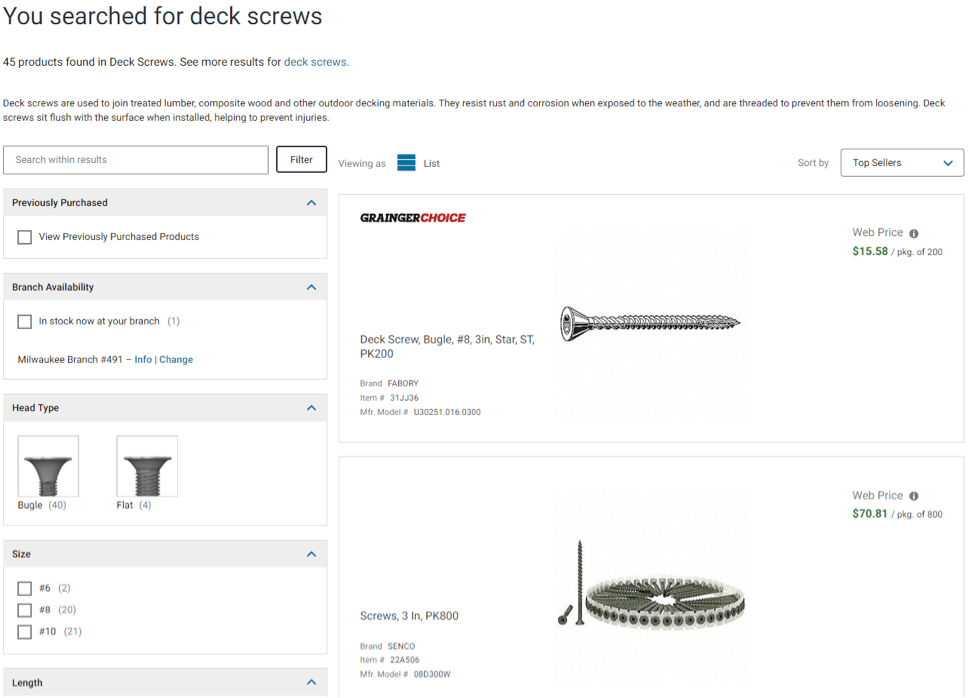
2. Faceted search
Faceted search is when you allow customers to narrow their search with attributes (size, price, color, etc.). This is typically implemented with a series of links on the left side of the page that you can click on to reduce the number of choices you are presented with.
To offer this, your digital commerce software needs to support faceted search, or you will need to license a 3rdparty search tool. Even with the right tool, your product data must be organized effectively to enable users to narrow choices by the most relevant features and quickly find what they need—improving the overall user experience.
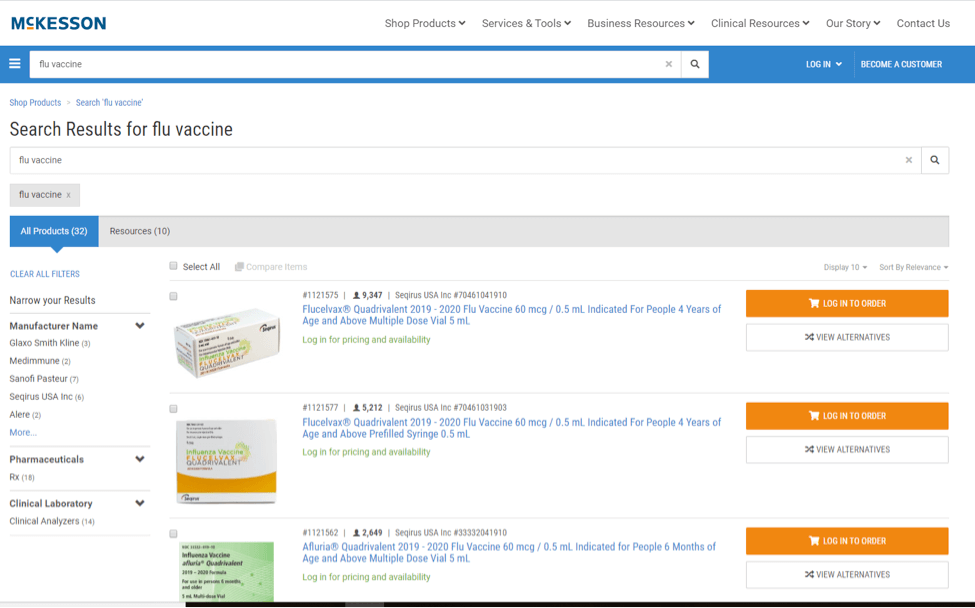
3. Multiple types of results
Search results across many digital commerce sites include only products. Increase your engagement and results by offering customers the ability to view content related to their search in addition to product results.
This content can pull in spec sheets and product literature that may come from your PIM, in addition to articles and blogs from your website.
4. Associated words
Optimize your on-site search by adding related words to your data. This gives your search tool information that won’t be displayed to users but is helpful in generating appropriate results. These could be terms that people use when searching for the product but that aren’t the actual product name.
Most commonly, associated words include misspellings, a generic name for the product (i.e. tissue versus Kleenex), or even a competitor’s product name.
If using a competitive product name, this should be done not to trick users, but rather, to help them as a user may be confused and may misremember your product name.
Better product recommendations
One proven way to increase average order value is through smart product recommendation tools—displaying options like “Customers also bought” or “You may also like.” Whether automated or manual, these recommendations depend on accurate and complete product information to deliver real impact on conversion and revenue.
If you don’t have software that will automate implementing recommendations, you can manually tell your PIM which other products are similar and set up your product pages to display that appropriately. Many software platforms have this capability, but with PIM it’s easier for the right people to be able to manage this data.
For many companies, keeping up with these recommendations manually is an activity they don’t have time for – both in terms of the initial setup and keeping those recommendations up to date as products change.
There are some great software tools that drive these recommendations from data on customer purchases, behavior on the site, and product relationships and categorization, including Episerver, Certona, 4Tell, Rich Relevance, and SLI Systems.
With complete, up-to-date product details and rich media, your PIM supports machine learning models that deliver more accurate recommendations. These data-driven experiences respond to user behavior and trends, increasing customer engagement and driving meaningful business outcomes.
Added value through content
In a world where you are competing against companies online with larger digital teams and more expensive software, the way you can win customers is through differentiating yourself based on your content. Use spec sheets, product videos, white papers, and articles to provide helpful resources to your customers that make their lives easier.
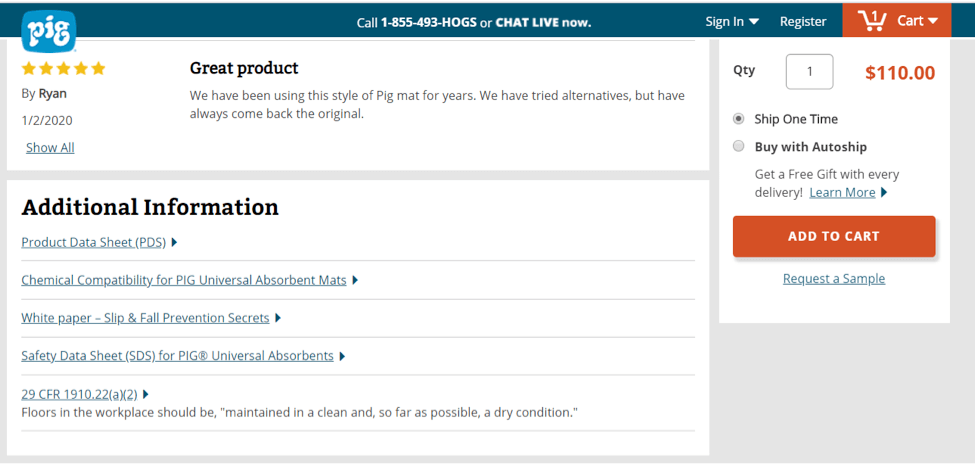 New Pig offers links to various spec sheets and related product literature at the bottom of their product page.
This content can be a headache to maintain and update, but with PIM, the updates you make in one place carry throughout all your channels. Your PIM software enables your marketing team to really leverage the content they have invested time in creating.
Ensure that the content your internal team creates can be found on your site product pages and throughout other key areas of your site. You could have a page that lists out all of your spec sheets. You could have another section of your site for how-to videos, but those same videos also appear on the appropriate product page.
Turning product data into customer insights
While structured product information supports better search, recommendations, and content delivery, its real value emerges when used to inform and adapt to customer behavior.
By analyzing how users engage with product data across your digital commerce channels—such as which filters they apply, which spec sheets they download, or which recommendations lead to conversions—you can transform static content into actionable insight.
Tracking key metrics like facet interaction rates, on-site search trends, and content engagement allows teams to refine product categorization, improve UX flows, and elevate merchandising strategies.
Over time, these insights also help shape smarter product development decisions. By identifying which product features resonate most with users, businesses can prioritize enhancements that align with customer preferences—creating more relevant experiences and driving brand loyalty.
Integrating this continuous feedback loop into your PIM and product planning process ensures that behavioral signals aren’t just collected—they’re applied to fuel smarter, more customer-centric growth.
Key metrics to track product data performance
Strong product data management isn’t just about organization—it’s about creating measurable value across digital channels. With the right PIM in place, teams can track and optimize performance in several key areas:
- Data completeness – Monitor how fully enriched each product record is, from essential attributes to digital assets. Completeness scoring helps ensure content is publication-ready for every target channel.
- Channel readiness – Track which products meet the unique formatting and content requirements for marketplaces, e-commerce platforms, or catalogs. Clear visibility into readiness status supports faster go-to-market execution.
- Content consistency – Maintain alignment across languages, regions, and customer touchpoints by managing product content centrally. When updates are made once and reflected everywhere, consistency becomes scalable.
- Workflow progress – Follow enrichment workflows to understand where products are in the publishing process and what actions are outstanding. This enables better cross-team coordination and accountability.
- Time-to-publish – Measure how quickly product records move from creation to completion. Reducing time-to-publish is a clear indicator of content agility and operational efficiency.
These metrics not only validate the strength of your product content—they unlock deeper insights into process performance, team productivity, and overall readiness to meet the demands of modern commerce.
Let your data lead the way
If your PIM is implemented well, it is going to reduce the work for digital commerce projects, including an effective search, product recommendation, and strategic content. Are you leveraging your data to improve your digital commerce results?
Not sure which tool to start with? That will depend on how your data is structured and the capabilities of your current digital commerce platform. As a digital commerce developer and Inriver partner, we would be happy to review your data and make recommendations for planning out the best approach for your company, reach us here.
About Lori McDonald – guest blogger
Lori is the Founder, President, and CEO of Brilliance Business Solutions. Brilliance is a web development firm that implements results-oriented digital commerce solutions for manufacturers and distributors. In business since 1998, Brilliance is an Inriver partner, Episerver Gold Partner, and a BigCommerce Partner Agency. Brilliance is known for their ability to provide clients with the freedom to innovate through empowering and enhancing their internal teams and has delivered successful digital commerce solutions for clients including Partsmaster, Unico, Reico Kitchen and Bath, Kimball Midwest, Graphic Controls, and Gesswein.
Published: March 25, 2020
Updated: July 7, 2025
Want to see the Inriver PIM in action?
Schedule a personalized, guided demo with an Inriver expert today to see how the Inriver PIM can get more value from your product information.
Frequently asked questions
What’s the difference between product data and product content?
Product data is structured info like SKUs and specs. Product content includes images, videos, and descriptions used to market products.
How can teams ensure alignment around product data strategy?
Use a shared PIM to connect teams and unify workflows, ensuring everyone works from the same trusted data source.
Can product data support a data-driven approach to digital commerce?
Yes—centralized product data enables smarter decisions, reveals gaps, and helps brands respond quickly to market trends.
How does quality product data improve customer engagement?
Accurate, enriched data helps customers compare, understand, and trust products—boosting conversions and loyalty.
Why is it important to track the impact of product data efforts?
Tracking metrics like publish speed and data completeness helps optimize workflows and scale what drives the most value.