How to build a human-led AI strategy for 2026
October 1, 2026A human-led AI strategy keeps direction, judgment, and accountability with people while AI executes governed work. Learn five steps for building the operating model.
A human-led AI strategy is an operating model in which people keep the responsibilities that cannot be delegated to machines, for instance, setting direction, exercising judgment, and holding accountability, while AI executes governed workflows underneath them. The World Economic Forum’s 2026 transformation framework identifies those three responsibilities as non-delegable, and it argues that AI value depends less on model capability than on whether you deliberately reorganize human roles around it.
Most organizations have not made that reorganization yet. Deloitte’s State of AI in the Enterprise survey of 3,235 senior leaders found that 74% of companies plan to deploy agentic AI within two years, yet only 21% have a mature governance model for autonomous agents. The gap between those two numbers is where AI initiatives stall, and leaders close it with decisions only they can make.
In this guide, you will learn what human-led actually means in practice, why AI strategies fail without it, and the five steps that turn the principle into a working operating model, including where your team stays in the loop once agents start doing real work.
What does “human-led” mean in an AI strategy?
Microsoft calls the organizations succeeding with AI “Frontier Firms,” and it defines them as human-led but increasingly AI-enabled. Through its own AI transformation journey, the company concluded that AI should expand what people can achieve while they retain meaningful control, judgment, and accountability. Human-led therefore describes who governs the work, not how much of the work people still perform by hand.
Across your organization, the three non-delegable responsibilities translate into concrete ownership:
- Setting direction. You decide which business outcomes AI serves and which workflows it operates in. McKinsey’s research on leadership in the AI era clearly states that while leaders can use AI to draft messages, they cannot delegate their aspirations.
- Exercising judgment. AI can summarize rules and outline risks, but its role remains advisory rather than authoritative. Your team makes the decisions that carry consequences, particularly when values conflict and time is limited.
- Holding accountability. AI models don’t bear responsibility for their outputs. Leaders remain accountable to customers, boards, regulators, and employees for every AI-driven outcome, even after execution has moved to agents.
None of this slows AI down. The WEF positions its human-led framework as the path from experimentation to measurable business value, meaning you redesign roles and governance so adoption can keep pace with your ambitions.
Why do AI strategies fail without human leadership?
When Microsoft licensed AI tools to over 200,000 employees, usage stagnated. They realized that access alone doesn’t drive transformation, and deploying a tool at scale doesn’t inherently change how work gets done.
Deloitte’s survey data shows the same pattern across industries, where fewer than 60% of workers with sanctioned AI access use it in their daily workflow.
| Failure pattern | What the data shows | Source |
|---|---|---|
| Access without activation | Fewer than 60% of workers with sanctioned AI access use it in their daily workflow, a figure unchanged from the year before | Deloitte: State of AI in the Enterprise, The untapped edge |
| Pilots that never scale | 95% of enterprise generative AI pilots deliver no measurable P&L impact, while roughly 5% of integrated pilots extract significant value | MIT NANDA: The GenAI Divide: State of AI in Business 2025 |
| Strategy misalignment at the top | 53% of CEOs say their leadership teams struggle to align on AI and talent strategies in a timely way, and 34% of companies have no policy for AI use at work | Adecco Group: Leading in the age of AI: Expectations versus reality |
| Work never redesigned | 84% of companies have not redesigned jobs around AI capabilities | Deloitte: State of AI in the Enterprise, The untapped edge |
Every row describes the same underlying mistake. Organizations buy capabilities and skip the leadership work of deciding how those capabilities change direction, judgment, and accountability. The gap between AI features and an AI operating model explains why two companies can deploy identical technology and get opposite results.

How do you build a human-led AI strategy? Five steps
The failure patterns above trace back to decisions nobody made. The five steps below put those decisions in the right order, and each one belongs to your leadership team rather than your IT backlog.
1. Set direction before you deploy anything
McKinsey’s research on AI-era leadership observes that executives will not always be the smartest presence in the room once agents join the workflow, which is why command-and-control approaches fall flat. The alternative they describe is creating context, meaning clear values, decision rights, and guardrails within which teams navigate change themselves.
Microsoft reached the same conclusion through experience: its first AI transformation lesson was to start with the business outcome rather than the technology, after its own tool-first rollout stalled. Direction means naming the outcomes AI serves in your organization before anyone evaluates a vendor.
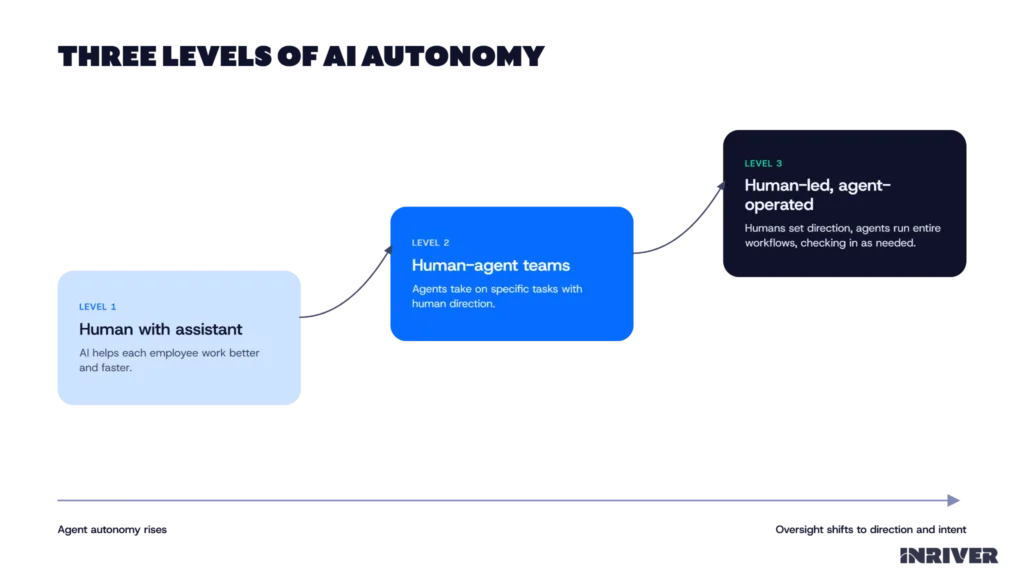
2. Define decision rights and autonomy levels
You cannot audit every step an agent takes, so your oversight model has to change shape. Adecco’s chief digital officer argues that autonomy and oversight must rise together, and that you audit intent, constraints, ethics, and values once step-by-step review becomes impossible.
Deciding who controls what AI agents can do in your operations therefore comes before deployment, not after an incident. Deloitte’s guidance matches, since organizations need explicit boundaries defining which decisions agents make independently and which require human approval. Setting the right level of AI autonomy for each workflow depends on the consequences of an error reaching the outside world.
3. Build governance before you scale
Data privacy and security top the list of AI risks leaders worry about (73%), followed by legal and regulatory compliance (50%), according to Deloitte. Its recommendation shares the name of this step, and it adds that oversight should become everyone’s role rather than a delegated technical function. In practice, governing agents require three capabilities:
- Boundaries that define agent autonomy per decision type
- Real-time monitoring that tracks agent behavior and flags anomalies
- Audit trails that capture the full chain of agent actions for accountability
The NIST AI Risk Management Framework organizes the same discipline into four functions, namely govern, map, measure, and manage. Solving your AI content control problem starts with these structures, and regulation such as the EU AI Act is turning them from good practice into obligation.
4. Redesign workflows, not tasks
Microsoft’s second lesson warns that accelerating a single step in a flawed process only creates a larger queue further downstream, which is why its teams mapped and simplified end-to-end workflows before deploying agents into them. Most organizations have not done that work yet.
Deloitte found that 53% of companies focus their talent response on educating employees to raise AI fluency, while far fewer rearchitect roles, workflows, and career paths. The organizations pulling ahead streamline the workflows AI can execute end-to-end and refocus people on judgment, exception handling, and strategic oversight, with new roles such as AI operations managers signaling that AI has become a structural component of how work gets organized.
5. Prepare your people for the handoff
WEF researchers identified five distinct postures employees take toward AI, ranging from enthusiasts to actively opposed, and they found that resistance often stays hidden because people comply in public settings while quietly circumventing tools in private. Your rollout plan should treat those postures as design inputs instead of obstacles.
Transparency does measurable work here, given that the EY Work Reimagined Survey 2025 found 63% of employees are more likely to embrace AI when they understand how it is used and retain override control. People support the systems they can see into and overrule.
Where do humans stay in the loop?
Steve Rudolph, vice-president of strategy and transformation at Pegasystems, puts it directly. In operational environments, AI must be “orchestrated to ensure consistent, auditable outcomes rather than operating as an unpredictable black box.” His point describes the entire human-led operating model. People hold the outer ring of direction, judgment, and accountability, while AI executes inside a governed cycle with a verification gate before anything reaches the outside world.
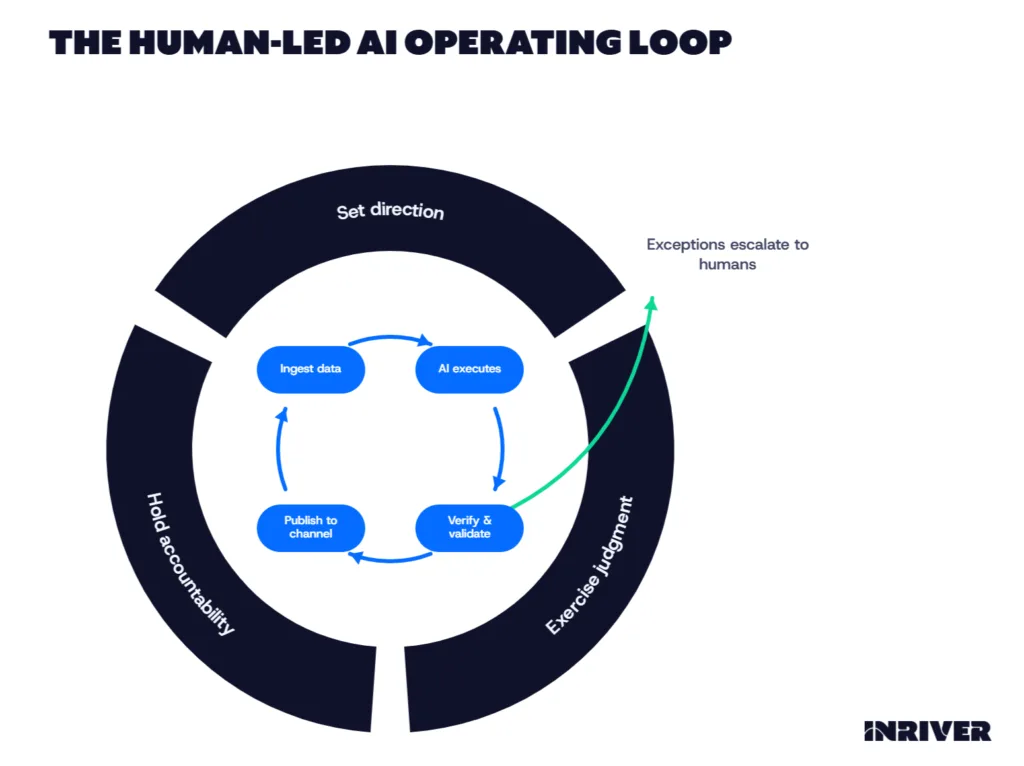
Read the loop from the inside out. AI ingests data, executes the work, and passes every output through verification and validation before publishing, while exceptions escalate upward to human judgment instead of slipping through. The outer ring never leaves human hands, since the three responsibilities it carries are the ones research consistently marks as non-delegable.
Product content shows you this model under real pressure, because errors there travel straight to buyers and channel partners. Product information orchestration applies the loop to the product data flow, and Inriver is built for exactly that job. Its flexible data model ingests product data from your existing sources without an upfront cleaning or ETL project, which gives agents trusted data to act on from the start. Its agentic orchestration then runs AI agent and LLM workflows across your product operations and passes every product-data-based agentic workflow through a verification and validation layer before anything reaches a channel. You get agentic speed while your team keeps the outer ring, which matters again when the EU AI Act reaches your product content.
Take back the lead on your AI strategy
Every finding in this article points to the same conclusion. AI initiatives succeed or stall on decisions that belong to you, not on the sophistication of the models you buy. Organizations that name their outcomes, set autonomy boundaries, govern before scaling, redesign the work itself, and bring their people along will convert AI investment into results the rest keep chasing. Your product data is one of the first places that discipline pays off, and the operating model to prove it already exists.
Ready to see Inriver in action?
Inriver transforms the way your business thinks about product data. Let an Inriver expert explain the many benefits of the enterprise-ready, fully adaptable Inriver platform.
- Get a personalized, guided demo of the Inriver platform
- Have all your PIM questions answered
- Free consultation, zero commitment
Thanks for choosing Inriver! We’ll be in touch soon.
Please try again in a moment.