How does the EU AI Act affect product content and PIM?
October 12, 2026The EU AI Act introduces specific rules for AI-generated product content. Learn how labeling, human review, image disclosures, and channel distribution affect PIM operations.
If your team uses AI to write product copy or create product images, Google Merchant Center requires you to put AI-written titles and descriptions into separate attributes labeled as AI-generated and to keep the AI metadata tag inside every AI-generated image.
The EU AI Act now adds legal duties to that same content, mainly through Article 50, which has applied since 2 August 2026 and covers chatbots and AI agents that talk to people, machine-readable marking of AI output, and visible labels on deepfakes. The good news is that the European Commission places ordinary product descriptions outside the text-labeling duty, so they need no visible AI label, although images, claims about health, consumer safety, or sustainability, and customer-facing chatbots warrant closer scrutiny.
Images are a key area where you should proceed with caution. The Commission has provided a practical test for this. If an AI-generated product image makes an item appear more appealing than it is in reality, it is considered a deepfake. However, if a real product is shown against an AI-generated background, it does not count as a deepfake, as long as the image does not mislead your buyers. Your role is equally important, because whether the law categorizes you as a provider or a deployer determines the responsibilities you, your PIM vendor, and your distribution channels have.
In this article, you’ll see which Article 50 duties reach your product content, who owes what, how AI labels travel to your channels, whether the Act applies when AI search and shopping agents read your data, and what to set up now.
- Which parts of the EU AI Act apply to product content?
- Are you a provider or a deployer when you use AI in your PIM?
- Do AI-generated product descriptions require AI labels?
- When does an AI-generated product image count as a deepfake?
- How do AI labels reach channels along with your product data?
- Does the EU AI Act apply when AI search and shopping agents read your product data?
- What should your product data team put in place now?
- FAQs
Which parts of the EU AI Act apply to product content?
Article 50 ties its duties to specific outputs and interactions, so you can check your catalog one content type at a time.
| Product content | What the Act requires | Who owes it |
|---|---|---|
| Descriptions generated or rewritten by AI | Marking in a machine-readable format for newly generated text and for rewrites that materially change meaning, style, or intent. The Commission’s example of product descriptions outside the visible-label duty excludes claims about health, consumer safety, or sustainability. | The AI system’s provider |
| AI translation of product text | No marking, because translation counts as standard editing | No one |
| Single words, alt text, image captions, and data labels | No marking, because outputs this short fall outside the scope | No one |
| Product images generated or edited by AI | Marking when the AI generates the image or alters it substantially, and a visible label when the image is a deepfake | The AI system’s provider for marking, and you for the label |
| Chatbots and shopping assistants on product pages | A notice, no later than the first interaction, that the person is talking to AI | The system’s provider, which means you if you built it in-house under your own name |
| AI agents acting for you or for a shopper | A disclosure that the agent is AI and whom it acts for, whenever it can interact with a person | The agent’s provider |
The Commission covers an agent when it can interact with a person, so your decisions about what AI agents can do in your product operations determine whether the duty reaches you.
Are you a provider or a deployer when you use AI in your PIM?
You’re a provider when you develop an AI system, or have one developed, and offer it under your own name or trademark, and you’re a deployer when you use an AI system under your own authority for professional work.
Your PIM vendor is the provider of its AI features when it offers them under its own name, and your team is the deployer when you decide how to use them.
Authority rests on your decision to use the system and on how you use its outputs, and it does not necessarily require technical control over how the system runs.
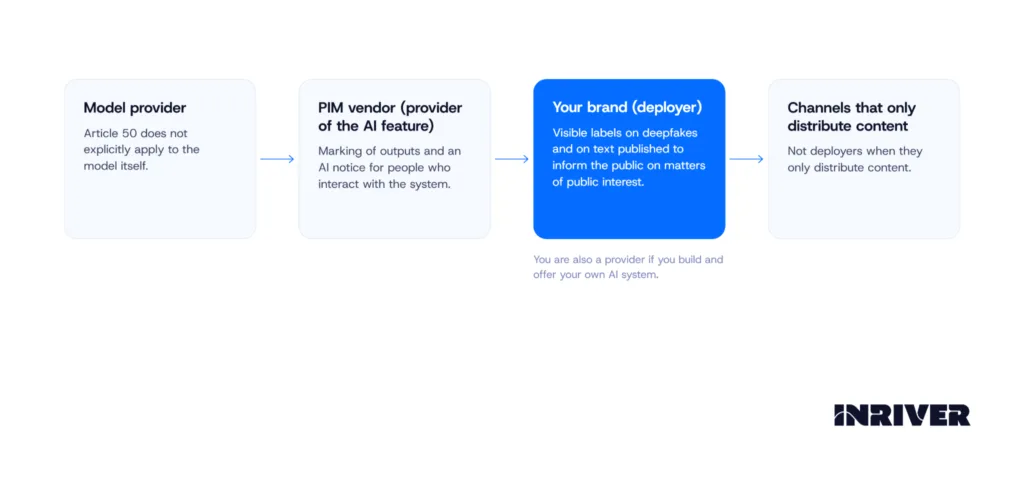
Roles can overlap. A company that builds a generative AI system in-house and uses it to create deepfakes is both a provider and a deployer, so it owes the marking and the label. A company that builds a chatbot in-house and puts it into service under its own name is a provider, and a company that modifies an existing generative AI system and offers it under its own name becomes the provider of the new system.
A provider can rely on the marking an upstream model provider applies, but it stays responsible for showing that its own system complies.
Do AI-generated product descriptions require AI labels?
Ordinary product descriptions don’t need a visible AI label, because the Commission names them among the texts outside the labeling duty. The duty covers text that is published, informs the public, and addresses a matter of public interest, and the Commission’s example leaves out claims related to health, consumer safety, or sustainability. Where your copy lands depends on what it says and who has checked it.
- A routine description. Copy without those claims matches the Commission’s example and needs no visible label.
- A description with those claims. Public health, environmental protection, and consumer safety are on the Commission’s list of public-interest topics, and its example does not cover such claims, so test that copy against the three elements of published, informing the public, and a matter of public interest.
- Copy a qualified person has reviewed. The exception needs two conditions together. Reviewers need relevant knowledge and professional judgment and must fact-check the content, and a person or company must hold ultimate legal responsibility for the publication, with identity and contact details easy to find.
- Copy the AI changes after sign-off. Any substantive AI intervention after review voids the exception, and a spell-check or grammar pass does not count as a review, so the level of AI autonomy you allow in your workflow decides whether your sign-off still counts.
When does an AI-generated product image count as a deepfake?
An AI-generated product image counts as a deepfake when it resembles a realistic product and would falsely appear authentic or truthful. The Commission checks four cumulative criteria, so you need to assess each image against all four.
- Does the image resemble the product appreciably? The Commission describes this as a high level of similarity, including any recognizable elements, and the image does not need to be identical. You compare the two objectively.
- Does the product exist, or could it plausibly exist? A realistic product qualifies, while something that defies the laws of nature, such as an elephant driving a car, falls outside the duty.
- Is the subject an object? The Commission defines objects as realistic, inanimate material items and includes consumer goods.
- Would the image falsely appear authentic or truthful? You judge this objectively and do not need to intend any deception. You weigh the level of resemblance, the message, where the image appears, and who is likely to see it.
In product advertisements or packaging, AI color correction, background extensions, aesthetic background replacement, compositions of existing products, and rescaling are likely to have only a minor impact on how authentic the image looks.
If your image qualifies, you disclose its AI origin with a visible or audible label no later than first exposure, and the machine-readable mark from your provider doesn’t replace that label.

How do AI labels reach channels along with your product data?
Your export carries your labels to each channel, because channels that merely distribute content are not deployers under the AI Act, while Google Merchant Center makes the AI tags part of the data you submit.
- Machine-readable marks
Your AI provider applies them to the output, and platforms and other distributors are encouraged to preserve them so that the people who see the content can learn its origin. - Visible labels
If you deploy a deepfake or text covered by the labeling duty, the Commission expects you to take proportionate measures to keep the label clear at first exposure, for example through contractual conditions with distributing partners and how your interfaces display it. - Google’s image tag
Google requires every image created with generative AI to carry the IPTC DigitalSourceType metadata and says not to remove embedded tags from images made with AI tools such as Product Studio. The attributes that can hold AI-generated images are image_link, additional_image_link, and lifestyle_image_link. - Google’s text attributes
AI-generated titles go into structured_title and AI-generated descriptions into structured_description, each with the digital_source_type value “trained_algorithmic_media”.
Does the EU AI Act apply when AI search and shopping agents read your product data?
The Commission’s guidelines put retrieval and machine-to-machine reading outside the interaction duty in Article 50. They list search and retrieval of information without generating or modifying content as activities among systems that don’t interact directly with people, and they exclude backend machine-to-machine calls whose outputs are not intended to reach a natural person.
Article 50 duties arise when a system generates or manipulates content or interacts directly with a person, and your data still matters to AI systems at three moments.
The question
Consumers are defaulting to AI-powered search, through ChatGPT, Gemini, Copilot, Perplexity, Claude, and Google’s AI Overview, to guide their choices and discover new brands.
Product pages are among the five page types cited most often in AI Overviews; your own site is a small share of what AI search draws on, and top brands can be absent from some answers.
ChatGPT sends most AI referral traffic in Conductor’s data, and Gemini leads in some industries, so Conductor concludes that focusing on one engine isn’t enough.
The comparison
In convenience-oriented stores, clean catalog feeds, accurate local availability data, and live pricing updates can boost credibility when shoppers or their AI agents compare alternatives. An AI agent values data quality over brand story, and HubSpot lists consistent terminology and entity clarity among the signals answer engines rely on.
The purchase
AI-mediated discovery increasingly carries through to execution, with agents comparing options, assembling baskets, and completing checkout through emerging payment protocols and merchant integrations.
ChatGPT already lets customers buy products cited in an answer without leaving the chat, so product directories will need to be optimized for agent readability, with semantic and behavioral metadata in the catalog.
KPMG warns that product, inventory, and pricing data that is not impeccably structured and machine-readable in real time leaves your brand invisible in the agentic economy.
What should your product data team put in place now?
Seven checks turn the Act’s duties and your channels’ requirements into daily product data work.
- Record your role for each AI system. Operators can be both a provider and a deployer, and each role brings its own duties.
- Own AI content control at the export step. Assign a person to AI content control for each channel feed and confirm that the IPTC tag and the structured title and description attributes survive, because channels are only encouraged to preserve marks.
- Name a reviewer for copy with claims. Google asks you to manually fact-check all AI-generated content before publishing, and the Commission treats fact-checking as the minimum for human review.
- Test product images before they publish. Run each AI-generated or AI-edited image through the Commission’s four deepfake criteria and label the ones that qualify.
- Put the AI notice on chatbots and agents. Show it at the latest at first interaction, and make sure every agent can disclose that it is AI and whom it acts for.
- Keep product, inventory, and pricing data structured and machine-readable. Put an owner on agent readability and on real-time machine readability, which KPMG links to your visibility in the agentic economy.
- Plan AI literacy for everyone who runs these systems. The Commission says AI literacy requirements apply to providers and deployers within Article 50, so build the training into your human-led AI strategy.
Inriver’s PIM platform coordinates enrichment, approvals, and channel activation between your source systems and your channels through product information orchestration, with AI workflows that pass through verification and validation before anything reaches a channel.
Book a personalized demo with Inriver to see how your team can manage AI-generated product content, reviews, and approvals in one flow.
Ready to see Inriver in action?
Inriver transforms the way your business thinks about product data. Let an Inriver expert explain the many benefits of the enterprise-ready, fully adaptable Inriver platform.
- Get a personalized, guided demo of the Inriver platform
- Have all your PIM questions answered
- Free consultation, zero commitment
Thanks for choosing Inriver! We’ll be in touch soon.
Please try again in a moment.