Distribute-and-forget is dead: Why product content needs a feedback loop
September 18, 2026Digital shelf signals reveal where product content drifts after distribution. Learn how to turn post-publication monitoring into action.
According to AirOps’ 2026 State of AI Search research, only 30% of brands stay visible from one AI answer to the next, and just 20% remain present across five consecutive runs. The brands did not change their content between those answers, yet the answers changed anyway.
Your team probably still runs the workflow that predates this reality. You enrich the data, secure the approvals, syndicate to every channel, and move on to the next launch. The model worked because a published product page stayed the way you left it. Now that shopping has a new customer in AI, your content gets reread and reassembled every time a buyer asks a question, and your visibility can shift between two identical prompts asked minutes apart.
Publishing, in other words, no longer marks the end of the work. It marks the midpoint of a loop most teams have not built yet.
Why “publish once, syndicate everywhere” stopped working
McKinsey research describes the new buying reality in one scene. Before a buyer ever reaches your product page, an AI tool may already have narrowed the field to three options and explained why one of them failed to make the cut. McKinsey’s related analysis of agentic commerce estimates that AI agents could mediate $3 trillion to $5 trillion of global consumer commerce by 2030, so the scene above is becoming the default path to purchase, not an edge case.
AI-driven discovery changed what a channel is. Your product content now serves two audiences, humans and machines, and the difference between the old model and the new one comes down to this:
| Channel as endpoint | Channel as reader | |
|---|---|---|
| Who consumes the content | Shoppers who land on the page | Shoppers plus AI systems assembling answers |
| How often it gets re-evaluated | When you push an update | Every time a question gets asked |
| What happens when content goes stale | The page underperforms gradually | The product drops out of answers entirely |
| What “done” means | Published and approved | Holding up under continuous rereading |
Once your channels behave like readers, the question stops being whether your content went out correctly. The question becomes what those readers are doing with it now, and most teams have no way to see that.
What changes after your content leaves the PIM
Nothing on the surface tells you your product content is decaying. The listings still look correct, the syndication logs still show success, and the drop happens somewhere you are not looking. Three findings from 2026 research show where.
1. AI answers rebuild themselves every time
Based on a GetMentions AI study that tracked 530,875 citations across 2,398 queries asked daily on ChatGPT, Google AI Mode, Perplexity, and Gemini, 69% of the sources behind a typical AI answer change from one day to the next. The same question, asked 24 hours apart, gets assembled from a substantially different set of sources.
Your product either survives that daily reassembly or it does not, and the outcome owes more to how clean, structured product data feeds AI search than to anything you would recognize as traditional ranking.
2. The platforms shift on their own schedule
Volatility also arrives from the platform side, independent of anything brands do. seoClarity’s citation trend analysis across five markets found that ChatGPT citation volume fell more than 90% at its March and April 2026 low point, then rebounded toward earlier levels by May. Brands that treated the drop as a content failure were chasing a cause that did not exist, and brands that never noticed the swing had no way to distinguish a platform change from a genuine content problem.
3. Freshness now functions as a visibility signal
The AirOps research cited earlier carries a second finding that matters here. Pages left without updates for a quarter are more than three times as likely to lose AI citations; more than 70% of pages cited by AI were updated within the past 12 months, and roughly 83% of citations on commercial-intent queries come from pages updated within the last year. Content that sits untouched after syndication ages out of consideration, even if every attribute remains accurate.
Improving distribution alone won’t resolve these three issues. You must monitor what happens to your content after publication to identify and address each problem.
How a product content feedback loop works
A feedback loop closes the gap those three findings expose. Instead of ending at distribution, the work cycles through six connected stages, and the output of the last stage feeds the first.
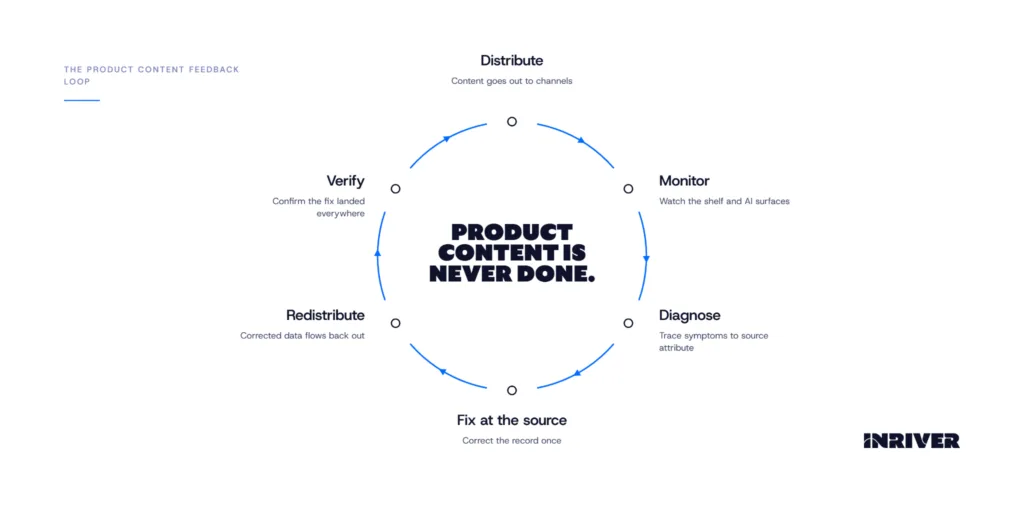
| Stage | What happens here |
|---|---|
| Distribute | Product content goes out to marketplaces, retailers, and every surface where buying decisions happen, formatted to each channel’s requirements. |
| Monitor | You track two layers at once, the shelf itself for accuracy, availability, and compliance drift, and the AI surfaces for whether assistants mention your products and describe them correctly. |
| Diagnose | A symptom on a channel traces back to a cause in the data. An incorrect claim in an AI answer, a failed compliance check, or a stale specification points to a specific attribute, asset, or relationship in the product record. |
| Fix at the source | You correct the product record once, in the PIM, rather than patching listings channel by channel. Channel-level patches recreate the same error at the next syndication, while a source-level fix propagates everywhere the data flows. |
| Redistribute | The corrected data moves back out through the same governed flow it came from, formatted and approved for each channel. |
| Verify | You confirm the fix actually landed where buyers and machines read it. Until the correction is visible downstream, the loop stays open. |
The monitoring layer deserves particular attention because its surface keeps expanding. According to BrightEdge research, AI Overviews now appear on roughly 48% of tracked queries, a 58% year-over-year increase, and only about 17% of the sources they cite also rank in the organic top 10. Rank tracking alone misses much of what AI reads, which is why AEO now accompanies SEO in product discovery.
Run continuously, the loop converts monitoring from a reporting exercise into an operating rhythm.
Which signals belong in your monitoring layer
Not every metric earns a place in the loop. The signals worth tracking share one trait; each of them traces back to something you can correct in the product record. Six meet that bar.
1. Content accuracy and compliance drift
Whether live listings still match the approved product record, and whether regulatory or channel requirements changed after publication.
2. AI answer presence
Whether assistants and answer engines mention your products, describe them correctly, and cite your content. Presence on these surfaces is the visibility layer where GEO and AEO priorities get decided.
3. Share of search
How often your products surface for category queries relative to competitors, on both traditional and AI-driven results.
4. Availability and buy box status
Whether the product can actually be purchased where it appears, since a correct listing on an unavailable product still loses the sale.
5. Review and Q&A themes
Which gaps buyers flag repeatedly, because recurring questions expose attributes your content never answered.
6. Image and asset performance
Whether visuals meet each channel’s specifications and whether your images remain visible to AI systems that parse them for answers.
Coverage matters less than depth at the start. Begin with your highest-revenue SKUs on your top channels, prove the loop works there, and expand outward from that base.
Closing the loop without losing control
Running processes at a catalog scale means that AI handles much of the correction work. Tasks such as enrichment, gap-filling, translation, and reformatting across thousands of SKUs exceed what any team could manually correct, so AI agents and LLM workflows do most of the fixing. However, an unchecked agent can publish errors as quickly as it publishes corrections.
The consequences of getting this wrong are already measurable. Forrester’s 2026 predictions research anticipates that one-third of companies will jeopardize customer trust in 2026 because of premature deployment of customer-facing AI.
Customers also conduct their own checks. A Gartner survey of U.S. consumers found that willingness to allow AI to make purchase decisions peaked at just 11%, even in low-stakes categories. Trust and accuracy emerged as major barriers to wider adoption. While people are willing to accept AI to help narrow their options, they still verify the results against actual content before making a purchase. As a result, your product data is scrutinized twice during the purchasing process, and any errors will not go unnoticed.
Therefore, verification and validation should be integral parts of the process, not just tacked on at the end. Teams that bypass this critical step are not truly running a feedback loop; they are simply automating their mistakes.
Where Inriver fits in the loop
Inriver operates within a single platform that integrates all processes. Its Digital Shelf Analytics feature addresses the monitoring and diagnosing stages by identifying accuracy drift, channel compliance gaps, and changes in share-of-search. It traces these issues back to the original product records.
The platform’s flexible data model enables practical corrections at the source, applying updates once to the data the platform collected in its original form. Additionally, agentic orchestration enables corrective actions at scale, with a verification and validation layer that checks each AI-driven change against trusted product data before redistribution.
The old “distribute-and-forget” approach assumes that content remains unchanged after publication, but the findings mentioned above show otherwise. Schedule a demo today to see how your product content is performing across all channels.
Ready to see Inriver in action?
Inriver transforms the way your business thinks about product data. Let an Inriver expert explain the many benefits of the enterprise-ready, fully adaptable Inriver platform.
- Get a personalized, guided demo of the Inriver platform
- Have all your PIM questions answered
- Free consultation, zero commitment
Thanks for choosing Inriver! We’ll be in touch soon.
Please try again in a moment.