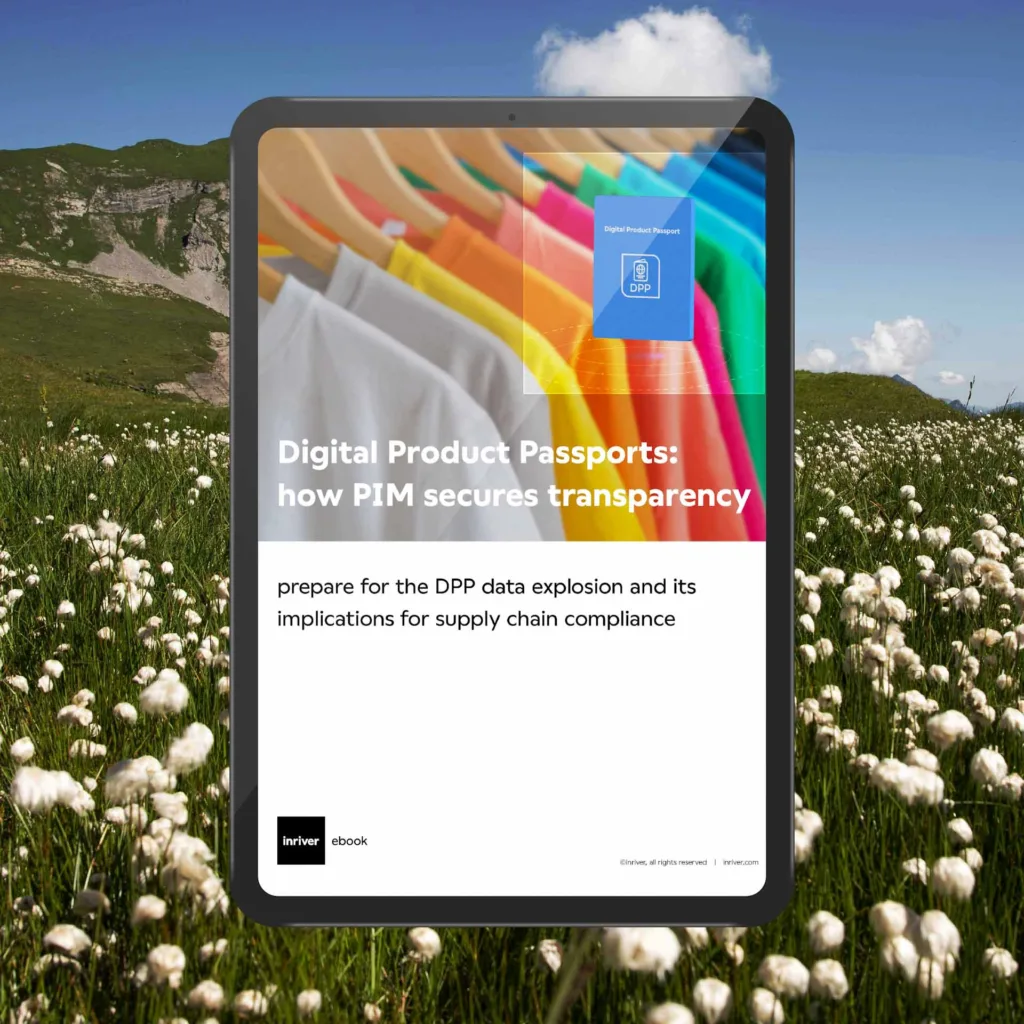
A complete brand guide to Digital Product Passport for textiles
Prepare for the textile digital product passport
See how structured product data helps you meet EU requirements, protect credibility, and support circular goals. Explore what DPP readiness looks like for your brand.
Skip to:
- What does textiles DPP require from your product data?
- What’s at stake for textile brands under the EU Digital Product Passport?
- How do you turn textiles DPP requirements into governed, usable product data?
- How does Inriver support DPPs for textiles at scale?
- How are top brands managing complex product information with Inriver?
- Prepare your textile product data for EU DPP requirements
- FAQs
European textile consumption ranks as the EU’s fourth-highest driver of environmental and climate impacts, following food, housing, and mobility, and current waste levels show how exposed the industry has become.
In the EU alone, around 5.8 million tonnes of textiles are discarded every year, or 11.3 kg per person, even as 88% of Europeans say clothing should be made to last longer. Production trends move in the opposite direction.
Global textile output doubled between 2000 and 2015, with a truckload of textiles still sent to landfill or incineration every second. Less than 1% of textile material returns to clothing production, while up to 35% of microplastics released into the environment originate from textile products.
As a result, regulatory pressure has intensified. A review by EU legal experts found that 53.3% of assessed environmental claims were potentially misleading, reinforcing concerns about greenwashing and weak product substantiation.
Under the EU Strategy for Sustainable and Circular Textiles and the Ecodesign for Sustainable Products Regulation, textiles now face clearer information requirements, a Digital Product Passport, and stronger expectations around durability, repairability, recycled content, and microplastics.
Consequently, the commercial risks surface quickly. Weak traceability raises exposure to greenwashing claims, erodes brand credibility, and can delay or block access to EU markets. Meeting DPP requirements depends on product data you can trace, verify, and reuse consistently across suppliers, systems, and channels, season after season.
What does textiles DPP require from your product data?
Under the EU Strategy for Sustainable and Circular Textiles and the Ecodesign for Sustainable Products Regulation, a DPP for textiles changes what regulators, partners, and consumers expect you to prove about each product. The focus shifts away from high-level sustainability statements toward structured, product-level data that remains consistent across markets and lifecycle stages.
For textile brands, DPP requirements focus on information you already manage today, but rarely in a single, governed place. The Commission’s strategy documents and consultation materials consistently point to these core data checkpoints:
- Material composition and fiber content
Clear, structured data on fibres, blends, and non-textile parts of animal origin, aligned with existing textile labelling rules. - Chemicals and substances of concern
Visibility into restricted substances and chemical use across production, supporting compliance and future substantiation checks. - Certifications and compliance evidence
Verified claims tied to recognised standards and supplier documentation, rather than marketing-led statements. - Environmental indicators
Data that supports durability, recycled content, and environmental performance, designed to be reused across reporting, audits, and passports. - Care, repair, and durability information
Instructions and attributes that support longer product lifetimes, repair, and reuse. - End-of-life and circularity data
Information that enables recycling, resale, or responsible disposal once the product leaves active use.
Across regulated categories, Digital Product Passport requirements are already influencing how furniture and fashion, apparel, and footwear brands structure product data. In textiles, however, seasonal assortments, frequent material changes, and multi-tier supply chains increase the pressure to manage this information consistently at scale.
Textile brands face new expectations for traceability and product transparency. Get practical guidance in the DPP ebook.
What’s at stake for textile brands under the EU Digital Product Passport?
Regulatory pressure on textiles extends well beyond sustainability claims. Across EU legislation and the synopsis report supporting the EU Strategy for Sustainable and Circular Textiles, several business risks emerge that directly affect how you manage product data today.
1. Stricter enforcement of existing labelling and product data obligations
Regulation (EU) No 1007/2011 already requires accurate fiber composition labeling and clear identification of non-textile parts of animal origin. Market surveillance authorities are empowered to verify this information and take action where discrepancies appear between labels, documentation, and the physical product. As DPP requirements layer on top, inconsistencies across systems and suppliers become harder to defend during inspections.
2. Higher barriers to EU market access for imported textiles
The EU Strategy for Sustainable and Circular Textiles links product compliance to stronger market surveillance, particularly for imports and cross-border e-commerce. The strategy highlights enforcement challenges created by complex global supply chains and signals tighter controls to ensure products placed on the EU market meet minimum environmental and information standards. Weak traceability increases the risk of delays, corrective measures, or restricted access.
3. Rising operational burden across suppliers and internal teams
The report identifies a broad need for suppliers to provide environmental and product profile information in a more standardized way. Without shared structures, brands absorb the cost through manual data collection, repeated supplier follow-ups, and system reconciliation, slowing product launches and audits.
4. Limited ability to participate in circular economy mechanisms
Extended Producer Responsibility (EPR) tools, reuse, repair, and recycling initiatives all rely on accurate, product-level information that can move across the value chain. Stakeholders repeatedly identified missing or inconsistent data as a blocker to effective textile collection, sorting, and treatment once products enter post-consumer streams.
5. Reduced credibility with regulators, partners, and downstream actors
The strategy materials stress that reliable information transfer is a prerequisite for trust between brands, recyclers, reuse organisations, and authorities. Fragmented product data weakens collaboration across these actors and limits participation in future policy-driven initiatives.
How do you turn textiles DPP requirements into governed, usable product data?
With the EU’s established regulations for DPPs, textile brands need to manage product data with far greater structure and consistency than spreadsheets or supplier documents allow. Product data now needs to stay aligned across regulatory checks, sustainability reporting, and every channel where products appear.
In this environment, product information management provides the foundation. A PIM system gives you one place to model required DPP attributes, including material composition, substances of concern, certifications, care instructions, and end-of-life information. Standardized formats keep those attributes consistent as data moves between teams, systems, and external partners.
Beyond baseline requirements, PIM also supports enrichment with sustainability attributes and compliance data that must stay linked to individual products. That linkage matters for broader sustainability reporting and for Scope 3 emissions, where material and supplier accuracy directly affects reporting quality.
Inriver is designed to support this level of control. Flexible data models adapt as DPP requirements change, while supplier-ready governance helps manage how information enters the system. Audit-ready structures reduce friction during inspections and reporting, establishing a stable product data foundation ahead of the full DPP rollout.
How does Inriver support DPPs for textiles at scale?
Managing DPP requirements across textile assortments demands more than storing data. Execution depends on how well product information flows between suppliers, internal systems, and every channel where your products appear. Inriver is designed to support that reality.
- DPP-ready data model
Inriver lets you model all required DPP attributes at the product and variant level, including materials, chemicals, certifications, care instructions, and end-of-life data. Flexible structures adapt as EU requirements evolve, without forcing rework across catalogs. - Supplier-ready governance
Controlled data onboarding ensures suppliers deliver information in consistent formats. Built-in governance supports validation, approvals, and version control, so product data stays accurate before it reaches audits, reporting, or publication. - Multi-system orchestration
Textile data lives across PLM, ERP, sustainability tools, and supplier systems. Inriver acts as the orchestration layer, connecting and synchronizing product information across platforms without creating new silos. This orchestration reduces duplication and manual reconciliation. - Omnichannel delivery
Enriched and validated product data flows from one source to every endpoint. With omnichannel delivery, the same DPP-ready information supports regulatory access, e-commerce, partners, and downstream use cases without inconsistency.
These capabilities give textile brands a controlled path to DPP readiness without slowing product launches or supplier collaboration.
What is PIM? Hear Inriver experts answer the all-important questions.
How are top brands managing complex product information with Inriver?
Across Europe, apparel and textile brands with complex assortments already use Inriver to bring structure and control to product information at scale. The focus stays on accuracy, consistency, and speed across fast-moving collections and multiple channels.
Fjällräven
Managing outdoor apparel across regions and seasons requires tight control over material composition, care information, and product attributes. Fjällräven uses Inriver to centralize and govern product data, enabling teams to maintain consistency across digital channels and internal systems while supporting long product lifecycles.

WE Fashion
Managing fast-moving fashion assortments requires accurate, reusable product information at scale. WE Fashion uses Inriver as a single source of truth to centralize product data, standardize fabric composition via dedicated templates, and coordinate updates across styles and channels, thereby improving governance and time-to-market.

Prepare your textile product data for EU DPP requirements
The EU’s Green Deal sets a clear direction for textiles. Products placed on the market should last longer, generate less waste, and provide clearer information about what people buy and how to care for it. Digital Product Passports turn those goals into enforceable expectations.
Your teams will feel the impact through cross-border complexity, tighter claim scrutiny, and the cost of chasing fragmented product information. Consumer trust depends on clear data around materials, care, and durability, while environmental outcomes improve through reuse, repair, and recycling powered by reliable product data.
DPP readiness starts upstream with governed product information. A PIM platform lets you manage textile data once and reuse it wherever regulation, sustainability, and commerce intersect.
Are you set up to do that today?
See the Inriver PIM in action
Inriver offers the most comprehensive PIM solution on the market, built for speed, scale, and complexity. Let an Inriver expert explain how the Inriver PIM can turn your product data flows into a sustainable revenue stream.
- Get a personalized, guided demo of the Inriver platform
- Have all your PIM questions answered
- Free consultation, zero commitment
Thanks for reaching out!
We’ll be in touch soon.
Please try again in a moment.