ETIM vs ECLASS: How manufacturers classify and share product data
November 16, 2026Compare ETIM vs ECLASS to understand which classification standard fits your trading partners' requirements. See how PIM helps manufacturers manage technical product data across systems and sales channels.
Explore PIM for manufacturingETIM and ECLASS are open classification standards that let you describe a product using the same classes, features, and values your trading partners use; the main difference is scope. ETIM covers technical products in five industry sectors, while ECLASS covers products and services across industries. You assign each product to a class, fill in the features that class defines, and share the result through an exchange format such as ETIM xChange or the ECLASS web service.
In this article, we’ll explain what classification standards do, how ETIM and ECLASS differ and where they overlap, and which standard fits the partners that receive your product data. We’ll also discuss how classified data reaches those partners and the Digital Product Passport, and what your PIM has to handle to keep that data current.
What do classification standards do?
ETIM International’s guidelines describe product classification as a logical, unambiguous taxonomy of products that lets anyone in a sector communicate about those products without misunderstandings. To make that possible, a standard places each product in a class and gives the class a fixed set of descriptors, which in ETIM are:
- Classes, which bundle similar products from different manufacturers or suppliers.
- Features, which specify the technical characteristics of the products in a class.
- Values, which form the fixed list of options an alphanumeric feature can take in a class.
- Units, which state what a numeric or range feature is measured in.
- Synonyms, which give a class alternative names so that people can find it.
ECLASS follows the same logic with classification classes, properties, and values. Each element carries a language-independent identifier, such as EC000016 for an ETIM class and EF000138 for an ETIM feature, and ECLASS gives every structural element a globally unique identifier called an IRDI, so partners in different countries can exchange the same codes and read their own translations.
Classifications and taxonomies also count as metadata, the descriptive layer that tells the systems receiving your product data what each piece of information means, and ETIM’s guidelines list less manual re-entry of information that already exists electronically and lower failure costs from incorrect orders among the benefits.
How ETIM and ECLASS compare
ETIM and ECLASS each grew out of the need for standardized product information that supports clear communication between the parties who trade products.
What is ETIM
ETIM started in 1991 as a Dutch product typology that later evolved into ISO 16354, and ETIM International, a non-profit association of national ETIM organizations and global industry members, now develops and maintains the model.
The model has two levels, product groups and product classes, but the groups only organize the classes, so the real work happens in the class, where you assign each product to exactly one class and fill in its features.
Features come in four types: alphanumeric (a closed list of values), logical (yes or no), numeric (one number), and range (two numbers that limit an interval).
What is ECLASS
ECLASS describes itself as the global reference data standard for classifying and unambiguously describing products and services, and it states that more than 4,000 companies use it.
It organizes products in a four-level hierarchy of classification classes and offers two representations of its content: Basic and Advanced. Basic presents a simplified structure, while Advanced adds application classes and value lists.
ECLASS states that its data model builds on ISO 8000, ISO 13584, and IEC 61360, and release 16.0 added 995 classes, 1,253 properties, 985 values, and 126 value lists.
| ETIM | ECLASS | |
|---|---|---|
| Maintained by | ETIM International, with national ETIM organizations | ECLASS e.V. |
| Scope | Technical products in five sectors | Products and services across industries |
| Hierarchy | Two levels: product group and product class | Four levels: segment, main group, a third level, and classification class |
| Example path | Group EG000017, then class EC000010, Combination of contactors | Segment 27, main group 27-05 Accumulator, battery, then class 27-05-10-01 Electric vehicle battery |
| Where descriptors attach | Features attach directly to the class | Basic, Advanced, and Asset application classes attach to each classification class at the fourth level |
| Official releases | About every two years, shortened from three years in 2021 | Every year |
| Languages | ETIM English plus national language versions | 31 languages |
| Exchange formats | ETIM xChange (JSON), BMEcat, and national formats in some countries | XML and CSV files, plus JSON through the web service |
ETIM International plans to publish ETIM 11.0 on December 1, 2026, and the latest ECLASS release is ECLASS 16.0 from November 2025.
How ETIM and ECLASS work together
ETIM and ECLASS teamed up in 2001 to harmonize their content, and the first milestone was a mapping of all electrotechnical ETIM classes to ECLASS. In April 2019, the two extended the collaboration from Germany to an international scope, aiming to avoid the inefficiencies of dual processing for users of the two standards.

Which industries and systems use ETIM and ECLASS?
The two standards describe their use differently. ETIM names sectors and applications, while ECLASS names the systems where it is established.
Where ETIM is used
ETIM has members in five sectors, and its guidelines describe the classification as a structure for electronic product databases and applications such as web shops, search engines, and configuration software.
- Electrotechnical
- HVAC and plumbing
- Building materials
- Shipbuilding
- Tools, hardware, and site supplies
Where ECLASS is used
ECLASS names four kinds of systems where it has already established itself, and it describes Basic as often used in purchasing, sales, and controlling, and Advanced as mainly used in engineering and CAx.
- ERP, as a product group system
- eProcurement, as purchasing categories
- PIM, for electronic article catalogs
- The Asset Administration Shell, for digital twins
Which classification standard should you use as a manufacturer?
Use the standard your trading partners require, because the recipients of your product data decide which one applies, and you will support the two standards if you serve distributors and engineering software users at the same time.
ECLASS states that companies are increasingly specifying it as a mandatory standard for their business partners. Schneider Electric’s 2025 ECLASS Congress presentation describes a manufacturer that invests in ECLASS, supports ETIM to serve its distributors’ e-commerce activities, names ETIM as the B2B e-commerce standard in its industry, and uses ECLASS Advanced for internal and external engineering software.
Ask each recipient which standard and which release it expects from you, starting with your distributors, customers, and engineering software users.
What role does classification play in distributing product data?
Classification gives every recipient the same codes for the same product description, and the exchange format is the file that carries those codes from you to them.
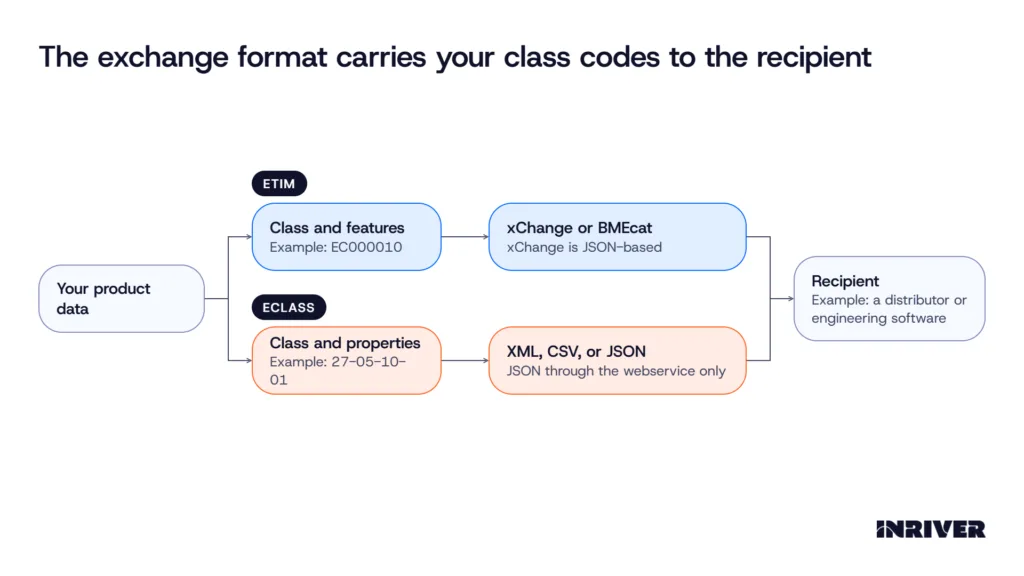
Some countries still use national formats alongside xChange or BMEcat, and ETIM announced xChange version 2.0 in November 2025.
The Digital Product Passport adds a further recipient of structured product data, and the European Commission describes it as a digital container for products, components, and materials that stores information on sustainability, circularity, and legal compliance. ECLASS states that its standard already offers a manufacturer-independent and cross-industry way to describe products for the passport, and it extended its material declaration aspect in release 16.0 to all classification classes except services.
How does a PIM platform support ETIM and ECLASS classifications?
ETIM’s guidelines state that building its structure into the product information management systems of international companies gives suppliers and wholesalers a way to standardize their data flow and exchange product information between countries, and a PIM supports ETIM and ECLASS in four ways.
- Content from classification standards reaches a PIM as files, such as ETIM’s IXF files and ECLASS’s CSV or XML files, and the ECLASS web service can bring release updates straight into a PIM.
- ETIM’s rules shape how a product record is filled in, since a feature’s unit and value list depend on its class, and a feature that does not apply stays blank.
- Release changes come with files that mark what is new, changed, or deleted, including the markers in ETIM’s IXF files and the TUF and CUF files that ECLASS says enable automatic migrations.
- Classified data leaves the PIM in the formats recipients use, with an xChange validation tool and a BMEcat certification tool from ETIM International to check it, and a community directory of software providers that support ETIM.
If your product data comes from an ERP, a PLM system, and supplier files, and it has to reach distributors, marketplaces, and your own channels in different formats, a PIM for manufacturers gives you one governed place to coordinate that flow.
Schedule a demo with an Inriver expert to learn how your product data can reach each recipient in their expected format.
Ready to see Inriver in action?
Inriver transforms the way your business thinks about product data. Let an Inriver expert explain the many benefits of the enterprise-ready, fully adaptable Inriver platform.
- Get a personalized, guided demo of the Inriver platform
- Have all your PIM questions answered
- Free consultation, zero commitment
Thanks for choosing Inriver! We’ll be in touch soon.
Please try again in a moment.