Can consistent product data still be wrong?
November 2, 2026Could AI be repeating the wrong product information? Consistent product data doesn't guarantee correctness. Join Inriver's masterclass to examine AI content restrictions, verification, and human approval.
Yes, consistent product data can still be wrong because agreement across channels doesn’t prove accuracy. AI shopping assistants and answer engines trust brands that keep messages consistent across every channel, so they repeat a wrong size, ingredient, or safety warning with full confidence once every channel shows it.
For instance, a product tested for a maximum load of 120 kg can carry a wrong value of 150 kg that starts in your PLM, moves into your ERP and PIM, appears on retailer websites, and reaches an AI assistant that quotes it. Every source in that chain agrees with the others, so the AI treats your brand as the authority on a load rating that buyers rely on.
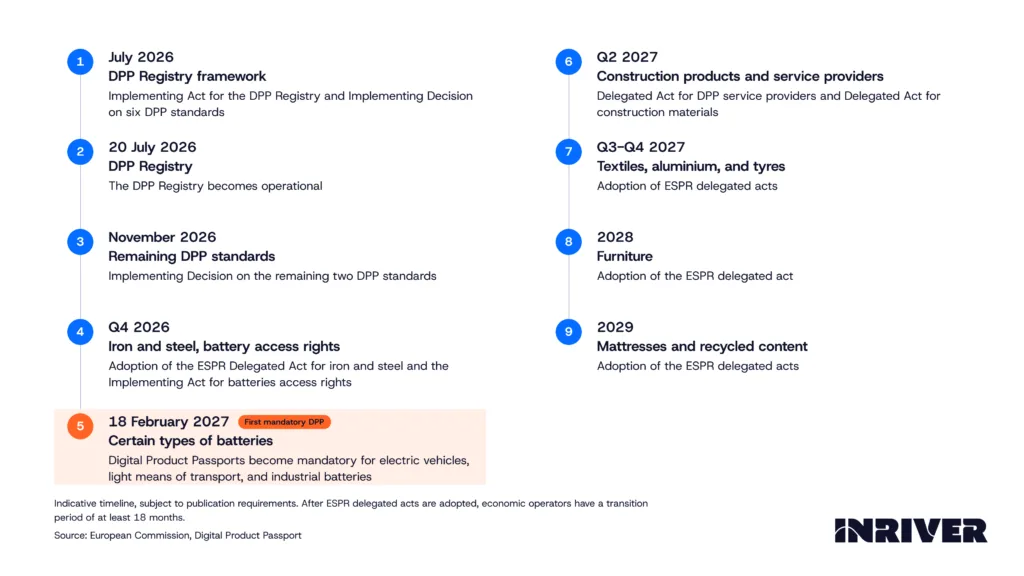
Today, wrong product data can mean fines or losing access to a market, with the first Digital Product Passports becoming mandatory for certain product categories on February 18, 2027. At the same time, generative AI adds to that exposure, since it can generate claims that breach industry regulations and write more of your product content, so one inaccurate detail can reach every channel at once.
In this article, we’ll discuss what separates consistent product data from correct product data, how a wrong value travels from your PLM to your ERP, PIM, and retailer channels; what the shift from returns to fines means for your team; and how you can verify your published product data against its source.
- What separates consistent product data from correct product data
- Why wrong product values appear in the gaps between your systems
- Why AI trusts product data that match across your channels
- From returns to fines: the new cost of wrong product data
- How to check your published product data against your approved record
- FAQs
What separates consistent product data from correct product data
Consistent and correct product data differ in definition, measurement, and outcome, and the table below sets them side by side.
| Consistent product data | Correct product data |
|---|---|
| Product attributes are identical across your brand site, retail partners, and distributors. | The specifications, dimensions, claims, and product images an AI engine uses match your approved record. |
| A consistency score measures agreement between channels. | A correctness score measures the share of published critical values that match the source and the share of values generated rather than inherited, along with how quickly a corrected value reaches every channel. |
| Gets you found. | Keeps you in the market. |
Syndicating the same wrong value to every retailer produces a high consistency score and builds solid trust on bad data.
Why wrong product values appear in the gaps between your systems
Each system in your product data flow is right about its own part of the product, with engineering specifications in your PLM, commercial and operational data in your ERP, and the story and assets in your content platforms. None of them assembles the full product the way a buyer, a retailer, or an AI assistant sees it, so wrong values appear in the gaps between them.
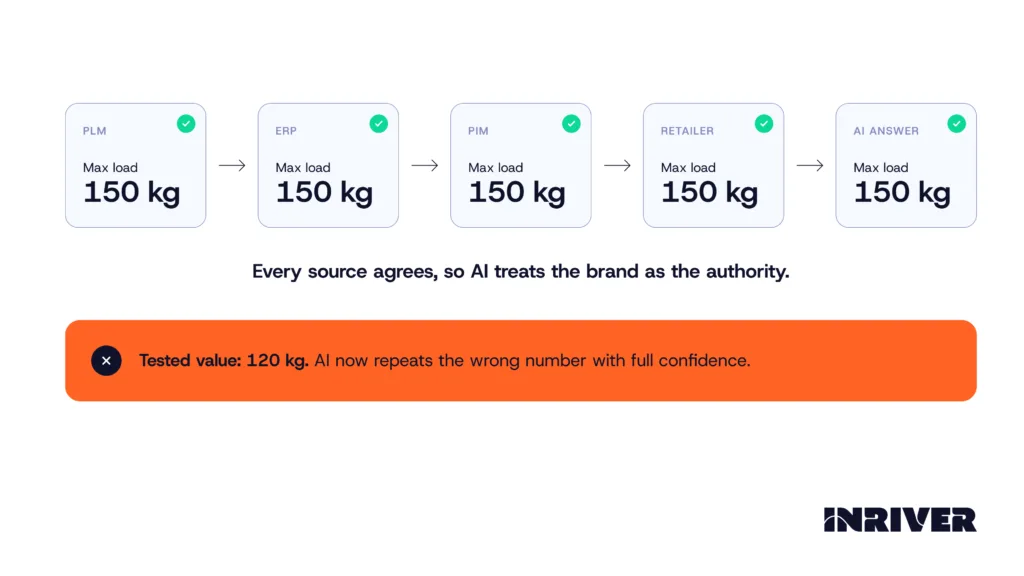
One gap opens when a spec updated in your PLM never reaches the listing, and another opens when nobody checks a marketing claim against the spec. The same product can also carry different dimensions, classifications, materials, or claims across your ERP, PLM, PIM, supplier sources, product pages, retailer listings, and distributor content. AI engines pull from all of them, so conflicting specifications can lower confidence in an answer.
Why AI trusts product data that match across your channels
Answer engines cannot inspect a physical product, so they corroborate, and the strongest signal they find is the same value on a brand site, three retailers, and a marketplace.
Message consistency is one of the five dimensions of AI visibility, and Steve Vink, Business Solutions Architect at Inriver, calls it the most underestimated. A single specification contradiction on a primary channel caps your score, and a competitor with cleaner distributed data wins that query regardless of product quality.
Inriver’s research also shows a gap between self-assessment and measurement: about 30% of manufacturers say they are fully ready for AI-driven discovery, while the share measured in practice is closer to 10%.
From returns to fines: the new cost of wrong product data
A Digital Product Passport is a digital container that holds information about products, components, and materials. It becomes mandatory only when a product-specific delegated act under the Ecodesign for Sustainable Products Regulation (ESPR) or another EU law requires it. Once such a requirement is in place, you cannot place covered products on the EU market or put them into service unless they comply with the relevant ecodesign and information requirements. National authorities enforce these requirements and can impose penalties under EU regulations.
Additionally, the European Commission provides an indicative timeline for these requirements, which is subject to publication requirements. Economic operators will have at least 18 months to transition after the ESPR delegated acts are adopted.
A digital data carrier connects each product to its passport, enabling public authorities to scan, verify compliance, and support market surveillance.
How to check your published product data against your approved record
Every consistency measure needs a correctness check next to it, and you can run that check on your critical attributes in six steps.
- Choose your critical attributes. Pick the five or ten attributes you would least like to get wrong, including allergen, voltage, IP rating, or age range.
- Name an owner for each one. Ownership works best per attribute and not per system, so engineering signs off the IP rating, compliance signs off the safety warning, and marketing owns the description.
- Find the system that holds the true value. Your team needs to confirm which approved system supplies each value before any comparison makes sense.
- Compare your top three channels against the approved record. Check the values each channel publishes against the values in that record. On the product page that matters most, open the structured data (schema.org markup) and compare five critical values with your source.
- Flag generated values. Mark every published value that your team or a model generated rather than inherited from the source.
- Repeat the check on a fixed schedule. Run the comparison again at regular intervals on the channels that matter most to you.
Inriver Digital Shelf Analytics provides insights into how your products appear on retailer and marketplace listings after launch. It also shows whether each listing’s content aligns with your approved records. Monitoring shows where wrong values already appear, and AI-generated content calls for guardrails of its own.
Join Inriver’s free Masterclass Episode 3, “From Consistency to Correctness,” to learn what AI may generate, what must be blocked, what needs human sign-off, and how the model you choose can change your data.
The online session takes place on Tuesday, December 1, 2026, at 15:00 CET / 9:00 AM EST with Steve Vink and Joakim Gavelin, and it works whether or not you run a PIM. Register for free to get the recording, and join live to receive the AI guardrails checklist.
See the Inriver PIM in action
Inriver transforms the way your business thinks about product data. Let an Inriver expert explain the many benefits of the enterprise-ready, fully adaptable Inriver platform.
- Get a personalized, guided demo of the Inriver platform
- Have all your PIM questions answered
- Free consultation, zero commitment
Thanks for choosing Inriver! We’ll be in touch soon.
Please try again in a moment.