How do you avoid publishing incorrect AI-generated product content?
November 23, 2026AI-generated product descriptions and technical claims require different controls. Join Inriver's masterclass to examine how model behavior and source verification affect product content accuracy.
Register for freeTo avoid publishing incorrect AI-generated product content, you need to establish guidelines for how AI can interact with each type of data. Every generated value should be checked against its source before it is published. While AI may rephrase sentences around a specification, it cannot alter or write the specification itself. This means that critical information such as safety ratings, allergens, certifications, and dimensions must remain unchanged. Environmental and health claims require approval from a designated individual, while descriptions and bullet points are generated and verified automatically.
Because consistent product data can still be incorrect, every value needs a check, but the volume generated by AI makes it impossible for a team to review each item individually across a catalog of 50,000 SKUs.
Therefore, you need to rely on established rules for sorting, allowing automatic checks to filter the majority of content. Only flagged items and content requiring sign-off will be passed on to a person for review.
The stakes are rising. When AI repeats the same wrong size, ingredient, or safety warning on every channel, it does so with full confidence.
With the first EU Digital Product Passport arriving in February 2027, a wrong value that once meant a return can now mean fines or losing access to a market.
In this article, we’ll discuss what AI may write in product content and what it cannot modify. Additionally, we’ll outline the five checks to perform before publishing generated content and explain why these checks need one place where generated content and source data from your ERP and PLM can be compared.
Want to see this framework applied live? Steve Vink and Joakim Gavelin will walk through it in Inriver’s free Masterclass on December 1, 2026. Save your seat.
Joakim Gavelin, Senior Principal Advisor at Inriver, on what the Masterclass covers
What AI may write in product content, and what it may not change
AI may phrase a fact from your approved record but may never invent one. The product data behind an AI answer determines whether your product appears in it, which makes accuracy a matter of AI visibility.
On a product page, the rule means AI can rewrite the sentence around a specification and cannot write or change the specification itself, and three lanes apply it to your content.
| Lane | Product content | What AI does |
|---|---|---|
| Generate at scale | Descriptions, bullet points, SEO copy, channel variants, and marketing translations that use an approved glossary | Writes and rewrites freely, then the output is checked automatically against the source |
| Blocked | Safety ratings, allergens, hazardous substances, certifications, dimensions, voltages, and age ranges | Reuses the value from the source and never creates or changes it |
| Human sign-off | Environmental and health claims (“recyclable,” “safe for children”), translated regulatory text, and first content for a new market | Drafts, then waits for an owner to approve |
Blocked is the strictest form of AI content control, because these are facts with an owner and the only place a value may come from is the source. The first lane covers wording for facts your record already holds, and copy that needs facts the record does not hold waits for a person’s approval before publication.
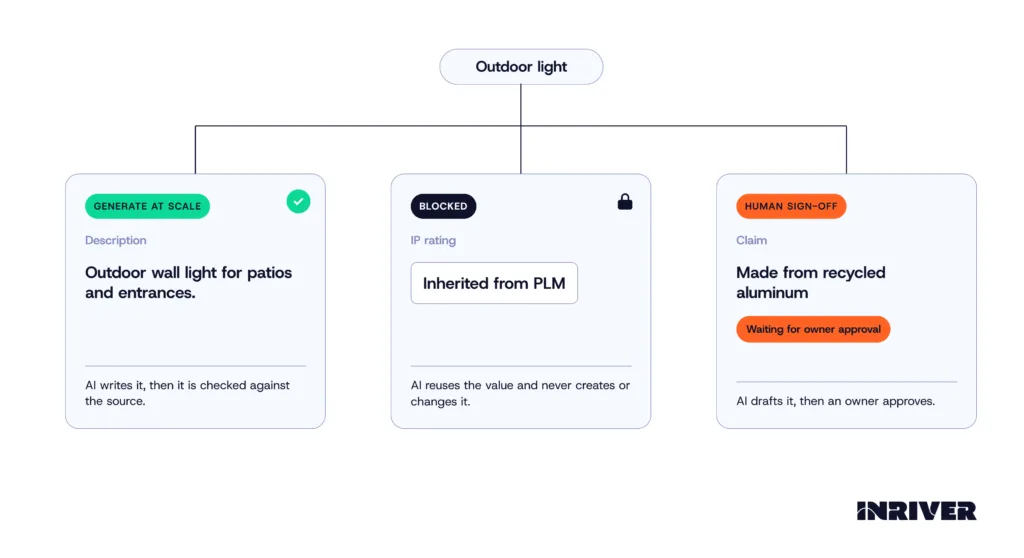
In the example below, an outdoor light shows how the three lanes divide one product page: the description is generated, the IP rating is blocked and inherited from the PLM, and the “made from recycled aluminum” claim waits for sign-off. Without the block on the rating, a model that reads “garden” and “outdoor” can add “fully waterproof” to the description, which nobody on your team wrote and which syndication then sends to every retailer.
How to check AI-generated product content before it’s published
The model you choose is part of the check. According to Steve Vink, Business Solutions Architect at Inriver, models differ in how often they fill gaps with invented detail, in which languages they handle well, and in safety rules built into the model that you cannot see. He adds that the choice matters more than most teams expect, and the five steps below reflect that. He will go deeper into how the model shapes the result, and which safeguards that requires, in the Masterclass on December 1.
- Lock the blocked lane. Set up your workflow so no model can write to the blocked attributes, which means safety ratings, allergens, hazardous substances, certifications, dimensions, voltages, and age ranges reach the page only as values inherited from the source.
- Give the model an approved term list. Supply the colors, materials, and product names your team has approved, and check every output against that list.
- Test each model per language and category. Run a fixed set of products in every language and category you publish before you trust a model with that content, and run the same set again whenever the model or its version changes, because a model update changes the system you validated and the AI autonomy you granted, so the workflow needs a fresh review.
- Compare every generated value with its source. Before anything is published, check each generated value against the value in your approved record, which is the verification step.
- Send flagged items and sign-off content to the owner. Let the automatic checks clear the bulk, and route only flagged items and sign-off content to the person who owns that attribute, so people review exceptions and not volume.
Steps 4 and 5 work only when the generated copy and the source values can be compared in the same place.
Why generated product content needs one place to check before publishing
To compare generated content with its source, you need both in one place, and your PIM, ERP, and PLM each hold a different part of that comparison. The PLM holds specifications and compliance documentation, the ERP holds transactional, SKU-level data, and the PIM manages the content that moves out to channels, with the PLM feeding specifications into it. You can then compare a generated description with its specification values, and a generated claim with the compliance documentation behind it.
Additionally, the comparison catches errors most reliably on structured attributes, where a wrong value is clearly defined, so your AI enrichment is only as reliable as the data model behind it. Keeping technical specs accurate starts with one owner and one source for every attribute, and that same pairing tells the check where to send a flag, whether to engineering for an IP rating, to compliance for a safety warning, or to marketing for the description.
Running the approved record, the AI generation step, and approvals in one governed flow turns these checks into guardrails for how content moves to your channels, so they don’t become a separate review queue and each flag reaches the owner who can resolve it.
The three lanes and five checks tell you what AI may touch and how to verify it. To go further, join Inriver’s free Masterclass Episode 3, “From Consistency to Correctness.” Steve Vink, Business Solutions Architect, and Joakim Gavelin, Senior Principal Advisor at Inriver, will cover how AI can treat your brand as the authority even when your data is wrong, how the model you choose shapes the result, and where AI visibility and compliance readiness overlap and where they don’t.
The online session takes place on Tuesday, December 1, 2026, at 15:00 CET / 9:00 AM EST / 8:00 AM CST and works whether or not you run a PIM. Register for free to get the recording, and join live to receive the AI guardrails checklist, which walks you through where your product data comes from, what AI is allowed to touch, and how you would know if something went wrong in your channels.
See the Inriver PIM in action
Inriver transforms the way your business thinks about product data. Let an Inriver expert explain the many benefits of the enterprise-ready, fully adaptable Inriver platform.
- Get a personalized, guided demo of the Inriver platform
- Have all your PIM questions answered
- Free consultation, zero commitment
Thanks for choosing Inriver! We’ll be in touch soon.
Please try again in a moment.