What does “AI-ready product data” actually mean? (It’s more than clean data)
October 16, 2026AI-ready product data requires more than accurate values. Learn how defined attributes, product relationships, validation rules, and channel requirements make information usable for AI.
AI-ready product data means product data your AI can read, connect, and check against a rule. Clean data gives you accuracy, consistent formatting, and no duplicates, all of which matter, though none of it tells an AI what an attribute means, which products belong together, or what a particular channel requires before publishing.
Picture a record where the material reads “stainless steel” in a field named spec_3, carrying no unit, no allowed values, and no link to the finish options the product ships with. Nothing about that record is dirty, yet your AI still writes vaguely from it, because your data model never defined what it was looking at.
Below, you will see what separates the two, who in your organization creates AI-ready data, and how to keep it that way across every channel you sell through.
Compare clean product data against AI-ready product data
Clean data describes the condition of your values, while AI-ready data describes the structure around them. Run the same product through both standards, and the difference becomes obvious.
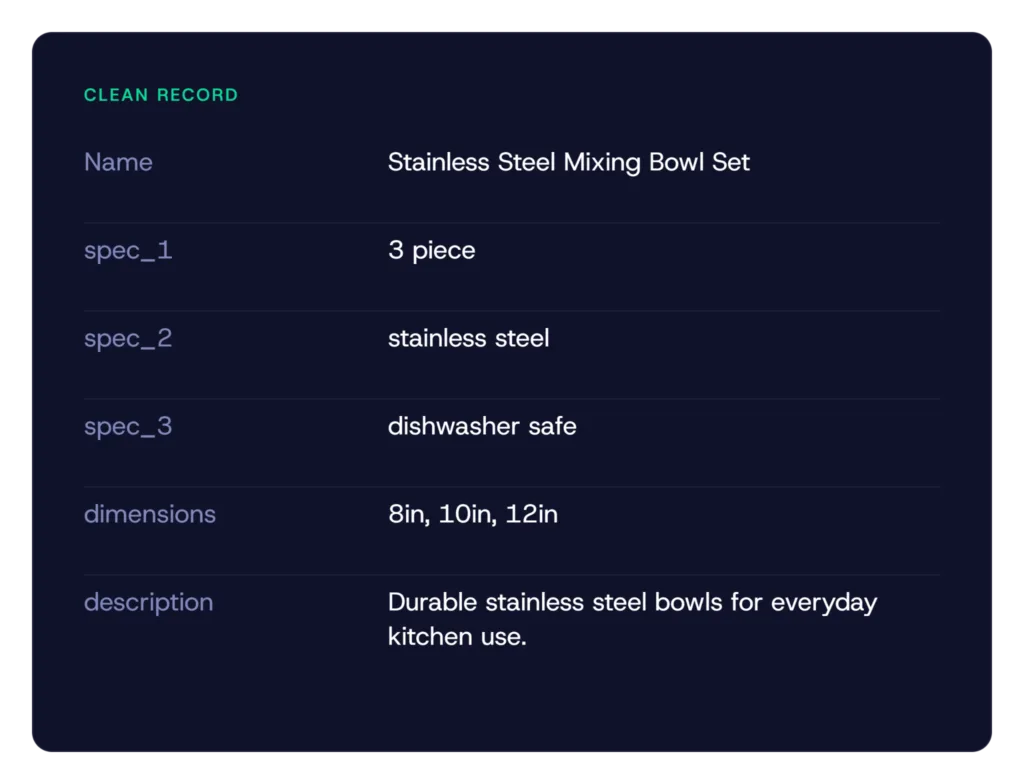
Every value above is accurate, correctly spelled, and free of duplicates. Your AI reading the same record has no way to tell whether spec_1 counts pieces or inches, whether 8in refers to diameter or height, or which bowl in the set each measurement belongs to.
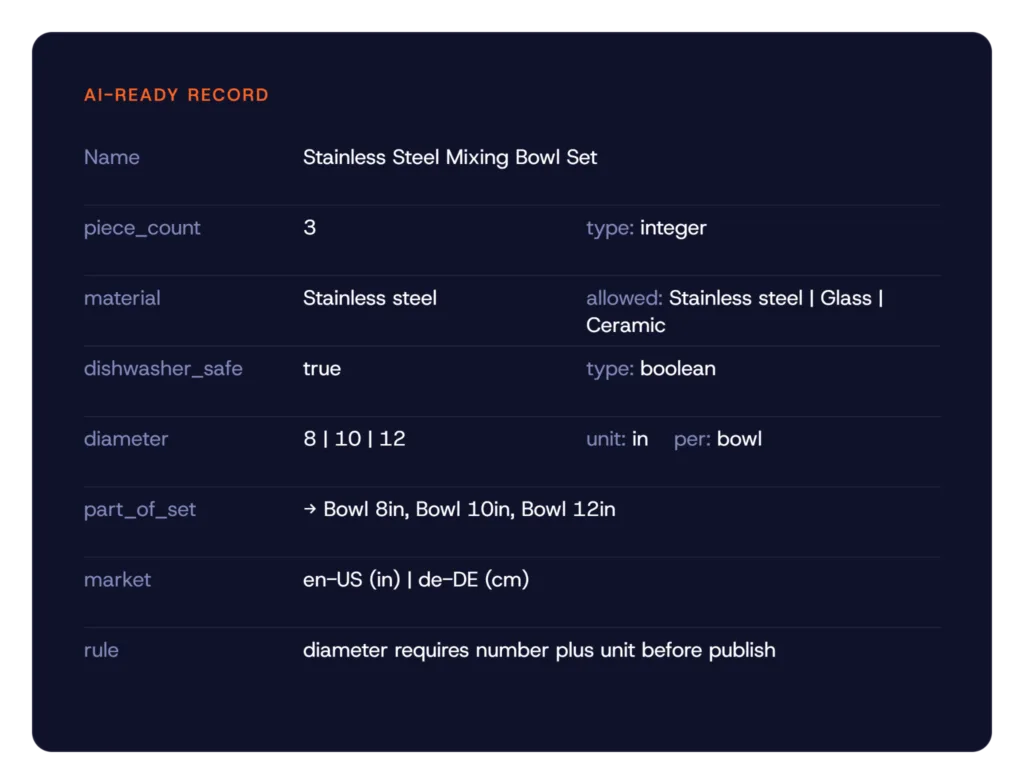
Same product, same underlying facts, and now your AI knows that 8 means diameter in inches, that three separate bowls make up the set, that German listings need centimeters, and that a missing unit blocks publication. Ask for a description, and you get specifics instead of adjectives.
Four changes occurred between those records, each essential for your AI.
- Defined attributes. Every field carries a name describing what it holds, a type, and where sensible, a list of allowed values. Your AI stops guessing at spec_3 and starts reading dishwasher_safe.
- Relationships. Set membership, compatibility, accessories, and replacements become links between records rather than sentences buried in free text. Your AI can follow a link, though it cannot reliably parse intent from a paragraph.
- Market and channel requirements. Units, language, and regulatory fields differ by destination, so your model stores those differences rather than forcing one listing to serve every market.
- Traceable rules. Validation decides what a complete record looks like before anything publishes, so you can check AI output against source values instead of trusting it.
Notice that cleaning the first record would not produce the second. You can correct every typo in spec_3, and the field still fails to tell your AI anything, because AI accuracy depends on how your model defines meaning, not on how tidy the values are.
Who creates AI-ready product data?
The people who already own each part of your product record create AI-ready product data, working to a model someone deliberately designed. No single team produces it alone, since the knowledge needed for one record usually spans engineering, merchandising, compliance, and whoever runs your PIM.
Three decisions determine whether your data turns out AI-ready, and they rarely belong to the same person.
- Someone designs the model. Deciding which attributes exist, what each one means, which values it accepts, and how records relate to each other shapes everything downstream. Design work usually involves your PIM team together with an implementation partner, informed by what the business actually sells.
- Someone supplies the values. Engineering provides specifications, suppliers provide their own data, merchandising provides positioning, and compliance provides regulatory fields. Each group answers for accuracy within its own fields.
- Someone enforces the standard. Validation rules, required fields, and approval gates turn the agreed model into something that holds up when a rushed launch tempts everyone to skip steps.
A workable ownership map assigns every field group to exactly one accountable team. Shared ownership of a field tends to mean nobody fixes it.
| Field group | Who owns it | What they decide |
|---|---|---|
| Identifiers and classification | PIM or data team | Naming conventions, category structure, which identifiers are mandatory |
| Technical specifications | Engineering or product management | Attribute definitions, units, tolerances, allowed values |
| Compliance and regulatory | Compliance or quality | Which markets require which fields, and what counts as evidence |
| Marketing content | E-commerce or brand | Tone, claims, differentiators worth storing as structured fields |
| Channel requirements | Syndication or channel managers | Per-channel mandatory attributes, formats, and limits |
| Relationships and hierarchy | PIM team with product management | Variants, kits, accessories, replacements, compatibility |
Two things usually go wrong here. Attribute design gets treated as a technical task and handed entirely to whoever configures the system, producing a model that matches the software rather than your business. Alternatively, nobody owns relationships, so compatibility and variant structure end up described in free text that your AI cannot follow.

How do you maintain AI-ready product data across every channel?
Keeping product data AI-ready across channels means maintaining one governed record and letting each channel pull what it needs, rather than maintaining separate versions for each destination. Channels disagree on required fields, formats, title lengths, and units, so a record edited separately in five places can drift out of agreement within a quarter.
The GS1 Global Data Model takes the same position, defining one consistent set of product attributes for worldwide exchange so you can list a product in a given market without rebuilding its data for each trading partner.
Four practices keep that single record trustworthy as products, markets, and channel rules change.
1. Validate at intake rather than at publish
Catching a missing unit or an unmapped attribute when data arrives from a supplier or an upstream system costs far less than catching it after a channel rejects the listing.
2. Store channel requirements as mappings, not as copies
Each channel gets a mapping from your attributes to its field names, formats, and limits, which means a change to the underlying value updates everywhere at once.
3. Review the model on a schedule
New product lines, acquisitions, and regulations introduce attributes your original design never anticipated, so your model needs room to absorb those changes without a rebuild.
4. Check AI output against source fields
Generated content stays trustworthy only if you compare it to the source values before publication.
Inriver handles those practices inside the platform. Its Spring 2026 release added unstructured data onboarding, letting teams ingest content from PDF, Excel, Word, or PowerPoint directly into Inriver, where AI-powered extraction, transformation, and field mapping do the heavy lifting while a final human review step keeps teams in control before data gets committed.
The same release added API connectivity for automated imports from upstream PLM, ERP, supplier portals, and partner feeds, with AI-based data mapping and validation catching quality issues at intake. On the outbound side, Syndicate Advance gained direct API connections to Home Depot, Perigold, Walmart, and Wayfair, with built-in validation that prevents rejections.
Inriver Inspire also supports documents as context for its AI, so generated product content draws on technical specs, compliance documents, and installation guides alongside the text and images already in your records.
Start with one product category
Pick the category where AI enrichment currently disappoints you most, then open ten records and check whether each attribute has a defined type, a unit, and a list of allowed values. Ten records will tell you quickly whether your problem is cleanliness or structure, and the answer decides what to fix.
Readiness arrives attribute by attribute rather than through one catalog-wide project, so the category you fix first becomes the template for everything after it.
Learn how Inriver can help you structure your product data for AI; schedule a demo today.
Ready to see Inriver in action?
Inriver transforms the way your business thinks about product data. Let an Inriver expert explain the many benefits of the enterprise-ready, fully adaptable Inriver platform.
- Get a personalized, guided demo of the Inriver platform
- Have all your PIM questions answered
- Free consultation, zero commitment
Thanks for choosing Inriver! We’ll be in touch soon.
Please try again in a moment.