AI product data enrichment software: A simple guide
Scale product content with AI and PIM
Understand how AI enrichment depends on governed product data. Read the State of AI in PIM report to see how teams are applying it.
Half of all consumers now use AI when searching the internet, according to McKinsey’s “The agentic commerce opportunity: How AI agents are ushering in a new era for consumers and merchants” report, and that shift is creating new pressure on the product data behind every search result, every channel listing, and every buying decision. Managing that data manually across hundreds or thousands of SKUs no longer scales.
AI product data enrichment software exists to close that gap, automating the work of filling, standardizing, and distributing product content across channels. This article walks through what the technology does, why it matters for commerce teams, and what to look for when evaluating your options.
What is AI product data enrichment software?
AI product data enrichment software is a category of tools that uses artificial intelligence to automatically complete, improve, and standardize product information at scale.
Instead of relying on your teams to manually fill in attributes, write descriptions, or tag images one SKU at a time, the software pulls structured data from raw inputs, like supplier files, images, or existing catalog records, and outputs clean, channel-ready product content.
The core capabilities typically cover five areas:
- Attribute extraction pulls product details like dimensions, materials, or specs directly from unstructured sources like PDFs or manufacturer data sheets.
- Data standardization maps inconsistent supplier inputs to a uniform format that your catalog and downstream channels can use.
- Image tagging analyzes product photos and automatically assigns relevant attributes, labels, or alt text.
- Validation checks existing records against defined rules and flags incomplete or inconsistent content before it reaches a sales channel.
- Content generation uses AI to produce product titles, descriptions, and marketing copy directly from structured attributes.
Key benefits of using an AI product data enrichment software:
- Faster time to market
- Fewer errors reaching customers
- Consistent product content across channels
- Reduced manual workload for your teams
Why it matters for modern commerce
Incomplete product data has a direct line to lost revenue, and the math is straightforward. If your buyers can’t find the information they need at the point of decision, they either abandon the purchase or buy and return. Returns driven by inaccurate or missing product descriptions cost retailers and brands in terms of margins, logistics, and customer trust.
Channel inconsistency compounds the problem. A product description that reads differently on your website than it does on a retailer portal or marketplace confuses buyers and signals to channel algorithms that your data is unreliable, hurting both your product’s discoverability and conversion.
The more channels you sell on, the harder it becomes to manage without a structured approach to product content creation, and most catalog teams are already stretched thin.
Compliance pressure is adding urgency that wasn’t there two years ago. The EU Digital Product Passport, part of the EU’s Sustainable Products Regulation (ESPR), will require brands to attach structured, verified data covering materials, sourcing, repairability, and environmental impact directly to individual products.
Meeting that requirement manually across thousands of SKUs isn’t realistic for most teams, and the brands that already maintain clean, governed product data will have a significant head start over those still working from inconsistent supplier files and spreadsheets.
What’s changed is that AI-driven commerce has raised the stakes on all of these problems simultaneously. Agents and AI-powered search tools now filter and rank products based on data completeness and structure, which means poor product data no longer just affects your conversion rate. It affects whether your products surface at all.
How AI changes the enrichment process
According to McKinsey’s report titled “The Economic Potential of Generative AI,” it is estimated that current AI technologies could automate tasks that take up 60 to 70% of employees’ time.
One clear example of where this time is spent is in product data enrichment. For most catalog teams, a significant portion of the working week is spent in spreadsheets, supplier files, and manual content tasks that AI can now handle in a fraction of the time.
| Before AI enrichment | After AI enrichment | |
|---|---|---|
| Attribute extraction | Team manually pulls specs from supplier PDFs, emails, and data sheets, one product at a time | AI extracts structured attributes automatically from unstructured sources across thousands of SKUs simultaneously |
| Categorization | Products are sorted manually into categories, often inconsistently across team members | AI maps products to the correct categories based on attributes and defined taxonomy rules |
| Content creation | Copywriters or data managers write descriptions individually, often from scratch | AI generates titles, descriptions, and marketing copy directly from structured product attributes |
| Error detection | Errors surface after products go live, caught by channel rejections or customer complaints | AI validates records against defined rules in real time and flags issues before syndication |
| Scale | Output is limited by team size and working hours | Enrichment runs continuously across the full catalog regardless of SKU volume |
The transition is not just about speed. AI can enrich data on a scale that your team cannot replicate manually. It also frees your team from tedious spreadsheet tasks, allowing them to focus on activities such as review, governance, and important decision-making that truly require human expertise. This is the purpose of AI-powered product enrichment tools.
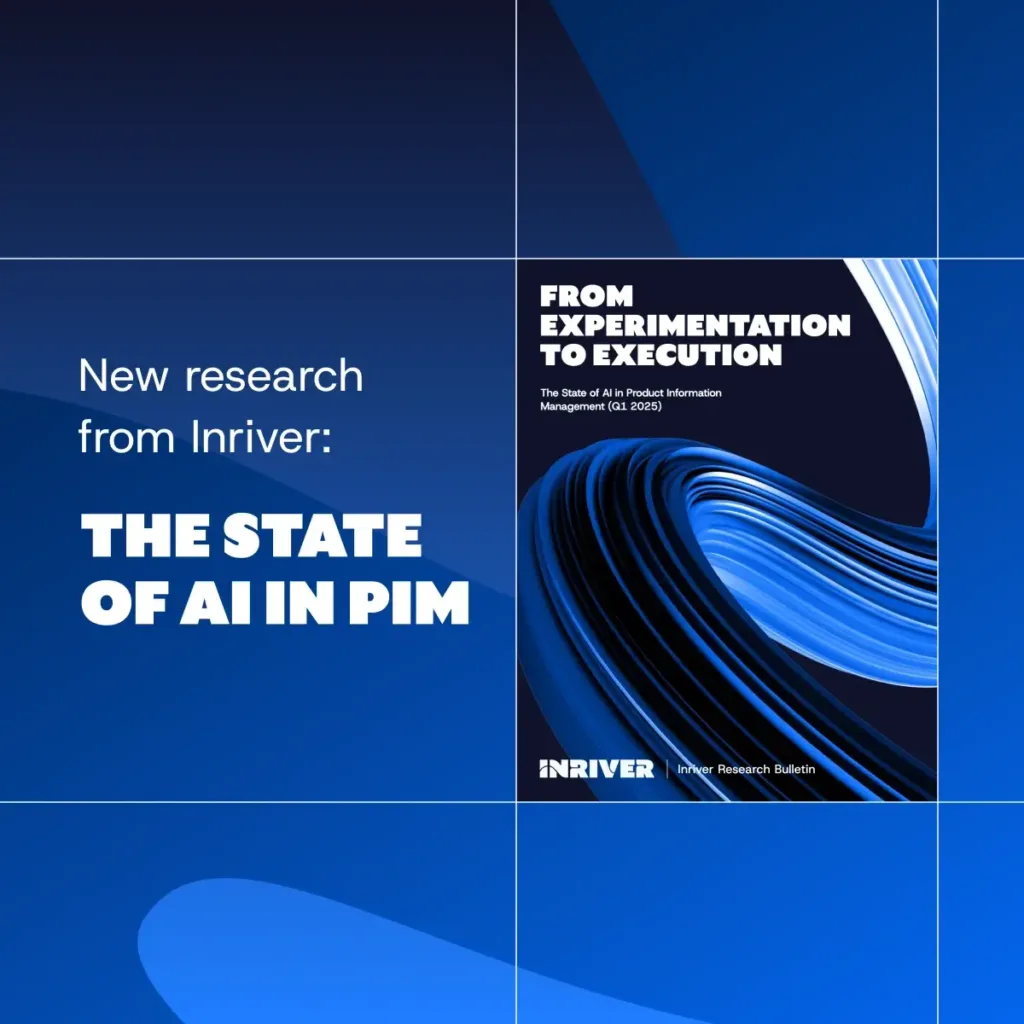
AI enrichment accelerates product onboarding and content creation, yet results depend on product data structure and governance. Explore what Inriver’s research reveals about AI adoption in PIM.
What to look for in the right solution
Before committing to a platform, evaluate it against these criteria to ensure it can support your team’s working methods and the scale you aim to achieve.
1. Native PIM integration
AI enrichment only works well when it pulls from and writes back to a clean, centralized data source. Look for a solution with a structured integration framework that connects to your existing systems without requiring custom builds for every new touchpoint. Inriver’s Integration Framework uses standard, pre-configured components to build integrations and adapters to systems like Salesforce Commerce Cloud and Magento, reducing development effort and accelerating delivery.
2. Multi-channel and multi-language support
Your product content needs to meet the specific requirements of different marketplaces, retailers, and geographies rather than being pushed out uniformly. Inriver’s omnichannel syndication supports both first-party and third-party selling models, including Amazon content patching for 3P scenarios that let brands update product detail page elements such as titles, bullets, specifications, and images, even when they are not the seller of record. Global coverage for Vendor Central content means the same streamlined workflow applies across all regions.
3. Data governance built in
AI enrichment without governed data produces inconsistent outputs at scale. Look for a platform that consolidates structured and unstructured product data into a single, extensible data model with clear access controls and compliance capabilities. Inriver’s product data governance solution is SOC2-compliant, hosted on Microsoft Azure, and built around a fully extensible data model that supports ongoing complexity from new products, ranges, and brands.
4. Scalability without a rebuild
Your catalog will grow, and your platform needs to grow with it. Inriver’s configurable data model supports catalogs of up to 90,000 SKUs, and customers report cutting the FTEs required to manage data enrichment by half as volume increases. The platform’s flexible data model also lets you reflect complex relationships between products and content, including compatibility rules, ingredient relationships, and component structures, directly in downstream channels without costly custom builds.
5. Collaboration and workflow features
AI handles the volume, but your team still needs to review outputs, approve content, and manage exceptions across roles, regions, and experience levels. Inriver’s new task- and role-focused UI surfaces the most relevant entities, actions, and information based on what a user is responsible for at a given moment, with collaborative workflows that provide structure around priorities, ownership, and next steps. New users onboard faster through guided walkthroughs and structured task flows, while experienced users navigate complex product data with less manual overhead.
6. Content distribution to external stakeholders
Enriched product data needs to reach distributors, resellers, and internal teams as reliably as it reaches your channels. Inriver’s Brand Store gives authorized users self-service access to accurate, approved product information through a secure, configurable web portal, with centralized user management, bulk access controls, and Single Sign-On support, eliminating the delays and errors that come with manual content requests.

Why PIM is the foundation for AI enrichment
The reliability of AI enrichment tools depends entirely on the quality of the data they utilize. Feed an AI model inconsistent, incomplete, or ungoverned product data, and the outputs will reflect exactly that, at scale and across every channel you syndicate to. A governed PIM becomes a necessary foundation for AI enrichment.
What PIM gives AI to work with:
- A single, verified source of product data drawn from ERP, PLM, and supplier systems
- A structured data model that AI can read, map, and generate content from consistently
- Governance controls that ensure outputs are tied back to approved, accurate inputs rather than generated in isolation
- Channel-specific formatting rules so enriched content meets the requirements of each destination before syndication
Where Inriver fits
Inriver Enrich sits at the heart of the Inriver PIM, consolidating data from ERP, PLM, and supplier systems into a single, governed environment where built-in AI enriches every SKU.
Standalone AI enrichment tools can generate content, but without a governing data model, there’s no reliable way to handle complex product relationships, channel-specific requirements, or compliance demands such as EU Digital Product Passports.
In Inriver’s “State of AI in PIM” report, this is identified as one of the key differences between teams that are gaining measurable value from AI and those that are still in pilot phases.
Getting AI and PIM integration right means enrichment outputs that are trustworthy enough to syndicate with confidence.
Fix the foundation, then let AI do the heavy lifting
Many teams don’t have a shortage of product data. What they have is a data quality problem, and throwing AI at it before addressing that won’t produce better results faster. It will produce worse results at scale. The right starting point is an honest audit of where your product data actually stands.
Three practical steps to get started:
- Audit your data quality first: Identify gaps, inconsistencies, or missing attributes across channels in your catalog. You can’t define priorities until you know where the problems are concentrated.
- Define your enrichment priorities: Not every SKU carries the same revenue weight. Start with the product categories that drive the most traffic, conversion, or return risk, and work outward from there.
- Choose a platform that integrates AI with governance: An integrated PIM with built-in AI enrichment provides a governed foundation that makes outputs reliable, consistent, and scalable from day one, rather than something you bolt on later.
See how Inriver handles enrichment at scale. Request a demo today and walk through it with a product specialist.
Ready to see these new innovations in action?
Inriver offers the most comprehensive PIM solution on the market, built for speed, scale, and complexity. Let an Inriver expert explain how the Inriver PIM can turn your product data flows into a sustainable revenue stream.
- Get a personalized, guided demo of the Inriver platform
- Have all your PIM questions answered
- Free consultation, zero commitment
Thanks for reaching out!
We’ll be in touch soon.
Please try again in a moment.