Using AI for product content creation: Benefits, risks, tools, and guidance
Turn AI into a content advantage
See how you can apply AI to product content creation with control, clarity, and confidence. Build faster workflows without losing accuracy or brand alignment.
Skip to:
- Product content creation AI: A revolution
- Why AI-driven content creation matters
- How AI content creation can help your business
- What risks to watch when using AI for content creation
- The best AI tools for product content creation
- How to start using AI tools for your product content
- AI is here. Get started with Inriver
- FAQs
The rise of AI-powered content is transforming how businesses approach product content strategy. Strong product content management keeps your inputs structured, outputs consistent, and teams aligned as you scale product content creation across channels.
McKinsey’s The state of AI in 2025: Agents, innovation, and transformation global survey shows how quickly AI is moving from experiments into day-to-day work: 88% of respondents say their organizations are regularly using AI in at least one business function, and common use cases include content support for marketing strategy, like drafting and idea generation.
Recent reports show that companies using AI-driven content creation are improving speed-to-market, reducing manual work, and strengthening customer experiences. Used well, AI tools in content creation help your team produce brand-compliant content generation at scale without losing control.
Product content creation AI: A revolution
McKinsey’s survey shows that knowledge management and marketing are among the business functions with the highest reported AI usage, driven largely by content drafting, idea generation, and information delivery.
At the same time, only around one-third of organizations have moved beyond pilots and begun scaling AI across workflows, highlighting a clear execution gap. That gap is especially evident in product content creation, where volume, update frequency, and channel variety place constant pressure on teams.
Many businesses already apply AI-powered content to:
- Generate product description drafts faster using structured inputs.
- Support personalized product messaging across regions and channels.
- Assist with the creation of image and visual content at scale.
These use cases explain why product content is often one of the first areas where AI moves from experimentation into production. Language-based tasks adapt well to automation, particularly when content needs to be reused and localized.
However, scale introduces complexity. As AI-driven content creation expands, managing updates, approvals, and distribution across systems becomes harder without tight coordination. Integrations play a critical role here. Connecting AI outputs to commerce and content systems through Inriver’s integration ecosystem helps keep product information aligned from creation through publication.
Why AI-driven content creation matters
Your customers expect accurate, relevant product information wherever they shop. They specify visuals and messaging across marketplaces, brand sites, and retail platforms in seconds. Gaps in product content show up immediately as missed visibility, lower confidence, or lost conversions.
AI-driven content creation helps you address these issues by accelerating how product information is created and adapted across channels. Instead of relying on manual updates or fragmented workflows, teams use AI to keep content current, relevant, and aligned as demands increase.
Used with clear intent, AI helps you:
- Produce product content faster without starting from scratch. Drafts, variations, and updates move more quickly when AI supports repeatable tasks.
- Adapt content across channels and audiences. Messaging adjusts to language, location, and context without duplicating effort.
- Improve performance where content influences decisions. Relevant, consistent product information supports engagement and conversion across digital touchpoints.
As product catalogs expand and update cycles shorten, manual processes struggle to keep pace. With AI-powered content, you can increase your output while reducing dependency on one-off fixes and reactive updates.
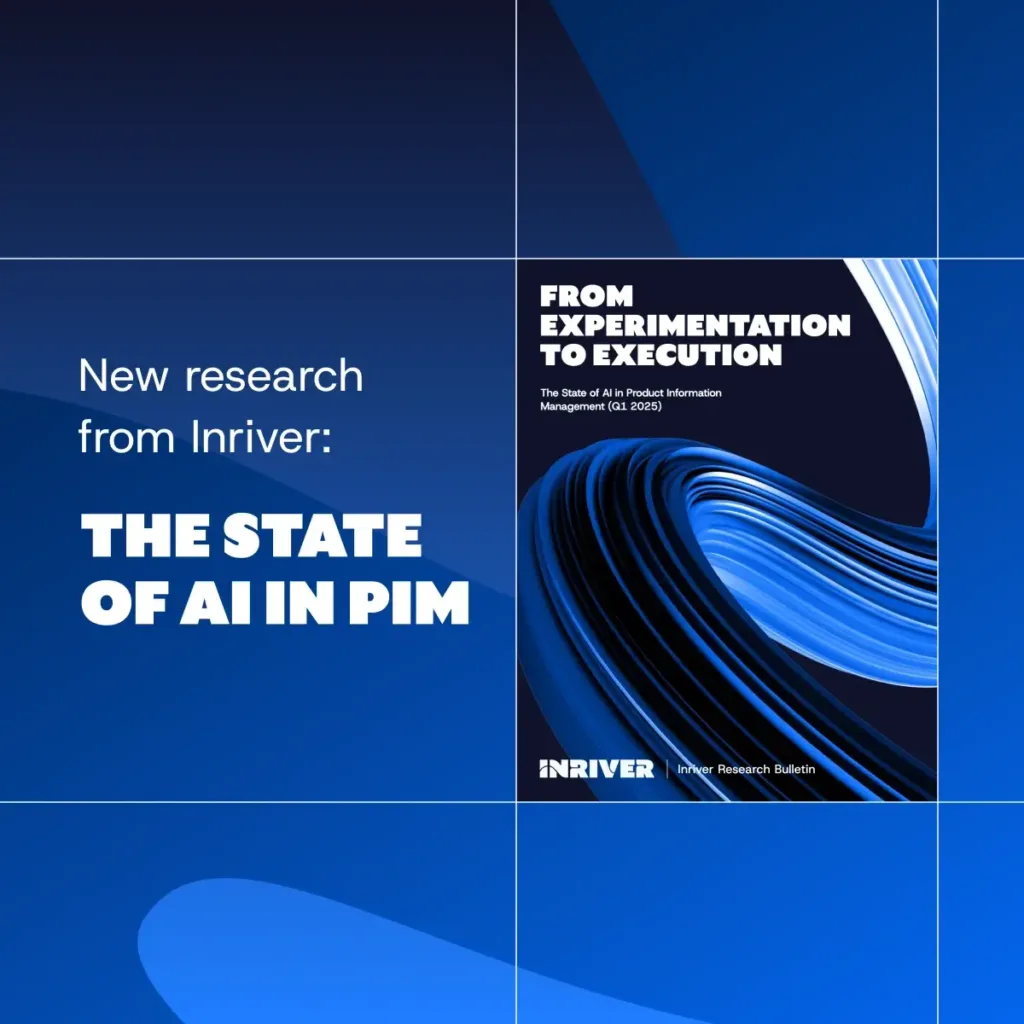
How AI is reshaping PIM today
AI is already changing how we manage, enrich, and deliver product information. Is your business ready for 2026 and beyond?
Find out with Inriver’s latest AI in PIM research paper.
How AI content creation can help your business
Business value from generative AI shows up when the technology is applied to specific use cases that change how work gets done. McKinsey’s analysis of 63 enterprise use cases shows that marketing productivity can improve by 5-15%, driven largely by content drafting, adaptation, and personalization, while sales productivity increases by 3-5% through faster preparation and more relevant messaging.
At the activity level, generative AI can automate or accelerate 60-70% of language-based work, including creating, updating, and tailoring product content across channels. For businesses, this translates into faster content cycles, reduced manual effort, and more consistent execution wherever product data supports digital commerce.
Used correctly, AI-generated content strengthens execution without weakening control. Inriver’s AI-powered content creation in action shows how this balance plays out across real product workflows.
Scaling content production without losing quality
Content teams spend significant time drafting, reworking, and standardizing product information. AI reduces this load by accelerating first drafts and producing consistent outputs when inputs are well-defined.
Applied to product content creation, AI helps teams:
- Generate draft content faster from structured product data.
- Reduce rework caused by incomplete or inconsistent information.
- Maintain language and formatting standards across channels.
However, quality doesn’t scale automatically. Clear rules, governed data, and review steps remain essential as output increases.
Product content personalization with AI
Content relevance increasingly influences how products are evaluated across digital touchpoints. AI supports personalization by adapting messaging across regions, languages, and channels without duplicating manual effort.
With the right foundation in place, your team can:
- Tailor product descriptions to the audience and market needs.
- Localize content efficiently while preserving consistency.
- Test variations across channels using performance feedback.
Personalization works best when your content remains connected to the systems that manage and distribute product information. You can read more about this connection in our AI for e-commerce resource.
What risks to watch when using AI for content creation
AI-generated content is often trusted by users, even when it contains errors. A BBC and Ipsos study found that 45% of AI-generated news summaries contained at least one significant error, spanning factual inaccuracies, sourcing mistakes, and opinions presented as facts. Even with errors, more than one-third of UK adults say they trust AI to produce accurate summaries, rising to around half of people under 35.
Accuracy risks and misplaced confidence
Errors in AI-generated content directly affect trust. According to the BBC’s research findings, 84% of respondents say a factual error would significantly damage trust, with similar reactions to sourcing errors and opinion-based inaccuracies. Despite this awareness, only 38% say they would question information in an AI-generated summary, even though 64% say error-checking is important.
Brand trust and accountability exposure
Responsibility for errors extends beyond the AI tool itself. The BBC research shows that 35% of respondents believe the named source should be held responsible for errors, even when content is generated by an AI assistant. Accountability is also assigned to AI providers (36%) and regulators (31%).
Brand association increases expectations of accuracy, so mistakes can directly affect how audiences perceive the source associated with the content.
Perceived quality and human involvement
Audience perception also shapes how AI content performs. Research published on SSRN identifies human favoritism, where content believed to involve human effort is rated more favorably than content perceived as fully AI-generated, even when objective quality is similar. Perceptions of automation influence credibility judgments, particularly in creative and evaluative tasks.
Governance risks in AI content creation
McKinsey highlights risks tied to generative AI in marketing and content workflows, including hallucinations, bias linked to training data, and copyright or brand misuse. The report explicitly states that customer-facing and brand-sensitive content requires human oversight, along with new quality checks when AI replaces human work.
What to do to govern AI-generated product content
- Require human review before publication, with a focus on accuracy and attribution.
- Define accountability across AI providers, brands, and publishers.
- Validate sourcing, attribution, timestamps, and provenance on all AI-assisted content, supported by clear rules for how product information is created, reviewed, and maintained. This is where strong product data governance reduces risk before content reaches customers.
- Apply additional scrutiny to content linked to trusted brand names, where audience expectations of accuracy are higher.
- Keep humans involved in evaluative and creative content tasks, where perceptions of automation affect credibility and quality.
- Centralize AI-assisted content workflows in systems that already manage product information and publishing, so reviews, approvals, and updates happen before content is distributed across channels. This is where PIM supports brand-compliant content generation without slowing teams down.

The best AI tools for product content creation
Most teams start their AI journey with tools that speed up writing. Fewer move beyond that stage. McKinsey reports that while AI use is widespread, most organizations fail to scale because tools are not embedded into everyday workflows. Tool selection plays a key role in whether product content creation remains an experiment or becomes operational.
Research from the International Journal of Information Management reinforces this finding. AI tools perform best in narrow, language-based tasks, while content quality, evaluation, and governance depend on human–AI collaboration and integration with existing systems.
Most AI tools support only part of the product content workflow. The comparison below reflects how different tools perform across documented use cases, strengths, and limitations, based on how organizations apply AI in marketing and content work.
| Tool or tool type | Documented use cases | Strengths | Limitations |
|---|---|---|---|
| ChatGPT / general-purpose LLMs | Marketing copy platforms (e.g., Jasper, Copy.ai) | Strong language output, flexible use | No product data awareness, no governance, accuracy depends on prompts |
| Marketing copy platforms (e.g. Jasper, Copy.ai) | Campaign copy, short-form product messaging | Faster production, brand tone controls | Limited factual validation, weak product data awareness |
| Writing assistants (Grammarly, QuillBot) | Editing, clarity, relevance | Improve readability and consistency | Do not generate or manage source content |
| AI-powered analytics and NLP platforms (IBM Watson) | Personalization, language analysis | Advanced data processing | Require high-quality data and integration |
| AI-enabled content systems integrated with enterprise data | Reuse, consistency, multi-channel publishing | Support governed workflows at scale | Higher setup effort, requires ownership of product data |
How to start using AI tools for your product content
Many teams see value in AI for content creation, but hesitate at the first step. Your teams can make progress by testing focused use cases, measuring results, and expanding based on what works. A structured approach keeps early experiments from turning into fragmented workflows.
Here’s how you can start using AI tools to support long-term execution:
1. Start small with defined use cases
Early adoption works best where scope and impact are easy to control. Drafting product descriptions, generating content variations, or supporting image creation offers fast feedback without disrupting core processes. Tools like ChatGPT, Copy.ai, and Jasper are often used at this stage to test speed, tone, and effort reduction.
2. Expand once results are clear
Efficiency gains should guide where AI fits next. Many teams move into updating existing product content, adapting copy for SEO, or supporting campaign content across channels. Expansion is more effective when AI supports repeatable tasks rather than one-off experimentation.
3. Use AI to inform decisions, not replace them
AI can surface patterns in content performance, channel engagement, and message relevance. Use these signals to adjust what you publish and where, while keeping final decisions with your team. Optimization improves when insight feeds back into structured workflows.
4. Connect AI to your content infrastructure
Automation without structure creates inconsistencies. Pairing AI with a PIM (product information management) platform keeps generated content tied to governed product data. Descriptions, images, and specifications stay organized, reviewed, and ready for distribution across every sales channel.
AI is here. Get started with Inriver
AI-powered content creation is already part of how product content gets produced. Results depend on whether that output connects to the systems that manage product data, workflows, and publishing. Without a PIM, AI-generated content stays fragmented and difficult to control
A PIM gives your AI outputs a structured home. Product descriptions, images, and specifications remain tied to governed data, reviewed before publication, and ready for use across every channel. That foundation reduces rework, limits inconsistency, and keeps your team aligned as content volume increases.
When AI is integrated into PIM, content production moves faster without losing accuracy or ownership. Updates flow through defined workflows, personalization stays manageable, and product information remains reliable wherever customers encounter it.
Inriver helps you connect AI-driven content creation to the product data that powers e-commerce. That connection turns experimentation into execution and scale into control.
Ready to see these new innovations in action?
Inriver offers the most comprehensive PIM solution on the market, built for speed, scale, and complexity. Let an Inriver expert explain how the Inriver PIM can turn your product data flows into a sustainable revenue stream.
- Get a personalized, guided demo of the Inriver platform
- Have all your PIM questions answered
- Free consultation, zero commitment
Thanks for reaching out!
We’ll be in touch soon.
Please try again in a moment.