AI for e-commerce: use cases and tools to boost your growth and transform your business
Embedding the latest AI technology into your e-commerce tech stack could revolutionize your revenue streams. Here’s what you need to know.
Skip to:
- Getting started with AI for e-commerce
- AI tools for e-commerce
- AI for product data enrichment at scale
- AI for content localization
- AI for digital shelf optimization
- AI for e-commerce scalability and automation
- Do you need an AI chatbot for e-commerce?
- How to implement AI for e-commerce
- AI for e-commerce FAQs
If you’re an e-commerce brand, you’ll know that one of the biggest challenges you face today isn’t recognizing the potential of AI—it’s moving from experimentation to real, measurable results.
Many e-commerce leaders are betting big on AI, and it’s paying off. According to McKinsey, top-performing e-commerce brands are twice as likely to prioritize AI and advanced analytics in their tech investments compared to their peers. Why? Because AI can deliver precisely what your business needs: sharper personalization, faster response to trends, and scalable performance.
Another McKinsey survey found that nearly 75% of retail leaders plan to increase their AI spending, focusing on areas like pricing, product discovery, and customer engagement. These strategic moves aim to stay ahead in a market that now expects real-time relevance and frictionless experiences.
But to make AI work for your business, you need more than curiosity—you need clarity. That starts with understanding your specific needs, evaluating the right tools, and ensuring your data and processes are ready to support AI-driven success. So where do you begin turning AI potential into real-world results?
AI for E-commerce
AI empowers e-commerce brands with machine learning and automation to improve how they manage, optimize, and scale their digital operations: from product content creation to customer experience, personalization, and performance tracking.
When used effectively, AI unlocks speed, consistency, and precision across every sales channel, making it one of the most impactful e-commerce AI tools available. It doesn’t replace human teams. It multiplies their impact.
But to maximize AI investment, a foundation of market-ready product information is key.
Key benefits of AI for E-commerce:
- Accelerated product content creation and enrichment
- Smarter personalization and product recommendations
- Enhanced AI product recommendations and targeting
- Scalable global content localization
- Lower costs through workflow automation
Getting started with AI for e-commerce
Successfully implementing AI in e-commerce starts with strategy, not software. Before investing in any tools, you need a clear picture of how AI can support your specific business goals. That means identifying use cases where automation, prediction, or personalization can drive measurable value for your business.
Start by asking questions like:
- Where are our current pain points in operations, content creation, or customer experience?
- Which tasks are repetitive, data-heavy, or error-prone?
- What outcomes are we trying to improve—conversion rates, inventory accuracy, campaign ROI?
Once you’ve identified potential areas for improvement, start small. Piloting AI in a focused use case—like automating product descriptions or forecasting inventory demand—lets you test results and build internal confidence before scaling.
Here’s a simple roadmap to get started:
- Audit your operations
Identify areas where inefficiencies exist or where better decisions could be made with predictive insights. - Prioritize quick wins
Choose use cases that are easy to implement but deliver visible ROI—e.g., content automation or chatbots. - Get your data in shape
AI is only as good as the data behind it. Ensure your product data is clean, centralized, and structured. A PIM system like Inriver’s can help, and has integrated PIM AI functionality to help you improve efficiency, accuracy and customer experience. - Choose the right tools
Evaluate AI tools that align with your priorities—many offer plug-and-play integrations or pre-trained models tailored to retail and e-commerce. - Set benchmarks
Define what success looks like and measure early performance to refine and scale your AI initiatives.
The key is not to over-engineer your first AI project. Instead, use it as a learning opportunity. As you prove value in one area, you’ll be better equipped to expand AI across more parts of your e-commerce operation.
Read more about Inriver’s AI-powered PIM solution capabilities.
AI tools for e-commerce: use cases and examples
AI is already transforming e-commerce operations, from inventory planning to customer service. In his video “7 Proven AI Systems Giving E-commerce Stores an Edge in 2025”, Liam Ottley showcases how today’s e-commerce brands are automating everything from WhatsApp order flows to AI voice agents and multilingual content generation.
Many of the strategies shared in that video align with what Inriver customers are already doing today, primarily when supported by a centralized PIM.
1. AI for product data enrichment at scale
Why it matters
In e-commerce, your product content is everything. But manual enrichment is slow, error-prone, and hard to scale. McKinsey research shows that personalization alone can reduce your acquisition costs by up to 50% and lift revenue by between 5 and 15%. AI accelerates enrichment, adds consistency, and ensures every SKU includes the details it needs to convert with buyers.
This guide to product feed enrichment outlines how to optimize every touchpoint and accelerate go-to-market strategies. AI-powered automation is becoming increasingly influential in many of these processes.
Recommended AI tools to support this use case
- Acrolinx: Content quality governance
- Grammarly Business: AI-powered grammar, tone, and clarity suggestions
- Pixelz: AI-powered image editing
- Inriver Inspire: AI-powered content creation
2. AI for content localization
Why it matters
Expanding into new markets requires more than translation; it demands localization that fits tone, cultural norms, and product regulations. CSA Research found that 76% of online shoppers prefer to purchase in their native language. AI-driven tools help brands move faster and scale global content without ballooning costs.
You can support faster localization and consistent global experiences with this PIM guide for e-commerce managers designed for scaling content operations.
Inriver Customer Spotlight: Pandora

Pandora uses Inriver to manage product data across 100+ countries and languages. With PIM at the center, merchandisers localize content with confidence, knowing it reflects real-time product updates. This enables faster expansion, easier onboarding of new markets, and a seamless omnichannel experience worldwide.
Recommended AI tools to support this use case
- Conductor: Real-time website QA and SEO monitoring
- Equally AI: AI-based web accessibility compliance
- Runway ML: AI-generated visuals and video for localized creative assets
- Inriver Enrich: Product data enrichment and syndication across languages and markets

3. AI for digital shelf optimization
Why it matters
The battle for product visibility is won or lost on the digital shelf. McKinsey reports that AI-powered personalization can lift revenue by up to 30%. Retailers and brands use AI to monitor stock status, pricing accuracy, product reviews, content quality, and share of search, without lifting a finger.
Boost content visibility and discoverability using these proven e-commerce content optimization tips.
Inriver Customer Spotlight: Marshall Group

Marshall Group uses Inriver Evaluate to audit their reseller channels across 13 markets. With real-time insights into availability, content correctness, reviews, and rankings, their teams act faster to fix gaps and improve performance. Post-implementation, Marshall saw a step-change in conversion rates and reseller collaboration.
Recommended AI tools to support this use case
- Nozzle: Amazon share-of-search and competitor intelligence
- Crayon: Competitive intelligence for e-commerce teams
- AB Tasty: AI-powered A/B and multivariate testing
- Inriver Evaluate: Digital shelf analytics
4. AI for e-commerce scalability and automation
Why it matters
Fast growth creates chaos if product data can’t keep up. AI workflows, automated data modeling, and centralized syndication give e-commerce teams the control they need to scale fast. Whether launching seasonal campaigns or entering new markets, automation helps ensure product content is accurate, complete, and timely.
If you’re selling across platforms, explore how multi-channel e-commerce strategies powered by PIM can simplify syndication and speed up execution.
Inriver Customer Spotlight: Flügger

Flügger, a Scandinavian paint and coatings retailer, implemented Inriver to eliminate manual processes and accelerate product launches. With a flexible data model, CVLs, and upselling automation built into its PIM, Flügger can now launch products within minutes, not days, and control the e-commerce experience with precision.
Recommended AI tools to support this use case
- Pricemoov: Dynamic pricing and AI-based price optimization
- Ocoya: AI-powered content scheduling and e-commerce campaign automation
- Optimove: AI-driven customer retention and predictive marketing
- Inriver: Scalable product information management and syndication
5. Do you need an AI chatbot for e-commerce?
Why it matters
AI chatbots can improve engagement and loyalty by providing 24-hour support and context aware guidance. However, your chatbot is only as good as your data foundation, and as we point out in our blog, your choice of PIM system is critical to making your bot smarter, faster, and brand-safe.
Examples of AI chatbots in e-commerce
Gymshark is a good example of how to integrate AI chatbots into an e-commerce store help customers that get stuck. And AI chatbots can be triggered to activate automatically based on a customer’s behaviour, such as when they fail to click-through on a transactional page or click back and forth to the same page multiple times.
How AI is reshaping PIM today
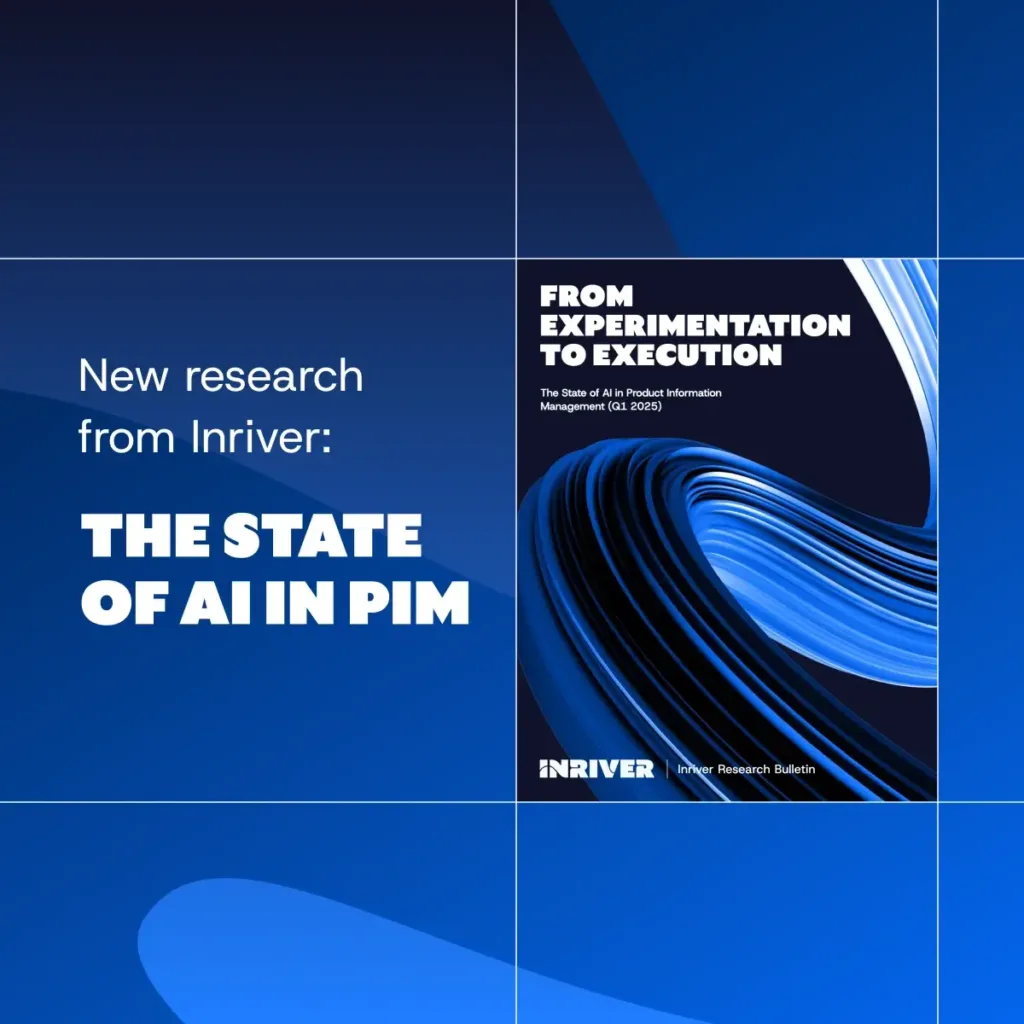
AI is already changing how we manage, enrich, and deliver product information. Is your business ready for 2026 and beyond?
Find out with with Inriver’s latest AI in PIM research paper
How to implement AI for e-commerce
Implementing AI for e-commerce isn’t about chasing hype. It’s about building a deliberate roadmap that balances speed with control.
According to Viktor Bergqvist, Head of Innovation Lab at Inriver, “the most successful AI programs start small, show quick wins, and then scale once the foundation is proven.”
Here’s how to get there.
1. Define business objectives before tools
Start by identifying where AI can move the needle in your e-commerce operations. Is the priority faster product content creation? Sharper personalization? Stronger forecasting? Clear objectives prevent wasted investment and ensure AI aligns with measurable goals.
Bergqvist noted, “AI is powerful, but not a magic wand—implementations fail when they’re not tied to real business outcomes.”
2. Target quick-win use cases
Pilot AI where the ROI is precise and controllable. Many retailers start with product content enrichment—automating descriptions, attributes, or translations. Others focus on recommendation models to improve conversion rates. Quick wins demonstrate value and help teams build confidence working with AI.
“Automating product descriptions or enriching product data are smart first steps,” Bergqvist explained. “They save hours of manual work and provide obvious productivity gains from day one.”
3. Build on trusted product data
AI quality rises or falls with the data it’s trained on. Without accurate product information, errors multiply across every channel. That’s why a robust PIM system must sit at the center of your AI strategy. PIM centralizes specs, compatibility, images, and metadata into one trusted source.
“AI is only as good as the data it learns from. If that data is inconsistent or wrong, your recommendations and insights will be too,” Bergqvist warned.
4. Layer governance and human oversight
AI can generate at scale, but brands still need checks. Create workflows with approval gates for compliance, tone, and accuracy. This is especially important for regulated categories or technical SKUs where minor errors can become costly.
Bergqvist advised, “Always keep a human-in-the-loop. AI should accelerate your teams, not replace them.”
Read more about generative AI risks, and rewards in e-commerce.
5. Integrate AI into your broader tech stack
Treat AI as part of your ecosystem, not a bolt-on. That means ensuring smooth integration with e-commerce platforms, PIM, ERP, OMS, and CRM systems. Otherwise, you risk silos that limit AI’s effectiveness.
As Bergqvist put it, “AI is a high-performance engine, but without a strong digital foundation, it won’t take you far.”
Integrating AI tools into your tech stack may be easier with a composable commerce architecture. Read our guide on how this differs from a traditional e-commerce platform approach.
6. Start small, measure, then scale
Avoid the temptation to roll out AI across the entire business on day one. Launch in a single category, measure outcomes, and refine the process before expanding. Track conversion lift, time-to-publish, and return rate improvements. With each success, expand into more markets, product lines, or customer touchpoints.
Building an AI-ready e-commerce future
AI will shape the next era of e-commerce, but it won’t succeed in isolation. As Viktor Bergqvist, Head of Innovation Lab at Inriver, noted, “AI is a high-performance engine, but without a strong digital foundation, it won’t take you far.”
The future belongs to businesses that combine advanced AI capabilities with connected systems, PIM, OMS, CRM, and e-commerce platforms, into one cohesive stack. This foundation ensures accurate, trusted data power every AI-driven recommendation, forecast, or interaction.
E-commerce leaders who act now and pair innovation with governance, speed with control, will be ready for what comes next: omnichannel personalization at scale, smarter automation, and AI-driven customer journeys.
The technology is here. The question is whether your stack is ready to handle it.
For more information on how to use AI for e-commerce, read our blog.
See the AI-powered Inriver PIM in action
Inriver offers the most comprehensive PIM solution on the market, integrated with the latest AI tools for speed, scale, and complexity.
Let an Inriver expert explain how the Inriver PIM can turn your product data flows into a sustainable revenue stream.
- Get a personalized, guided demo of the Inriver platform
- Have all your PIM questions answered
- Free consultation, zero commitment
Thanks for reaching out!
We’ll be in touch soon.
Please try again in a moment.