How to use AI for e-commerce
September 18, 2025AI in e-commerce drives smarter search, creates product content, and powers recommendations. The potential is huge, but the challenge is knowing how to use it effectively while protecting accuracy and trust.
It wasn’t that long ago that a mention of artificial intelligence sparked images of Star Trek or distant science fiction. However, today AI is part of everyday life, of how we connect, work, and shop. In fact, the power of AI is no clearer than in e-commerce, where the latest innovations are rapidly changing how consumers discover, choose, and interact with brands and products.
For example, an effective AI-powered chatbot can make or break a brand’s success in the digital marketplace. These chatbots can manage gift searches, FAQs, orders, returns, customer service, and much more. And that’s just one instance of AI for e-commerce.
The market reflects this momentum. AI in e-commerce is projected to reach $8.65 billion in 2025 and $17.1 billion by 2030—a steep climb from a few years ago, when adoption was still in its infancy.
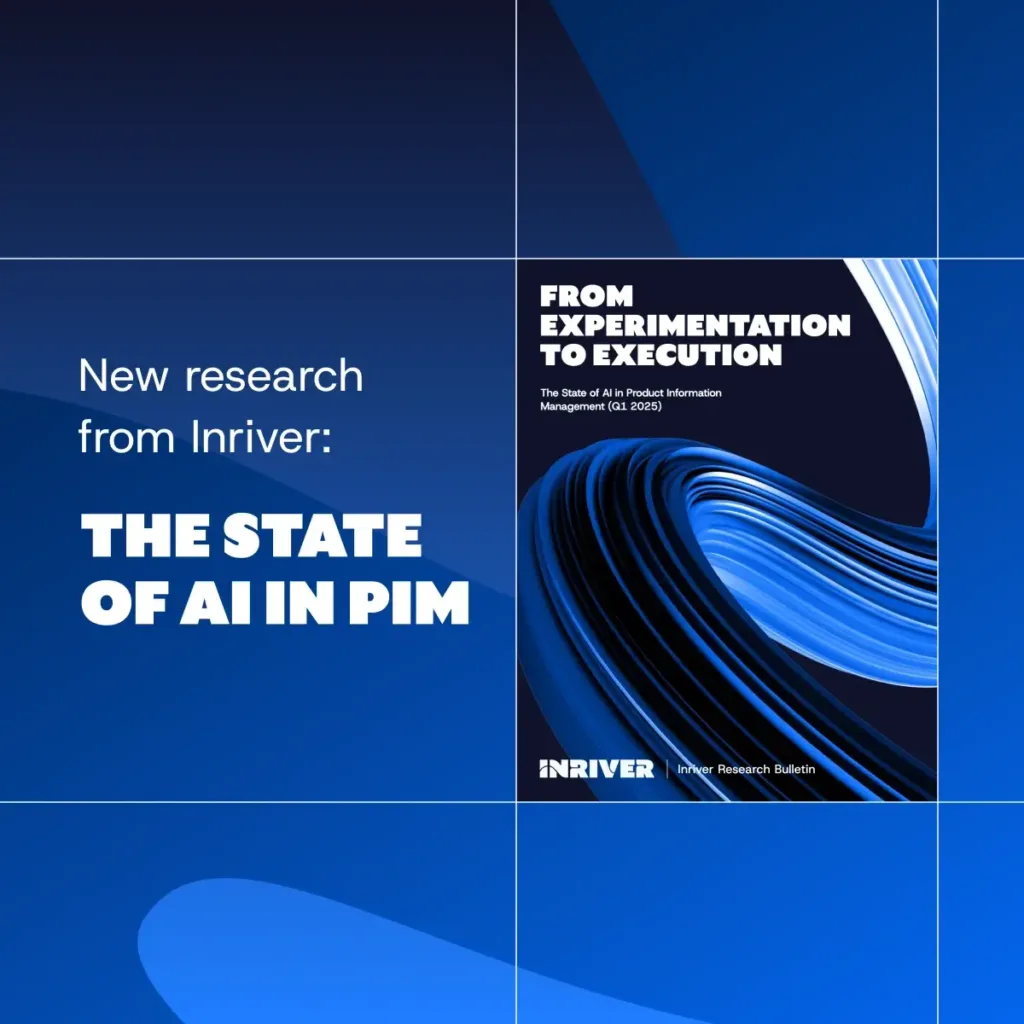
Inriver’s research, The State of AI in PIM, shows that 87% of companies report stronger customer trust with AI, even though 90% still struggle with accuracy issues.
These findings show that, despite AI’s power, its adoption still raises questions. How will AI reshape your current ecosystem? Will it replace people—or empower them? And what challenges should you prepare for when investing in AI?
This article answers those questions so you can see where AI delivers the most value in e-commerce and how to put it to work effectively.
Why use AI for e-commerce?
AI accelerates content creation, enhances search, and personalizes every interaction, enabling shoppers to find the right product more quickly.
When you automate repetitive work, teams focus on strategy and loyalty. The question now isn’t whether to start, but where to start for the most significant impact.
Viktor Bergqvist, Head of Innovation Lab at Inriver, highlighted how customers are already harnessing this shift: “Generative AI can draft rich product descriptions, specs, and marketing copy in seconds when connected to a PIM. It even analyzes product images to auto-suggest attributes, ensuring consistent data across every channel.”
Personalization, chatbots, and recommendations all become more accurate and trustworthy when grounded in governed product data.
How AI is used in e-commerce
AI is already transforming everything from content creation to shopper experience. When your e-commerce strategy is built on a foundation of PIM, you are in the right place to get the most out of AI and the many opportunities it brings.
It powers: automated product content creation, SEO-rich media data, performance optimization, data validation, personalized recommendations, instant translations, and streamlined operations across ERP, CRM, and ecommerce systems.
But Viktor reminds leaders that its impact extends further: “AI doesn’t just elevate the customer journey—it also optimizes logistics, pricing, and even product development. Leaders should see it as a capability that spans both the front and back office.”
The right PIM platform for e-commerce ensures that your data remains consistent across all channels, enabling AI to perform optimally.
Here are six areas where that combination delivers the most impact today:
1. Create product content at scale
Turn attributes into high-converting descriptions in minutes. Adjust tone for different audiences and channels without draining your team’s time.
2. Make your media searchable
Utilize AI to generate alt text, captions, and media tags that enhance accessibility and SEO, enabling your products to be discovered more quickly.
3. Optimize content for performance
Analyze copy and visuals for tone, clarity, and keyword coverage. Get AI-driven recommendations to lift engagement and conversion.
4. Strengthen product data quality
Fill missing attributes, validate measurements, and enforce taxonomy rules so your shoppers always see accurate, complete information.
5. Elevate the shopping experience
Deliver hyper-relevant recommendations, intent-based search, instant translations, and AI-powered chat that guides shoppers in real time.
6. Keep operations in sync
Automate publishing schedules, update inventory, and connect ERP, CRM, and e-commerce systems without manual rework.

What are the challenges of using AI in e-commerce?
AI adoption in e-commerce delivers results, but you’ll face hurdles if it isn’t managed carefully. Here are the biggest challenges you need to control:
Hidden costs
The real expense isn’t the software license — it’s the governance. You’ll need to invest in clean data, integrations, monitoring, and retraining.
Viktor pointed out that these hidden costs are often overlooked: “You need to budget for enablement—training, prompt patterns, and review workflows—as well as the infrastructure to monitor and tune models. Companies that skip this planning discover hidden costs later.”
Data readiness
AI scales whatever you feed it. If your product attributes are incomplete or scattered, those errors spread across every channel. Centralizing clean, trusted product information in a PIM solution is the single most important step to prevent costly mistakes.
Viktor emphasized the point: “AI is only as good as the data it learns from. Centralizing clean, trusted product information in a PIM is the step that too many companies overlook.”
System integration
Many e-commerce stacks still run on legacy ERP or CRM systems that weren’t built for AI. Getting them to work together often requires custom development, which can delay the impact. Without interoperability, your AI can’t deliver consistent results.
Human oversight
Fully autonomous AI is rare and risky. According to Inriver’s whitepaper, The State of AI in PIM, half of companies (50%) still rely on direct human oversight, while 26% use selective automation with checkpoints at high-risk moments.
You need product experts reviewing outputs, not just publishing them unchecked.
Viktor warned against skipping this step: “Generative AI might produce subtle inaccuracies, so you need editors or product experts reviewing outputs rather than blindly publishing them. Always keep a human in the loop.”
Measurement gaps
The research also reveals apparent measurement gaps. 68% of companies rely on indirect metrics, such as CSAT scores, to gauge AI success. Instead, benchmark against clear KPIs, such as product page conversion, bounce rates, return rates, and revenue impact.
94% of successful adopters measure outcomes such as revenue impact and time-to-market.
Viktor urged leaders to set measurable outcomes from the start: “Define success by surface—PDP conversion, bounce on ‘no results,’ CSAT for AI chat, return rate, and margin impact. Without this instrumentation, you won’t know if AI is paying off.”
Skills and culture
AI adoption changes how your teams work. Without training and ownership, employees resist new workflows or mistrust machine-led outputs.
Viktor sees this as a leadership responsibility: “Budget for enablement. Training staff, creating review workflows, and giving employees ownership of AI outputs turns fear into confidence. Without that cultural shift, the technology won’t stick.”

Why should you integrate AI and PIM?
The challenges of AI adoption don’t come from the algorithms; they come from the data. A PIM provides the complete, clean, and trusted product information AI needs to perform reliably.
When PIM software is your single source of truth, every AI output—content, recommendations, or personalization—stays accurate, compliant, and consistent across channels. If you choose a PIM embedded with the latest AI innovations, like the Inriver PIM, your business wins through:
- Governed accuracy: AI outputs based on complete, validated product data, reducing the 90% error risk many brands still face.
- Compliance at scale: built-in governance rules ensure claims, translations, and tone stay consistent across every channel.
- Real-time agility: product specs, pricing, and availability update instantly, so AI never promotes outdated or unavailable items.
- Omnichannel consistency: every touchpoint reflects the same trusted information.
Viktor explained why this foundation matters: “AI is a high-performance engine, but without a strong digital foundation, it won’t take you far.”
Beyond PIM, you also need OMS, CRM, and integration middleware so your AI can pull data in real-time across the entire stack. If you have a fragmented ecosystem, AI’s potential stays limited. When you have a connected system, AI becomes a growth engine for your entire business.
Why PIM is key to AI success in e-commerce
- Governed, complete product data – fuels AI accuracy and reduces errors
- Real-time data sync – keeps specs, pricing, and availability current
- Consistent content across all channels and languages
- Built-in governance – safeguards compliance and brand standards
- Single source of truth – eliminates conflicts and outdated information
What is the future of AI in e-commerce?
AI in e-commerce has already moved beyond pilots. For you, the future won’t be defined by adoption; it will be determined by how quickly you adapt to shifting behavior, rising compliance demands, and the expectation for real-time personalization.
Viktor explains, “AI acts as the connective tissue linking channels, making sure context follows the customer from app to store to support chatbot. That’s what creates a seamless brand experience.”
Here’s where you’ll see the biggest impact next:
Voice-assisted product discovery
Shoppers expect to search by natural language. With clean attributes and compatibility mapping in your PIM, AI can deliver accurate results and higher add-to-cart rates.
Sustainability and compliance
ESG and product safety facts will be displayed directly on product detail pages. With approvals and audit trails in place, you can prove every claim in real time.
Predictive inventory and demand
Smarter buying, bundling, and replenishment will cut stockouts and forecast errors. You’ll know when to restock before your customers even notice gaps.
Real-time personalization
Session-level recommendations and tailored content will meet every shopper where they are. With a strong product graph and translations in PIM, you’ll serve accurate, compliant content instantly.
What should e-commerce brands do now?
As the data shows, AI in e-commerce has become the competitive standard. Top brands base their AI on comprehensive, governed product data, ensuring every output is accurate, compliant, and ready for conversion.
Here’s where you can start:
- Start with quick wins: Pilot content enrichment or semantic search with proven AI tools for e-commerce to demonstrate ROI fast.
- Build a strong data foundation: Centralize clean, governed product data in a PIM. “It’s the foundation every AI output relies on.”, Viktor says.
- Enforce human oversight: Add approval gates for accuracy, compliance, and tone.
- Seize hidden opportunities: “Supplier feed normalization or AI-drafted care guides don’t grab headlines, but they cut costs and drive efficiency in ways customers still feel.”, noted Viktor.
Your next move is about alignment. Anchor AI to measurable outcomes and scale deliberately.
See what AI can achieve when every product detail is right. Share the AI in PIM infographic with your team, or go deeper with our whitepaper, The State of AI in PIM.
Ready to act? Book a personalized Inriver demo and give your business the edge your competitors can’t match.
See the Inriver PIM in action
Inriver offers the most comprehensive PIM solution on the market, built for speed, scale, and complexity. Let an Inriver expert explain how the Inriver PIM can turn your product data flows into a sustainable revenue stream.
- Get a personalized, guided demo of the Inriver platform
- Have all your PIM questions answered
- Free consultation, zero commitment
Thanks for reaching out!
We’ll be in touch soon.
Please try again in a moment.