AI in B2B marketing: Tools, execution, and product data readiness
AI that fits how your team works
A practical guide to AI for B2B marketing that shows how to reduce complexity, govern output, and scale execution. Download the Inriver research to assess your readiness.
Survey findings from more than 1,000 B2B marketers show AI as part of everyday marketing work, yet many still rate their overall effectiveness as moderate. Marketing teams support more channels, formats, and buyer roles than before, often without additional time or headcount.
While investment continues across content creation platforms, marketing technology, and automation tools, maintaining consistency remains challenging. Expectations tied to B2B e-commerce strategy and B2B multichannel marketing strategies continue to rise, especially across digital touchpoints where accuracy and relevance matter most.
This article outlines how B2B teams apply AI under those conditions. You will see where AI fits inside daily operations, which tools support the work, and which practices help teams use AI without adding complexity across campaigns, channels, and product-led experiences.
Why are B2B marketing teams turning to AI?
Content programs, channel execution, and campaign operations now move faster than manual processes can support. Many teams introduce AI once production work begins to slow delivery, especially across email, SEO, social, paid media, and digital commerce, where teams increasingly use AI for e-commerce to manage content volume and accuracy.
Research shows that AI already supports a large share of everyday marketing work, which explains why adoption often starts inside existing workflows rather than as a standalone initiative.
Gartner outlines how generative AI now supports core marketing activities, including copy creation, subject line testing, image generation, video highlights, and immersive product visuals. These tools help teams explore variations, refine ideas, and maintain momentum without extending review cycles.
While McKinsey adds an organizational dimension, noting that employees already use AI more often than leaders expect, which lowers adoption friction and accelerates integration into daily work.
Teams tend to turn to AI where pressure concentrates most:
- Managing higher content volumes, with copy, imagery, and video drafted or accelerated through generative tools
- Supporting personalization across buyer roles, where tailored creative combinations help maintain relevance
- Improving campaign execution through faster iteration and asset variation across channels
- Reducing workflow bottlenecks, since familiarity with AI shortens production cycles
Which AI tools are shaping B2B marketing in 2026?
Marketing teams rely on AI-supported content marketing workflows to maintain pace as campaign volume and channel demands increase. Digital Marketing Institute research shows that AI now supports core marketing tasks across email, SEO, social, PPC, and analytics, which explains why tool adoption follows execution pressure rather than experimentation.
Gartner reinforces this shift, pointing to generative AI as a driver of faster production, testing, and personalization across marketing workflows tied to B2B e-commerce.
Adoption of AI agents also continues to rise, reaching 79%, with two-thirds of companies reporting measurable value, according to DMI research.
1. Content creation and ideation tools
These tools support day-to-day production by helping teams draft, adapt, and iterate content without slowing delivery cycles.
- Writer
- Jasper
- Canva AI
- Adobe Firefly
- Notion AI
2. Content optimization platforms
Optimization tools focus on improving clarity, relevance, and performance across email and search, where minor adjustments affect visibility and engagement.
- Surfer SEO
- MarketMuse
- Clearscope
- Grammarly Business
- Seventh Sense
3. AI agents and conversational systems
AI agents support operational tasks and conversational experiences, reflecting growing use of AI chatbots in marketing and customer-facing workflows.
- Intercom Fin
- Drift AI
- Ada
- LivePerson AI
- HubSpot ChatSpot
4. Personalization engines
Personalization platforms assemble content variations to support relevance across buyer roles and channels, a need that becomes increasingly critical as B2B e-commerce journeys grow more complex.
- Dynamic Yield by Mastercard
- Optimizely Content Intelligence
- Bloomreach Engagement
- Salesforce Einstein
- Adobe Target
5. Channel-specific AI tools
These tools apply AI directly inside search, social, email, and paid media platforms to support testing, optimization, and execution at scale.
- Google Performance Max AI
- Meta Advantage Plus
- Mailchimp AI
- Hootsuite OwlyWriter AI
- Semrush AI Writing Assistant
6. Automation and analysis tools
Automation and analytics platforms help teams manage performance data, operational workflows, and reporting without adding manual overhead.
- Breeze HubSpot Marketing Hub AI
- Marketo Engage
- Salesforce Marketing Cloud AI
- Tableau GPT
- Looker Studio AI
These tools reflect how AI has become embedded across marketing execution. Marketing teams adopt them to maintain pace, manage variation, and support performance across B2B e-commerce channels, reinforcing a more AI-driven e-commerce model rather than introducing entirely new ways of working.
As AI spreads across marketing workflows, product information becomes the limiting factor.
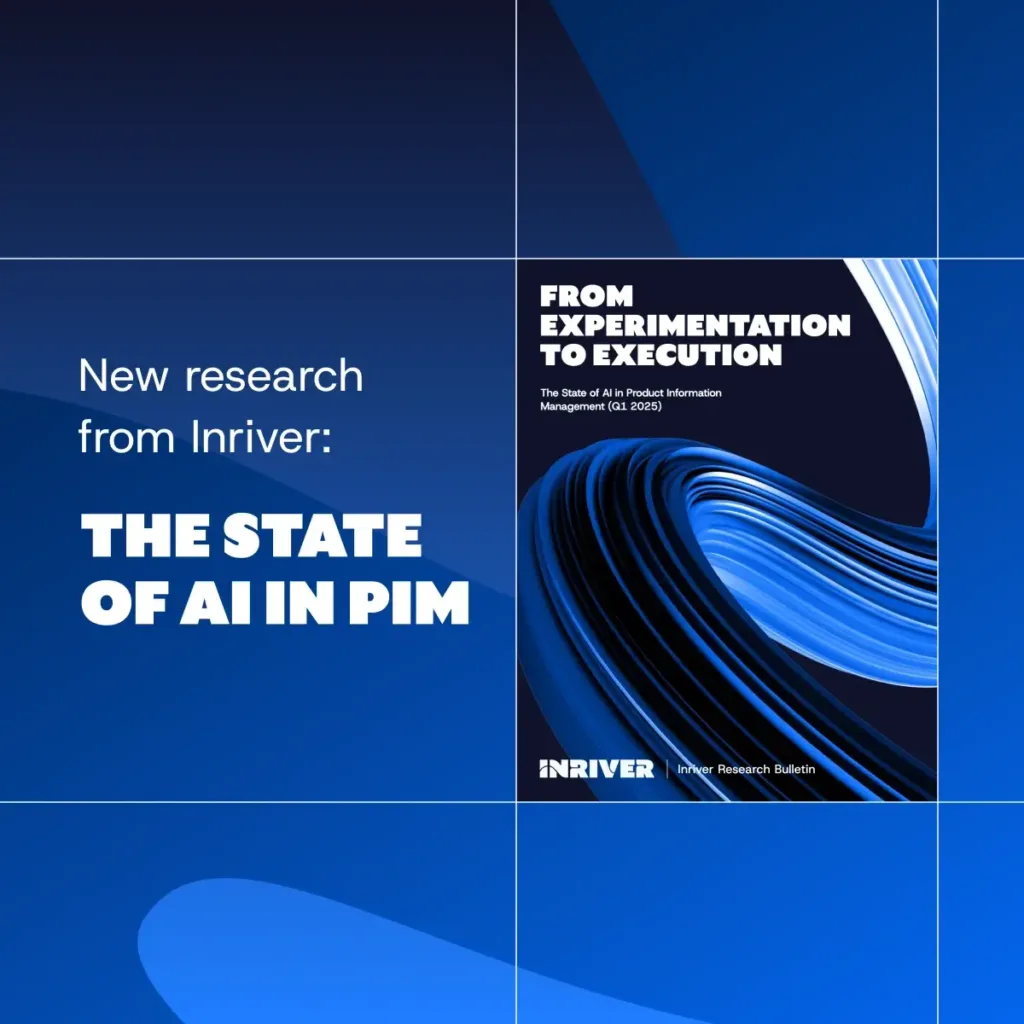
Explore what Inriver’s research reveals about AI, governance, and PIM maturity.
How can B2B marketers apply AI without creating extra complexity?
AI works best when your teams can apply it within existing workflows rather than build new ones around it. Your team can avoid unnecessary complexity by treating AI as part of execution rather than a separate initiative, with clear ownership and shared standards guiding its application.
1. Align AI with B2B multichannel marketing strategies
AI already supports execution across email, SEO, social, paid media, and B2B e-commerce. Complexity increases when teams introduce AI in isolated pockets without considering how channels connect. Alignment starts by anchoring AI to the same workflows that support your broader e-commerce strategy, rather than introducing isolated tools that operate outside campaign planning and execution.
- Map where AI already supports campaigns and channels
- Assign ownership for setup, review, and optimization within each channel
- Apply shared standards, so AI output stays consistent across touchpoints
This approach keeps AI aligned with B2B multichannel marketing strategies and prevents fragmentation.
2. Scale syndication through controlled automation
Syndication often breaks down when content updates rely on manual coordination. AI reduces that friction when automation is applied selectively to repeatable tasks.
- Automate predictable steps like formatting, routing, and recurring updates
- Define which actions run automatically and which require review
- Share clear expectations with partners to reduce rework
These steps support syndication AI expansion without adding handoffs or process overhead.
3. Support personalization with consistent product information
Personalization depends on variation, but variation only works when the underlying product information stays aligned. AI accelerates content assembly, which makes data gaps more visible.
- Standardize product attributes, descriptions, and classifications
- Resolve inconsistencies before AI generates or adapts content
- Keep product information aligned across channels tied to B2B e-commerce
Consistent data allows personalization programs to scale without accuracy issues.
4. Govern AI output as part of B2B product data strategies
As your marketing team adopts more AI tools, maintaining governance becomes harder. Each additional model introduces its own policies, review processes, and risk controls, which increases operational overhead and fragmentation.
Inriver addresses this challenge through a bring-your-own-LLM approach, supporting the most popular, enterprise-ready LLMs. This empowers your team to separate model choice from governance, while keeping AI usage anchored to a single product data foundation. With Inriver, you can:
- Reduce AI sprawl by using preferred large language models without creating separate governance structures for each one, such structures, which also require ongoing maintenance and oversight;
- Centralize and standardize data privacy levels, controls, and agreements for easier oversight, maintenance, and risk management;
- Treat AI-generated output as part of your integrated B2B product data strategy, and not as isolated content requiring parallel processes.
This approach supports flexibility at the model level while keeping control centralized and consistent, helping teams scale AI usage and governance without adding complexity.

Why does product data influence AI outcomes in B2B marketing?
AI now operates inside core PIM workflows rather than around them. Inriver’s research shows that 97% of companies have moved beyond AI experimentation, and 83% report AI embedded across multiple systems and workflows that rely on shared product data.
In fact, many teams already use AI for enrichment, product data categorization, onboarding, validation, and performance analytics, which places PIM at the center of how AI supports marketing execution.
However, accuracy remains a limiting factor: 90% of companies still report occasional content issues, which is why 64% have introduced structured oversight and review processes to govern AI output.
These patterns show how product data readiness influences AI outcomes across marketing execution, operational scale, and manufacturing workflows.
Product data readiness sets the baseline for AI performance
Marketing teams rely on AI for product content creation, variation, and validation, making output quality dependent on the structure and accuracy of the underlying product information. Those applications rely on existing product information rather than creating new sources of truth.
When product data is structured, current, and governed, AI produces more reliable output. When it is not, limitations appear early, before content reaches downstream channels. This is where AI and PIM connect at a foundational level.
Accuracy and consistency determine how AI scales across channels
AI accelerates the flow of content and product information across channels. Minor inconsistencies in product data surface faster once AI-assisted assets appear across websites, email, paid media, partner portals, and B2B e-commerce.
Shared standards and review steps help limit rework and keep execution aligned as campaigns expand. Without that discipline, AI increases both distribution speed and correction cycles.
Operational scale exposes gaps in product data management
As companies connect more systems, channels, and teams, reliance on shared product data increases. Larger catalogs and more complex data structures place pressure on how attributes and classifications are maintained.
Manufacturing organizations highlight this effect clearly, since scale and technical complexity demand stronger discipline. At this level, PIM manufacturing scale becomes a test of data control rather than volume alone.
Data discipline signals readiness for AI-enabled PIM
Your team’s readiness for AI-enabled PIM depends on how you can manage product information today. Consistent standards, clear ownership, and review checkpoints allow AI to extend existing workflows rather than introduce new risk. This pattern aligns with B2B manufacturers’ readiness for PIM, where governed product data supports scale across marketing and commerce. In practice, AI and PIM move forward together only when data discipline is already in place.
How should your B2B marketing team approach AI moving forward?
Although AI investments have increased steadily over the past months, only a small number of companies consider their use fully integrated into everyday marketing work. Progress depends less on expanding adoption and more on how teams apply AI inside existing workflows. Practical decisions start with prioritizing applications that already support execution, rather than launching broad initiatives disconnected from daily work.
Your marketing team can move forward faster when AI adoption aligns with reliable product data, clear ownership, and defined review standards. Applying AI where data is accurate and processes are established helps reduce rework as usage grows.
How prepared is your team to support AI with dependable product information? The Inriver research offers a grounded view of what readiness looks like in practice.
Ready to see these new innovations in action?
Inriver offers the most comprehensive PIM solution on the market, built for speed, scale, and complexity. Let an Inriver expert explain how the Inriver PIM can turn your product data flows into a sustainable revenue stream.
- Get a personalized, guided demo of the Inriver platform
- Have all your PIM questions answered
- Free consultation, zero commitment
Thanks for reaching out!
We’ll be in touch soon.
Please try again in a moment.