What’s the difference between AI features and an AI operating model in PIM?
AI features complete individual PIM tasks. An AI operating model governs how AI work is verified, approved, measured, and moved through product information workflows.
An AI feature performs a task inside your PIM, such as generating a product description or translating an attribute, while an AI operating model defines how your product operation ingests, verifies, approves, and activates AI work across the business. The feature helps one person finish one job faster, whereas the operating model determines whether your team can trust AI output at scale.
The gap between the two shows up in revenue. IBM’s Institute for Business Value studied 1,000 executives and found that organizations that pair AI adoption with strong organizational change achieve up to 73% higher revenue growth than their peers, yet only 15% of organizations reach that intersection.
McKinsey reports a similar pattern: only 21% of companies have fundamentally redesigned their operating models around AI, even though workflow redesign correlates more strongly with bottom-line impact than any other factor McKinsey tested. Most organizations bought the features, and far fewer built the model that turns those features into results.
Product data teams face the same choice, and your evaluation improves once you understand product information orchestration and where AI belongs.
In the sections below, you’ll find what each term covers, a side-by-side comparison you can use in vendor conversations, and a diagnostic to assess which one your organization actually runs.
- What counts as an AI feature in PIM?
- What is an AI operating model in PIM?
- How do AI features and an AI operating model differ in practice?
- Why don’t AI features deliver results on their own?
- What does an AI operating model look like in a PIM workflow?
- How do you know if you have AI features or an AI operating model?
- Build the operating model before you buy the features
- FAQs
What counts as an AI feature in PIM?
An AI feature in PIM is a discrete capability that completes a single task on command, and you’ll recognize it because it activates when a user triggers it and stops when the output appears. Most PIM platforms in 2026 offer some combination of the following:
- Content generation, which drafts product descriptions, titles, or marketing copy from existing attribute data
- Translation and localization, which converts product content into other languages for regional channels
- Attribute extraction, which pulls structured values out of supplier PDFs, spreadsheets, or free-text fields
- Image tagging and recognition, which assigns keywords or categories to product photos automatically
- Data quality suggestions, which flag missing attributes, inconsistencies, or completeness gaps in a record
These capabilities deliver real value, and dismissing them would be a mistake. A description generator saves your content team hours per SKU, and automated attribute extraction removes some of the most tedious work in supplier onboarding.
The problem starts with how vendors label them, because the market rewards the boldest claim rather than the most accurate one. Gartner examined the vendor landscape in 2025 and estimated that only about 130 of the thousands of vendors claiming agentic AI actually deliver it, a practice the firm calls agentwashing. Rebranded chatbots, scripted automation, and single-task generators routinely carry the same “agentic” label as systems that genuinely coordinate work.
You can cut through the labels with one test. Ask what happens after the feature produces its output. A feature hands the result back to a person, who then checks it, routes it, approves it, and moves it to the next system, which means every task the AI completes still depends on your team to carry it forward.
Deciding who should control what AI agents can do in your product operations only becomes a meaningful question once AI moves beyond this single-task pattern, and that distinction leads directly to the operating model.
What is an AI operating model in PIM?
McKinsey found that roughly 79% of organizations skip decomposing their workflows into discrete tasks and deciding which ones shift to AI and which ones stay with people. An AI operating model in PIM is exactly that missing work applied to product information. It is the defined system of rules, workflows, and checkpoints that governs how AI participates in your product data operation, covering which tasks AI performs, what its output must pass before reaching a channel, who holds authority to approve or override it, and how you measure whether it improves business results.
💡Definition: An AI operating model in PIM is the governed system that determines how AI work enters, moves through, and exits your product information flow, from data ingestion to channel activation, with verification and human decision rights built into every step.
A working AI operating model in PIM covers five components:
- Decision rights. Your team knows which decisions AI makes on its own, which ones require human approval, and who owns the final call when AI output and human judgment conflict. IBM found that 68% of executives say AI adoption has slowed precisely because decision rights and escalation paths remain unclear.
- Verification and validation. Every AI output is checked against trusted product data and business rules before it moves downstream, so accuracy doesn’t depend on someone remembering to review it.
- Workflow embedding. AI operates inside your enrichment, approval, and syndication flows rather than in a separate tool that someone copies results out of. McKinsey’s research shows top performers are twice as likely to redesign workflows before selecting AI tools, which reverses the order most buyers follow.
- Data foundation. AI acts on product data that is already structured, current, and usable, because output quality tracks input quality no matter how capable the model is.
- Measurement. You track business outcomes such as time-to-market, channel accuracy, and rework rates instead of counting how many AI features your team activated.
Notice that none of these components names a specific technology. An operating model describes how work gets done, which is why two companies can run the same AI features and produce different results. The components also depend on each other, since decision rights mean little without verification to enforce them, and verification means little if the underlying data cannot be trusted.

How do AI features and an AI operating model differ in practice?
Procurement teams evaluating PIM platforms in 2026 routinely receive demos of the same five features you saw in section two, so the practical differences only surface when you ask questions about accountability, failure, and scale.
The table below gives you those questions in a form you can bring into vendor conversations, since each row exposes a difference that a feature demo never shows.
| Dimension | AI features | AI operating model |
|---|---|---|
| What triggers the work | A person clicks a button or runs a job, and the AI performs one task on demand | Defined workflows initiate AI work based on events, such as new product data arriving or a channel requirement changing |
| Scope of responsibility | The AI produces an output, and responsibility for everything after that returns to your team | The system carries output through verification, approval, and channel activation with checkpoints at each stage |
| Who owns accuracy | Whoever happens to review the output, which often means nobody formally does | Assigned decision rights specify who approves, who overrides, and what rationale gets documented |
| Dependence on individuals | Results depend on the habits of the people using the feature, so quality varies by person and by day | Rules and checkpoints apply consistently regardless of who is working, so quality holds when staff changes |
| What happens when AI is wrong | The error passes through unless a person catches it before publication | Validation against trusted product data stops the error before it reaches a channel |
| How value gets measured | Adoption counts, such as how many descriptions the team generated | Business outcomes, such as time-to-market, channel accuracy, and reduced rework |
| How it scales | More volume requires more people reviewing more outputs | More volume flows through the same governed process without adding review headcount |
The “who owns accuracy” row deserves your closest attention, because it separates platforms faster than any other question. IBM’s research found that 35% of executives cannot say who holds authority to challenge or override AI recommendations in their organization, and 34% lack a repeatable process for resolving conflicts between human judgment and AI output.
Top performers in the same study answer these questions before scaling anything, and 91% of them maintain clear rules for when AI output should be followed, challenged, or escalated. Those rules are the practical mechanics behind setting the right level of AI autonomy in product content workflows, and they exist as documented policy in an operating model rather than as individual judgment calls.
Why don’t AI features deliver results on their own?
By 2027, Gartner predicts over 40% of agentic AI projects will be canceled, citing escalating costs, unclear business value, and inadequate risk controls. None of those three reasons describes a technology failure. AI features underdeliver because they get added to product operations that were never redesigned to receive them, so the feature accelerates one task while everything around it continues working the way it always has. McKinsey documented this pattern directly in its research on why bolt-on AI generates little value, and its findings translate cleanly into product data work.
Three failure patterns account for most of the gap:
1. The surrounding complexity stays intact.
Your team generates descriptions in seconds, but those descriptions still wait in the same approval queues, pass through the same handoffs, and depend on the same people reconciling data across systems.
McKinsey also notes that when agentic systems operate inside workflows not redesigned for them, errors propagate across the organization at machine speed, meaning an unverified AI mistake in product data can reach every channel before anyone reviews it.
2. Value stays trapped at the task level.
Individual activities finish faster, but the full flow from product data ingestion to channel activation moves at the same pace because the bottleneck was never the task the AI accelerated. A launch delayed by coordination across engineering specs, operational data, and customer-facing content stays delayed no matter how quickly any single description gets written.
3. Technology leads, and the operation follows.
McKinsey found that AI transformations lead primarily, as technology programs fail at rates above 80% because they optimize tools rather than change how work gets done.
Buying a PIM for its AI feature list repeats this mistake at platform scale, and the fix requires deciding how AI-generated content gets governed before deciding which platform generates it. If your team addresses their AI content control problem first, you can choose platforms with far more clarity.
Each pattern compounds the others. Intact complexity keeps value trapped at the task level, and technology-first buying guarantees the complexity never gets addressed, which is why adding more features to a feature-based approach produces diminishing returns rather than a turning point.
What does an AI operating model look like in a PIM workflow?
Product data enters most organizations from suppliers, ERP systems, PLM tools, and spreadsheets in whatever structure those sources happen to use, and an AI operating model becomes visible in what happens to that data next.
The flow below traces the path from raw input to channel activation, and every stage answers one of the questions the previous sections raised about ownership, verification, and scale.
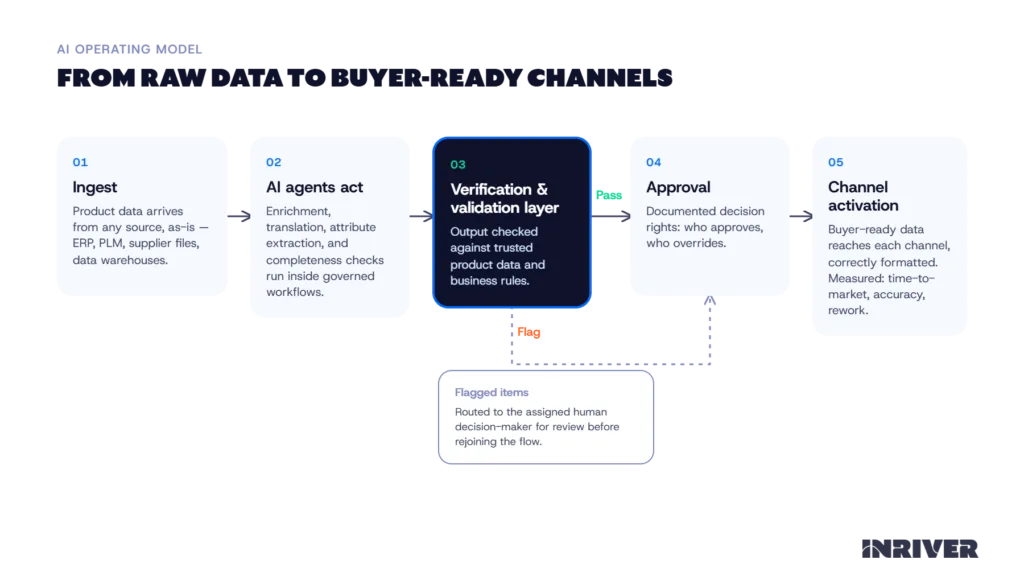
Two stages in this flow do the work that features alone cannot. Stage one determines whether AI ever gets trustworthy input, because agents acting on fragmented or stale data produce fast, confident, wrong output. Stage three determines whether anything downstream can be trusted, since validation against governed product data catches errors before they reach a channel, not after a distributor complains.
Notice also that human judgment appears at a defined point with documented authority instead of hovering over every task, which is what makes the model scale without adding review headcount.
Inriver builds its platform around these two stages. Its flexible data model ingests product data from many sources and product data warehouses as-is, without the upfront cleaning, restructuring, or ETL project most platforms require, giving AI usable data from the start. Its agentic orchestration then runs AI agent and LLM workflows across content, e-commerce, data, and product development, and adds a verification and validation layer to every product-data-based agentic workflow, so agents work at speed while output gets checked against trusted product data before anything reaches a channel.
Manufacturers running this kind of governed setup report strong results, with 96% expressing high trust in AI for PIM and 65.6% seeing revenue increases of 5 to 10% after deployment, according to the Inriver AI in PIM study from 2025.
Your platform choice matters less than whether this flow exists at all, and any vendor claiming an operating model should be able to show you each of the five stages in a live environment rather than on a slide.
How do you know if you have AI features or an AI operating model?
You can run the same kind of honest audit on your product operation with the questions below. Answer each one yes or no, and count how many times you answer no.
Self-assessment: 8 questions about your product operation
- 1. Can you name the person or role who holds final authority when AI-generated product content conflicts with human judgment?
- 2. Does AI output pass through automated validation against your trusted product data before it can reach a channel?
- 3. Do your AI capabilities operate inside your enrichment and approval workflows rather than in a separate tool your team copies results from?
- 4. Would your AI-assisted processes keep producing consistent quality if your two most experienced product data people left next month?
- 5. Do you require a documented rationale when someone overrides an AI recommendation, the practice 85% of top performers in IBM’s study follow?
- 6. Do you measure AI value through business outcomes such as time-to-market and channel accuracy rather than through usage counts?
- 7. Can AI act on your product data today without a cleanup or restructuring project happening first?
- 8. Do your escalation rules for AI work exist as written policy rather than as habits individual team members developed on their own?
Five or more no answers mean you run AI features, whatever your platform’s marketing says. Two to four no answers mean parts of an operating model exist without the connective structure that makes them dependable. Zero or one means the model is largely in place and your attention should turn to measurement and refinement.
Treat the no answers as a sequenced work list rather than a verdict. Questions one, five, and eight concern decision rights, and they cost the least to fix because they require policy decisions rather than technology changes.
Questions two, three, and seven concern your platform and data foundation, and they carry the most weight in any upcoming PIM evaluation. Working through the list in that order gives you the practical starting point for a human-led AI strategy, since every question keeps a person with documented authority at the center of the answer.
Build the operating model before you buy the features
Most teams do this backward, and it costs them. They pick the platform with the longest AI feature list, then discover a year later that nobody agreed on who approves output, the data still needs restructuring before agents can use it, and quality depends on whichever reviewer happens to be careful that day. You now know the fix runs in the opposite direction.
Settle your decision rights first, since they only take a policy conversation, and let the data foundation and verification requirements drive your platform choice rather than trail behind it.
Put Inriver’s verification layer to the test on your own product data; schedule a personalized demo today.
Ready to see Inriver in action?
Inriver transforms the way your business thinks about product data. Let an Inriver expert explain the many benefits of the enterprise-ready, fully adaptable Inriver platform.
- Get a personalized, guided demo of the Inriver platform
- Have all your PIM questions answered
- Free consultation, zero commitment
Thanks for choosing Inriver! We’ll be in touch soon.
Please try again in a moment.