Why is your AI enrichment only as good as your data model?
Better AI enrichment begins with better product attributes
Generic AI content often reflects incomplete product records. See how Inriver Inspire uses structured product information to support more accurate enrichment.
Skip to:
- What is a product data model, and why does AI enrichment depend on it?
- Why does AI-generated product content come out generic or inaccurate?
- How can you tell it’s a data problem, not a prompt problem?
- Can your data model handle an acquisition, a new market, or a new product line?
- What can you do with your product data to improve AI enrichment?
- FAQs
Your AI enrichment is only as good as your data model because the structure of your product attributes affects how reliably you can catch errors in AI-generated content. A 2024 study of product listings enriched by large language models found that detection of hallucinations, meaning content unfaithful to the source input, exceeded the targeted precision and recall on structured attributes, where hallucinations are clearly defined, while precision on unstructured attributes was lower because those attributes are ambiguous.
AI use is common, but fully scaled use is rare. McKinsey’s survey of 1,993 participants found that 88% of respondents use AI in at least one business function, while only 7% reported that AI is fully scaled across their organization. In addition, Gartner predicted that through 2026, organizations would abandon 60% of AI projects unsupported by AI-ready data, and a Gartner analyst said data with issues is not ready for AI.
In this article, we’ll explain what a data model contains, why AI-generated product content comes out generic or inaccurate, who should define your model, and which tests you can run on your own product data.
What is a product data model, and why does AI enrichment depend on it?
A product feed for ChatGPT requires nine fields for every item, and your product data model is the structure that holds those values, organized as data elements grouped into entities with relationships defined between them. Because required fields must contain a value, the values your enrichment produces reach the feed only when your model has a place for each of them.
Your AI-ready product data also needs metadata alongside the values themselves, because proving that data is AI-ready is a metadata-driven practice that aligns, qualifies, and governs the data.
What AI enrichment works from
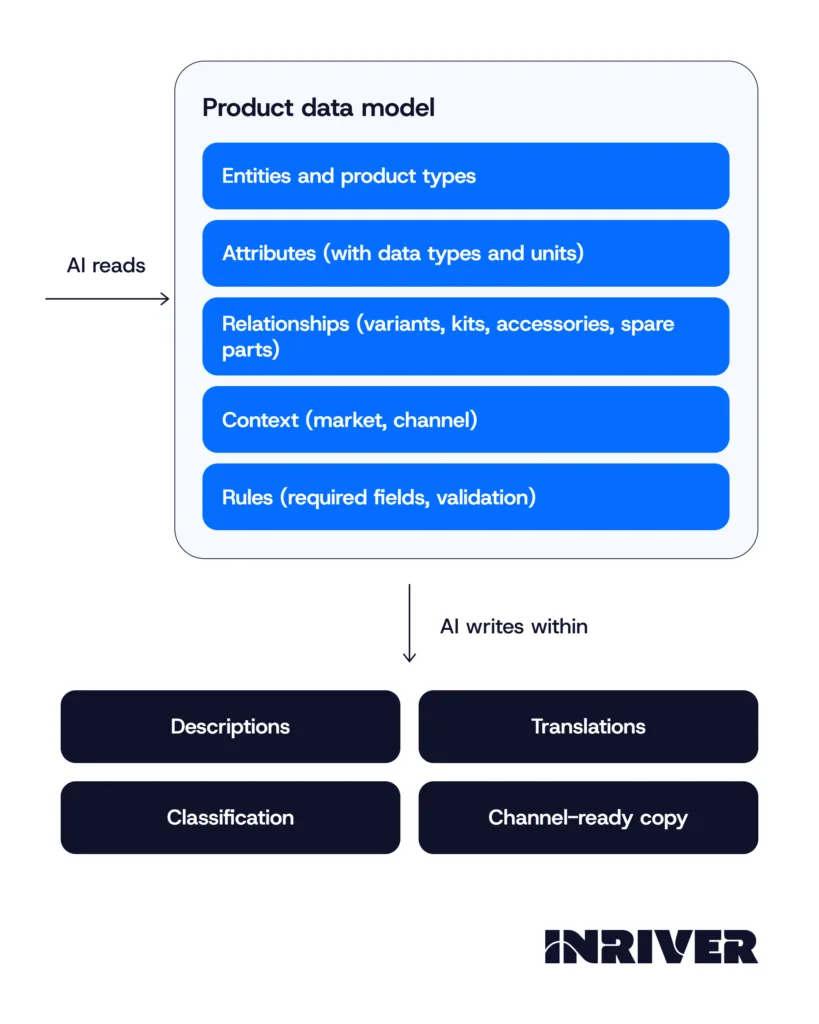
Gartner states that proving data is AI-ready is a practice based on metadata that aligns, qualifies, and governs the data, so your AI-ready product data needs that metadata alongside the values themselves
Which parts of your data model does an AI feed ask for?
The table below maps each part of your model to what the specification asks for and what it states about gaps.
| Part of your model | What the specification asks for | What it states about gaps |
|---|---|---|
| Entities | One row per purchasable item or variant, each with a stable item_id | An item_id is never reused for a different item |
| Relationships | A shared group_id and a variant_dict of selected options on each variant row | Option names must match across a group, and conflicting values between attributes and variant_dict are not reconciled for you |
| Attributes with units | Dimensions with at least two of length, width, and height, plus a unit | Units are not inferred, so you convert measurements before upload |
| Identifiers | A GTIN of 8, 12, 13, or 14 digits with a valid check digit | An unassigned GTIN is omitted, and an MPN is not invented to replace it |
| Requirements | Nine required fields, including title, description, brand, price, and availability | A row is rejected when availability is omitted, empty, or unrecognized |
| Market context | A standard upload that targets the US | Additional markets require confirmation from OpenAI |
Why does AI-generated product content come out generic or inaccurate?
Of 317 product content leaders, 90% reported that their organizations still experience occasional AI-related content accuracy issues. Large language models are also trained only on the information available to the providers that build them, which limits their usefulness where nuanced, enterprise-specific knowledge is needed, so your own product records are the place to look when descriptions come out generic.
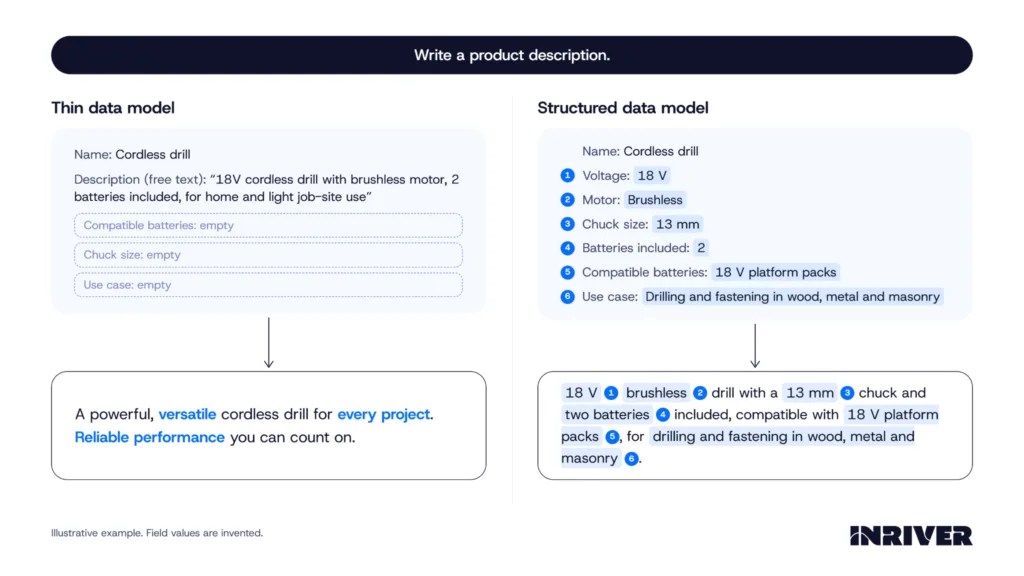
The two records below receive the same prompt, so any difference in AI accuracy in product content comes from the data model. The first record keeps its detail in one free-text description and leaves compatible batteries, chuck size, and use case empty, while the second stores each detail in its own attribute.
How can you tell it’s a data problem, not a prompt problem?
Three checks on the record behind a piece of content show whether you are dealing with a data problem rather than a prompt problem.
1. Check how unknown values are stored
Replace placeholders such as null, unknown, or n/a with blank values for unknown optional fields, because an empty value does not mean zero or false.
2. Read the description field as a fact sheet
Compare your description fields with a factual description of each item in plain text, with a title of at most 150 characters and a description of at most 5,000 characters, before you rewrite a prompt.
3. Compare your records with the use case
List the product types and edge cases your AI task covers and confirm that your records include them, because AI-ready data must be representative of the use case, including its patterns, errors, and outliers.
Can your data model handle an acquisition, a new market, or a new product line?
A data model built from each customer’s requirements can adapt where a fixed data model cannot, so your first decision is whether your business or your software defines your data model.
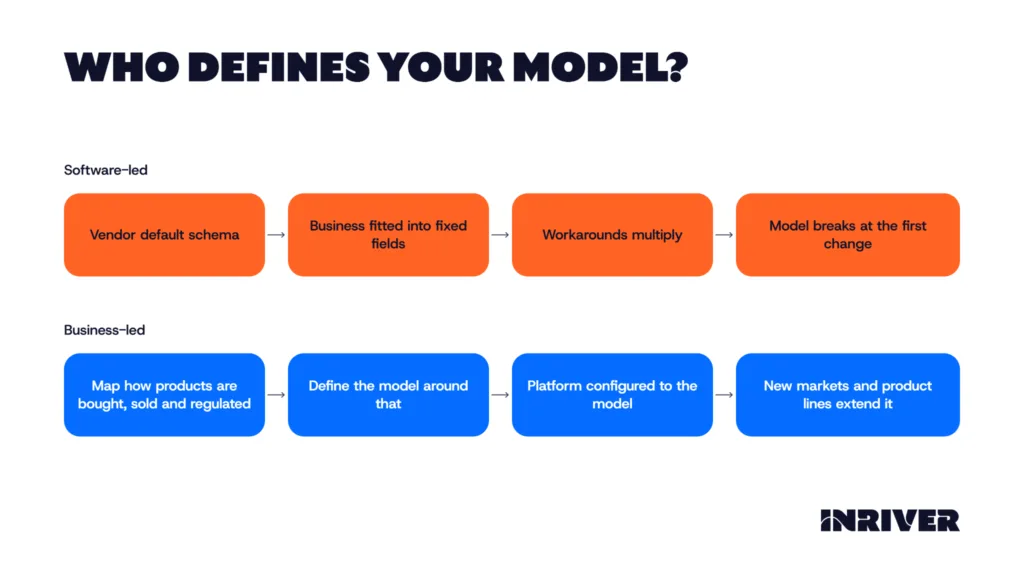
Six questions show whether your model can handle an acquisition, a new market, or a new product line, and each counts as a pass only when you can answer yes without a workaround.
Acquisition
- Do both catalogs name the item ID the same way? A feed accepts id or sku as aliases for item_id but asks you to send only one name per value.
- Do both catalogs group variants the way your site presents them? A feed groups only variants of the same product as presented on your site.
New market
- Does your model store the sizing system for each size value? A feed lists systems such as US, UK, and EU and implies no size conversion when you omit the system, though the field requires feed setup.
- If your products fall under the Ecodesign for Sustainable Products Regulation, can your model supply a unique product identifier and metadata for each Digital Product Passport? Economic operators must register each passport in the European Commission’s registry with unique product identifiers and associated metadata, through a user interface or an API.
New product line
- Does your model carry a condition attribute? An omitted condition may be treated as new, and used or refurbished items must always be declared.
- Does each variant carry its own price, availability, URL, and images?
AI-ready data is ongoing work that needs constant improvement as AI use cases change, so repeat these questions whenever a new catalog, market, or product line arrives and treat each workaround you find as an early sign of where PIM implementations break.
AI enrichment depends on the information available in your product records. See how Inriver Inspire uses structured attributes to support more specific product descriptions, classifications, and other content while validating output against trusted data.

What can you do with your product data to improve AI enrichment?
You can take three actions to improve AI enrichment.
1. Map your model to every feed that receives it.
An OpenAI format and a Google-compatible format spell pre-order availability as pre_order and preorder and accept the unknown value differently, and one format applies to the entire upload instead of to individual rows, so supplying both from one data model spares you the content chaos of maintaining a separate tool for each.
2. Put verification between AI and every channel.
AI output that goes straight to channels with no built-in validation is one of five signs product data software isn’t built for AI agents, and Inriver orchestrates AI agent and large language model workflows with built-in verification and validation. Inriver Inspire AI runs end-to-end workflows within one governed system and is built for organizations whose product data operations are outrunning the capacity of their existing teams and tools.
3. Compare AI-generated content with human-created content.
Use DataOps and data observability processes that track data patterns and changes and adjust your data requirements as needed.
See what AI-ready product data looks like in practice; schedule a personalized demo with an Inriver expert today.
See the Inriver PIM in action
Inriver transforms the way your business thinks about product data. Let an Inriver expert explain the many benefits of the enterprise-ready, fully adaptable Inriver platform.
- Get a personalized, guided demo of the Inriver platform
- Have all your PIM questions answered
- Free consultation, zero commitment
Thanks for choosing Inriver! We’ll be in touch soon.
Please try again in a moment.