How to solve your AI content control problem once and for all
October 7, 2026AI content control requires clear permissions, verification, and approval rules. Learn how to prevent inaccurate AI-generated product information from reaching your sales channels.
To address AI content control, apply four measures to every workflow where AI generates product content: limit what the AI can change, assign a decision owner, add a verification step against trusted data, and keep an approval log before publication. With these controls in place, reviewers can oversee the process without checking each listing individually, and AI workflows can stay fast while maintaining oversight.
McKinsey’s 2026 AI trust survey of about 500 organizations found that nearly two-thirds of respondents cite security and risk concerns as the top barrier to fully scaling agentic AI, well ahead of regulatory uncertainty and technical limitations.
This article discusses where those concerns turn into control gaps in your product operations and which controls close them.
- What is the AI content control problem in product operations, and why does it happen?
- What layers of control does AI-generated product content need?
- Who decides what AI can change, and how much human review does each type of product content need?
- How do you verify AI-generated product content before it reaches a channel?
- Where should you start fixing AI content control?
- What platform capabilities support AI content control in product operations?
- FAQs
What is the AI content control problem in product operations, and why does it happen?
McKinsey’s survey authors separate AI systems that say the wrong thing from systems that do the wrong thing, such as taking unintended actions, misusing tools, or operating beyond appropriate guardrails, and they note that the consequences of failure grow materially as AI systems take on greater autonomy.
For your product operations, the AI content control problem is the gap between what AI can change in your product content and the limits, checks, and approvals your team has set around those changes. The survey also finds that active mitigation lags behind perceived relevance across nearly every risk category, and the figures below show how respondents rate inaccuracy and how they view their organization’s response to incidents.
What causes AI content control gaps?
Findings from McKinsey and IBM point to four causes, and each one corresponds to a decision your team can make before the next AI workflow goes into production.
1. Decision rights are unclear
IBM’s Institute for Business Value found that 68% of executives say AI adoption has slowed because decision rights and escalation pathways are unclear, and 35% say it is still unclear who has the authority to challenge or override AI recommendations.
A similar share, 34%, lacks a consistent way to resolve conflicts when human judgment and model output diverge. IBM’s researchers read those gaps as a sign that many organizations still rely on improvised judgment at the moments that matter most.
2. Outputs go unchallenged
More than half of the employees IBM surveyed say people fail to push back on AI when they should, and 43% of executives say employees do not feel safe raising concerns about AI outputs. Without that pushback, an error that nobody flags can reach every listing the workflow touches.
3. Rules trail adoption
Of the 8,400 employees IBM surveyed, 64% have AI guidelines, and 65% say those guidelines already trail how they actually work, while 77% of technology leaders in IBM’s 2026 Tech Leader Study say AI adoption is moving faster than their current governance capabilities.
McKinsey reports a similar pattern, with only about one-third of organizations reaching a maturity level of three or higher in strategy, governance, and agentic AI governance.
4. Ownership is missing
McKinsey found that organizations with clear ownership for responsible AI, particularly through AI-specific governance roles or internal audit and ethics teams, average a maturity score of 2.6 on its four-level model, compared with 1.8 for organizations without a clearly accountable function.
Naming an owner for each AI workflow gives your team the same explicit accountability, and the next section covers the controls that owner manages.
What layers of control does AI-generated product content need?
OWASP’s LLM Top 10 describes excessive agency as the vulnerability that lets damaging actions follow unexpected, ambiguous, or manipulated LLM outputs, and it typically traces the cause to excessive permissions, excessive autonomy, or both.
In your product operations, those two causes translate into two questions for every AI workflow: what the AI is permitted to touch, and what happens to its output before anything reaches a channel.
Six layers cover both questions. The four measures from the introduction appear as permissions, the approval gate, verification, and the evidence record, and trusted data and channel release complete the path an AI-generated change follows before release.
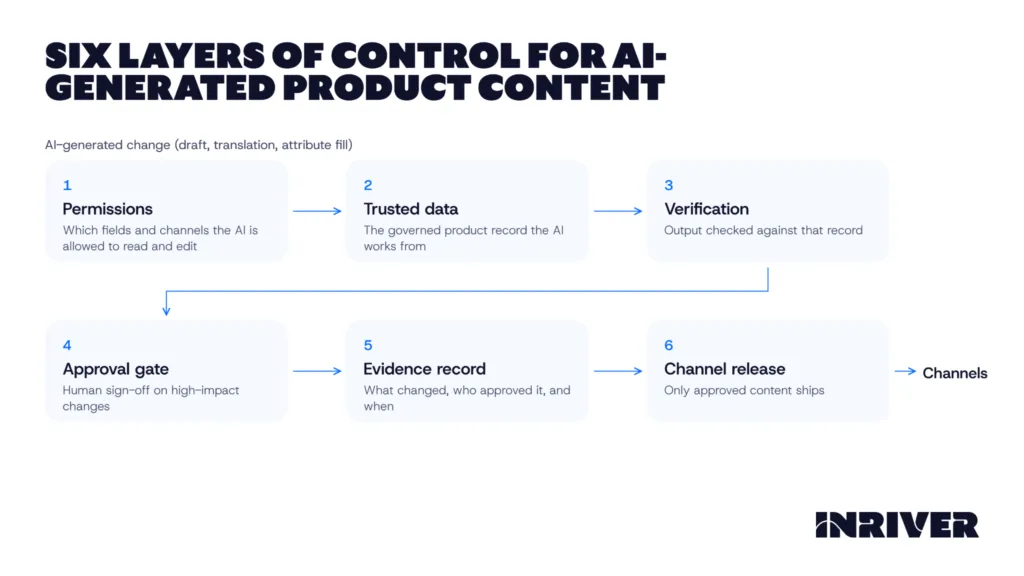
Each layer has a specific job in the flow, and several of them draw directly on published guidance.
- Permissions. At this layer, your team sets what AI agents can do in your product operations. OWASP’s example of limiting damage is authenticating an email extension through an OAuth session with a read-only scope, and the same logic lets you restrict each agent to the fields and channels its task requires.
- Trusted data. The AI works from the governed product record, which gives the verification layer a fixed reference to compare each output against.
- Verification. OWASP treats insufficient scrutiny of LLM outputs as a vulnerability separate from excessive agency, so limiting permissions at layer 1 and checking output at layer 3 are separate controls, and your workflow needs both.
- Approval gate. OWASP recommends a human-in-the-loop control that requires a person to approve high-impact actions before they are taken; an example is a social media app with an approval routine for the “post” operation. The equivalent operation in your workflow is the step that publishes content to a channel.
- Evidence record. McKinsey’s trust survey authors state that organizations without clear accountability, controls, and effective monitoring mechanisms risk slower adoption, higher incident impact, and diminished stakeholder trust. A record of each change, its approver, and the date gives that monitoring something to work from.
- Channel release. IBM’s action guide recommends enforcing decision rights through policy and governance agents, and this layer is the last point where your team can apply that enforcement before content reaches a channel.
IBM also reports that seven in 10 executives say AI-related execution issues have increased over the past year, and its action guide recommends embedding judgment checkpoints and pause points into workflow orchestration tools to catch those issues before they multiply.
Your verification step and approval gate can both run within the same product information orchestration that moves content to your channels, keeping them from becoming a separate review queue.
Who decides what AI can change, and how much human review does each type of product content need?
Only 32% of the enterprises in IBM’s 2026 research expect codified decision rights for human-AI work to be in place in a mature 2028 organization, even though top performers are already twice as likely to have clearly defined decision authority for AI-impacted work and 91% of them have clear rules for when AI should be followed, challenged, or escalated.
Your team can start now with two tools: a table that sets how much human review each type of change requires and a one-page card that records who holds authority over each AI workflow.
How much human review should each type of change get?
IBM’s action guide recommends classifying AI decisions by risk and consequence and assigning a required level of human involvement to each class. The table below applies that approach to three consequence levels, with an example change from a product content workflow in each row.
| Consequence of an error | Example change | Human involvement |
|---|---|---|
| Low | AI drafts a description that no channel receives | AI proceeds, and the change is written to the evidence record |
| Medium | AI translates existing attribute values for a channel | A judgment checkpoint or pause point before the workflow continues |
| High | AI publishes changed content to a channel | A named person approves before the action is taken |
Your tier assignments set the level of AI autonomy in product content workflows for each type of change, with human involvement rising as the consequence of an error increases.
How do you verify AI-generated product content before it reaches a channel?
Verification compares each AI output with your governed product record and sends it down one of three routes before the content moves toward a channel. McKinsey’s survey of 1,719 respondents found that nearly three-quarters of AI high performers have fundamentally redesigned workflows because of their AI use, compared with one-quarter of other respondents, and a verification step is one form that redesign can take.
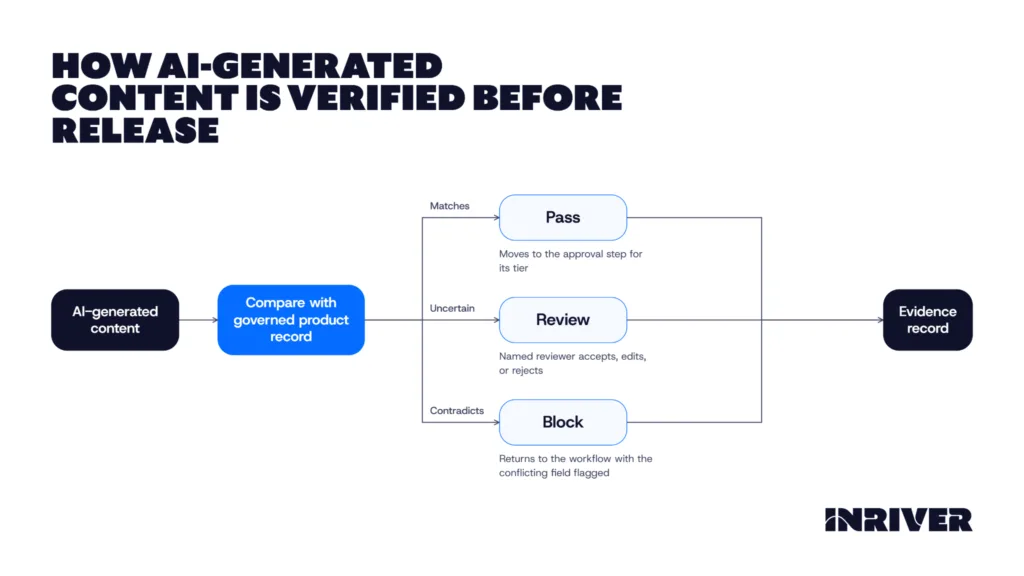
- Pass. Output that matches the record moves to the approval step its consequence tier requires.
- Review. Output your checks cannot confirm goes to a named reviewer, who accepts, edits, or rejects it. IBM found that 79% of top performers reward employees who surface and correct AI issues, so a recorded reviewer decision is worth keeping.
- Block. Output that contradicts the record returns to the workflow with the conflicting field flagged, and your team resolves it before anything reaches approval.
Regulation adds a second reason to keep these records, because the European Commission states that providers and deployers within the scope of Article 50(2) and (4) of the EU AI Act must comply with transparency obligations for AI-generated or manipulated content from 2 August 2026, while AI systems placed on the market before that date have a transitional period until 2 December 2026. Your team can see which workflows fall within that scope by reviewing the EU AI Act’s impact on product content and PIM.
Where should you start fixing AI content control?
Start with the decisions that need only policy, then change how your workflows route AI output, and finish with measurement and reviewer preparation. The checklist below follows that order.
- Start with decisions that need policy only
✔️Complete one decision-rights card for your highest-volume AI workflow.
✔️Assign a consequence tier to every AI workflow your team runs today.
✔️Name the person who approves high-tier changes before anything is published. - Change how your workflows route AI output
✔️Restrict each agent to the fields and channels its task requires.
✔️Add the pass, review, and block routes to your highest-tier workflow first.
✔️Start an evidence record for every approved change. - Measure outcomes and prepare your reviewers
✔️Place metrics that capture the business value of AI-supported work on the dashboards your team already uses to run the operation, instead of on a separate AI scorecard.
✔️Use scenario simulations and sandbox environments to rehearse override and escalation decisions before they come up in your workflows.
✔️Schedule training for the people who review AI output, covering the pass, review, and block routes and the escalation thresholds on your decision-rights cards.
The first group gives your team the written decisions to build a human-led AI strategy on, since it assigns an owner, a consequence tier, and an approver to each workflow.
What platform capabilities support AI content control in product operations?
The checklist above depends on a governed product record to verify against and on a workflow that routes AI output before it reaches a channel, and Inriver covers both for your product data. Its flexible data model ingests product data from your existing sources as-is, without the usual cleanup or ETL project, and Inriver works with your existing systems as the coordination layer between your upstream sources and downstream channels.
Its agentic orchestration then runs AI agent and LLM workflows across content, e-commerce, data, and product development, with a verification and validation layer that checks every product-data-based agentic workflow against trusted product data before output reaches a channel.
Schedule a demo with an Inriver expert to see how to run these workflows on your own data.
Ready to see Inriver in action?
Inriver transforms the way your business thinks about product data. Let an Inriver expert explain the many benefits of the enterprise-ready, fully adaptable Inriver platform.
- Get a personalized, guided demo of the Inriver platform
- Have all your PIM questions answered
- Free consultation, zero commitment
Thanks for choosing Inriver! We’ll be in touch soon.
Please try again in a moment.