How do you set the right level of AI autonomy in product content workflows?
September 28, 2026AI autonomy should vary across product content workflows. Learn how risk, verification, regulatory exposure, and performance determine how much control AI receives.
You set the right level of AI autonomy in product content workflows by scoring each workflow against three things, namely the consequence of an error in that workflow, how reliably its output can be verified against trusted product data, and how long the workflow has been running with a measured error rate.
Capability is not a criterion, because what the AI can do tells you nothing about what it should be allowed to do unattended. If you skip this scoring, you end up at one of two poles, and both poles fail.
Based on McKinsey’s March 2025 State of AI survey, 27% of organizations have employees review every piece of gen AI content before use, which turns review capacity into the bottleneck that automation was meant to remove, while a similar share reviews 20% or less, which sends unverified attributes, translations, and claims to channels where errors mean suppressions, chargebacks, and compliance exposure.
Gartner’s June 2025 forecast that over 40% of agentic AI projects will be canceled by the end of 2027 names inadequate risk controls among the leading causes, and an autonomy level nobody set deliberately is exactly that.
Autonomy in product content is a per-workflow setting, and the rest of this article shows you how to choose it, apply it across channels and attributes, and adjust it as the evidence comes in.
What are the three AI autonomy levels for product content work?
Enterprise governance frameworks in security operations, GRC, and IT have converged on a three-position model for AI autonomy, and the positions translate cleanly into product content operations. Each level addresses a specific question: where does human judgment stand in relation to each execution?
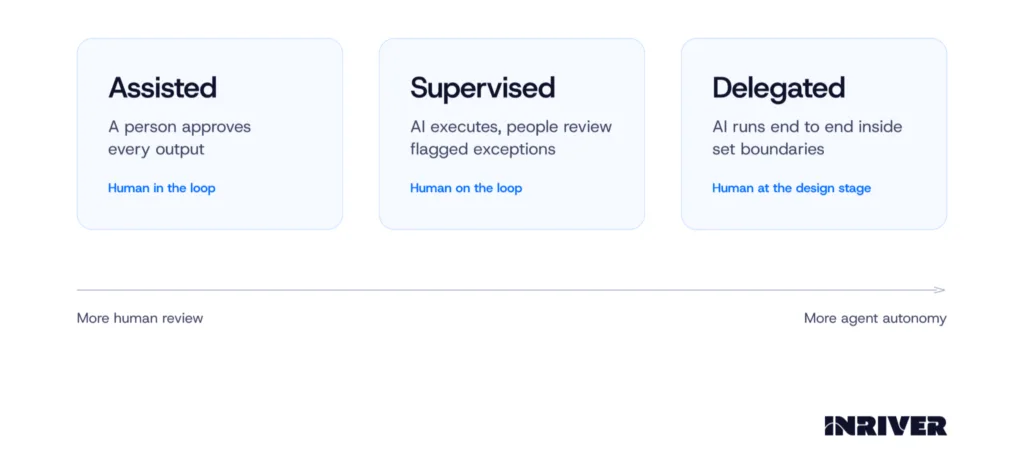
- Assisted mode is worth its cost for regulated claims, safety data, and hero copy on a flagship launch, where a single error is expensive enough to justify a human touching every output.
- Supervised mode suits attribute enrichment, translation across markets, and channel formatting at volume, since those outputs can be checked automatically against your product data while people handle only the flagged exceptions.
- Delegated mode belongs to work like internal tagging or draft-stage enrichment that sits behind a downstream approval gate anyway, where errors stay cheap and reversible.
The delegated level is often misunderstood by teams. Humans don’t disengage from delegated workflows; their authority extends to the moment the workflow was approved, when the boundaries were set and the exception criteria documented.
An enrichment agent that fills long-tail attributes without reviewing each item still operates within decisions a person made. Determining who should control what AI agents can do in your product operations is a key design-stage question.
Supervised mode occupies a middle ground for a reason: most product content work involves high volume and checkable outputs, making automated validation coupled with exception review the natural default. Your task in the next section is to identify which of your workflows genuinely meet the criteria for the other two settings.
Which factors set the right AI autonomy level for each workflow?
Gartner predicted that most agentic AI projects are early-stage experiments driven by hype and often misapplied, and it recommends pursuing agentic AI only where the value is clear. Product content teams can turn that caution into a concrete calibration, because four factors do the real work, and the agent’s capability is deliberately not one of them.
1. Verifiability of the output
An AI-generated attribute value that your platform can automatically check against a governed product record supports far more autonomy than a free-text claim only a human can judge. Verification coverage sets your autonomy ceiling, so measure it per workflow before you set anything else.
2. Consequence and reversibility of an error
A wrong internal keyword costs you a correction, whereas a wrong specification on a distributor feed costs you a chargeback or a delisting. Autonomy should scale with how cheap and reversible a mistake is, never with how impressive the agent looks in a demo.
3. Regulatory exposure of the content
Product categories carrying safety, environmental, or labeling obligations warrant tighter settings by default, and the EU AI Act’s implications for product content and PIM add a documented-oversight expectation on top of your existing category rules.
4. Maturity of the workflow
A workflow you stood up last month has not yet earned the autonomy of one that has run for two quarters with a measured exception rate, regardless of what the vendor promised.
Scoring stops being useful the moment you apply one score to a whole workflow, though, because consequence changes with the destination. The same enrichment agent does not deserve the same freedom everywhere it publishes, so calibrate per channel:
- Your own e-commerce site. Errors surface quickly and get fixed in minutes, so supervised mode suits most enrichment and formatting work here.
- Marketplaces with penalty regimes. Incorrect data triggers suppressions and chargebacks you cannot quietly undo, so tighten exception thresholds and route borderline outputs to human review.
- Distributor and syndication feeds. Downstream partners republish your data into systems you do not control, which makes errors slow to trace and expensive to correct, so treat these as your most conservative setting.
- Regulated attributes on any channel. Safety warnings, compliance markings, and certification claims stay at assisted level everywhere, because reversibility stops mattering once a regulator or an injured customer is involved.
The same granularity applies within a single product record, since marketing copy, dimensional data, and hazard statements can legitimately carry three different settings inside one listing. Handling that precision as written policy rather than tribal knowledge is what solving your AI content control problem actually looks like, and it only works when product information orchestration keeps every attribute, rule, and channel requirement moving through one governed flow instead of scattered spreadsheets.

How do you raise AI autonomy safely over time?
Teams grant the most autonomy on the day they know the least about an agent, right after the demo, and then never revisit the setting until an incident forces the conversation. Reverse that pattern by treating autonomy as something a workflow earns through evidence, the same way you extend responsibility to a new team member.
- Start every new agentic workflow at assisted level, regardless of how confident the demo made you feel, and log every human correction as structured data rather than informal feedback.
- Measure the exception rate over a defined period, because a workflow that produces validated, accepted output for weeks has generated the evidence you need to loosen review requirements.
- Move one setting at a time, shifting from assisted to supervised for a single attribute class or channel, and hold the new setting long enough to confirm the error profile before expanding it.
- Tighten immediately when the evidence turns, since a spike in exceptions after a model update, a new channel requirement, or a catalog expansion is a signal to add checkpoints back without rebuilding the workflow.
Autonomy handled this way becomes an adjustable, documented control rather than a leap of faith, which is what separates a genuine AI operating model from AI features bolted onto an unchanged process.
Set the AI autonomy level for each product content workflow
Pick your five highest-volume product content workflows, score each against verifiability, consequence, regulatory exposure, and maturity, and write down the level each runs at today. Most teams discover the current settings were never chosen at all.
Every position on the dial depends on one capability, namely checking agentic output against product data you trust, and Inriver builds that verification and validation layer into the flow, so a human-led AI strategy runs at full volume without giving up control. Book a demo to see verified agentic workflows inside Inriver.
Ready to see Inriver in action?
Inriver transforms the way your business thinks about product data. Let an Inriver expert explain the many benefits of the enterprise-ready, fully adaptable Inriver platform.
- Get a personalized, guided demo of the Inriver platform
- Have all your PIM questions answered
- Free consultation, zero commitment
Thanks for choosing Inriver! We’ll be in touch soon.
Please try again in a moment.