Who should control what AI agents can do in your product operations?
September 25, 2026AI agent governance defines who owns each agent, what it can change, and where humans intervene. Learn how to govern AI across product information operations.
In a September 2026 report on governing agentic AI, PwC emphasizes that every AI agent needs a designated business owner accountable for its decisions and actions. Although this requirement seems straightforward, many companies struggle to comply because they have not identified the owner, defined the agent’s decision-making boundaries, or clarified when human consultation is necessary.
Control over AI agents in product operations rests with specific individuals, not policies. The board establishes governance over agents, while executives determine ownership and escalation rights. Each business owner is responsible for individual agents, much like how a manager oversees their direct reports.
In this article, we will discuss the different levels of governance, the authority agents should have, and how to ensure accountability in day-to-day product data management.
- Why do AI agents in product operations need an owner?
- How do you onboard an AI agent like an employee?
- Who is accountable for AI agent decisions?
- How much authority should an AI agent have?
- How does Inriver keep AI agents accountable in product operations?
- 3 Questions that test your AI agent governance
- FAQs
Why do AI agents in product operations need an owner?
Research from the World Economic Forum, published in November 2025 in collaboration with Capgemini, found that organizations are moving agents from prototypes into real-world deployment, while most remain unsure how to evaluate, manage, and govern those agents responsibly.
💡82% of executives plan to adopt AI agents within the next one to three years, yet the gap between accelerating experimentation and mature oversight keeps widening.
Product operations is directly exposed to that gap. An agent that enriches product content, translates attributes, or shares data with a retail channel is performing tasks that previously required a human. The results still reflect your brand and compliance obligations.
Since someone approved that work before introducing agents, it’s crucial to determine who is responsible for approvals now, rather than relying on assumptions.
Ownership becomes especially important when agents are involved in orchestrating product information. This is because a single agent’s output influences downstream enrichment, approvals, and channel activation. If an error occurs with no designated owner, it can propagate throughout the entire process before anyone has a chance to address it.
How do you onboard an AI agent like an employee?
The World Economic Forum recommends onboarding AI agents with the same rigor you apply to a new employee, meaning well-defined roles, safeguards, and structured oversight practices. PwC extends the same logic in its digital workforce model, and KPMG’s 2025 report on agentic AI governance arrives at matching controls from the risk side. Taken together, the three frameworks translate into an onboarding sequence you can run before any agent touches production data.
- Assign a verified identity. Every agent gets a unique identifier, so each action and decision traces back to a specific agent rather than to a shared system account.
- Define the role and its boundaries. Document what the agent is hired to do and set explicit scope constraints, including limits on data access, tool usage, and decision-making authority.
- Grant task-specific access rights. An agent enriching product descriptions needs access to content fields, not to pricing approvals or channel credentials. Authority follows the role, exactly as it does for people.
- Set escalation rules before deployment. KPMG’s controls require agents to flag ambiguous situations and hand them to human review instead of guessing. Decide upfront which situations qualify.
- Turn on auditable activity logs. An immutable record of agent interactions and decisions gives the owner evidence to review and makes anomalies visible early.
New hires earn wider responsibility after they demonstrate reliable work, and agents should follow the same progression. Start each agent with narrow authority, review its logged output, then widen the scope deliberately as its track record supports it.
Who is accountable for AI agent decisions?
Based on PwC’s report, humans remain accountable for outcomes, decisions, and risk appetite even as agents take on more of the operational work, and that accountability splits across three levels of your organization.
| Level | Who holds it | What they answer for |
|---|---|---|
| Governance | The board | Whether the organization has effective governance for agentic AI at all |
| Operating model | Executive and functional management | Ownership assignments, escalation rights, and decision accountability across the agent portfolio |
| Agent level | A named business owner | The decisions and actions of each individual agent |
The build side of the agent carries its own accountability, separate from the three levels above. In a whitepaper on governing agentic AI systems, researchers at OpenAI split the agent lifecycle into three parties, namely the model developer who builds the underlying model, the system deployer who builds and operates the agent on top of it, and the user who directs it. Their core principle holds that at least one human entity must remain accountable for every harm an agentic system causes, so responsibility never disappears into the software.
When you apply the structure to your own product operations, assignments become concrete. The right owner for a syndication agent is the person who owned channel readiness before the agent existed, and the right owner for an enrichment agent is whoever answered for content quality.
PwC’s requirement points to a named individual for a reason, since shared ownership leaves no one positioned to answer when an agent’s output goes wrong, and the table above ends in a single name per agent rather than a committee.
How much authority should an AI agent have?
PwC addresses authority through two key variables: an agent’s level of autonomy and the importance of the decisions it makes. The criticality of these decisions typically increases when agents interact directly with your value chain.
For example, an agent responsible for drafting internal content notes poses less risk than one that publishes product data to a live retail channel. Together, these two variables help determine the level of control each agent requires.
| Low criticality | High criticality | |
|---|---|---|
| Low autonomy | Retain evidence of the agent’s actions | Require approvals before execution |
| High autonomy | Set a monitoring cadence | Monitor continuously with the ability to intervene |
PwC pairs its matrix with two essential questions for every agent:
- Execution, which assesses if the agent performs tasks correctly in terms of performance, security, and compliance, and
- Intent, which evaluates whether the agent is pursuing appropriate objectives within its designated authority.
Agents must have clearly defined limits on independent decision-making and escalation to humans.
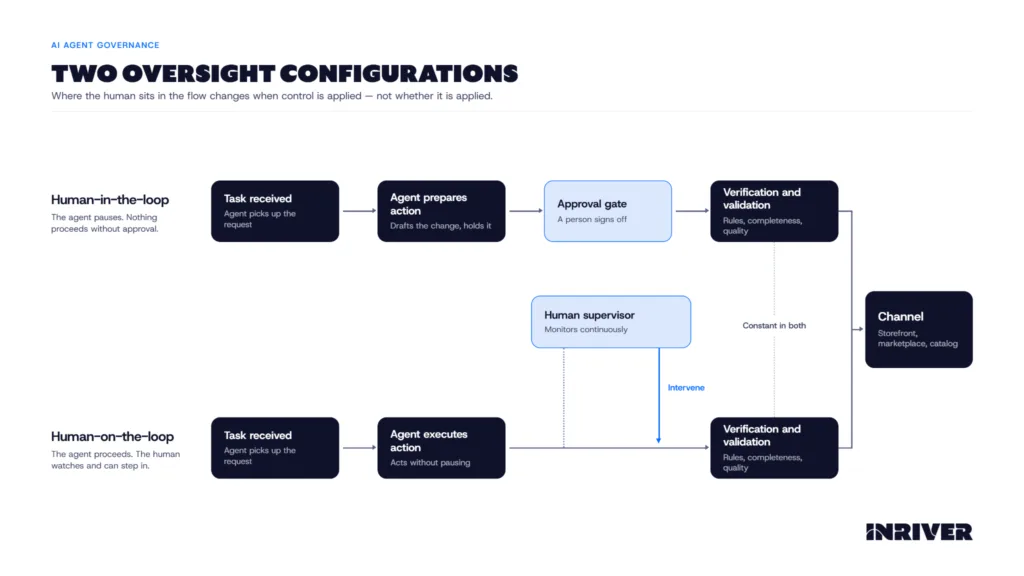
KPMG’s controls set these limits based on a pre-deployment risk assessment. The “human-in-the-loop” approach requires human approval for decisions, while “human-on-the-loop” allows agents to act independently with human oversight. Both configurations should be integrated into AI workflows, ensuring verification and validation happen during the work process.
Approval should be reserved for the highest criticality areas within the matrix. Requiring approval for every decision forces the approver to move quickly rather than carefully, and the control stops controlling anything.
How does Inriver keep AI agents accountable in product operations?
Ownership models clarify responsibility, but their effectiveness relies on enforceable accountability in daily operations. If an owner lacks visibility into their agent’s actions and has no checkpoints between the agent’s output and the channel, they hold the title without genuine ownership of outcomes.
Inriver builds that enforcement directly into how product data moves. The platform orchestrates AI agent and LLM workflows across content, e-commerce, data, and product development, and adds a layer of verification and validation to every product-data-based agentic workflow.
Agent output is validated against trusted product data before reaching any channel, ensuring accountability comes from automated workflow checks rather than manual post-publication reviews. The flexible data model supports the same goal from the other direction, because agents act on product data that is already usable inside the platform, which keeps their output verifiable in the first place.
Each level of the accountability structure from earlier in this article gets what it needs to do its job:
- The board gets audit evidence, since agent actions run through governed workflows that leave a traceable record
- Executives get monitoring across the agent portfolio, with escalation paths defined in the flow instead of in a policy document
- Each agent’s business owner gets verified output, because validation runs before the agent’s work reaches a channel, not after a distributor complains
Your team keeps agentic speed on enrichment, translation, and syndication work, and you keep the control the ownership model assigns to you.
3 Questions that test your AI agent governance
Three questions tell you whether the ownership structure in this article exists in your organization or only on paper, based on PwC’s 2026 report on agentic AI.
1. Can you evidence ownership, authority, and escalation for every agent touching product data?
A passing answer names the business owner of each agent, documents what the agent decides alone, and shows the escalation path a person can follow today, not a policy scheduled for review next year.
2. Can your operating model detect, decide, and intervene at machine speed where risk demands it?
A passing answer points to monitoring that runs continuously on your high-autonomy agents and a tested way to halt an agent’s actions before bad data reaches a channel.
3. Do autonomy and criticality determine the control intensity for each agent?
A passing answer shows different control postures for different agents, since an agent drafting internal content and an agent syndicating to retail channels should never sit under the same oversight regime.
If your company meets this standard, you’re on the right track. PwC’s 2026 AI Performance study, based on a survey of 1,217 senior executives, found that 74% of AI’s economic value is captured by just 20% of organizations. These leaders are expanding the number of decisions made without human intervention at almost three times the rate of their peers and are advancing further in AI governance.
See what verified agentic workflows look like in your product operations; schedule your personalized demo today.
Ready to see Inriver in action?
Inriver transforms the way your business thinks about product data. Let an Inriver expert explain the many benefits of the enterprise-ready, fully adaptable Inriver platform.
- Get a personalized, guided demo of the Inriver platform
- Have all your PIM questions answered
- Free consultation, zero commitment
Thanks for choosing Inriver! We’ll be in touch soon.
Please try again in a moment.